


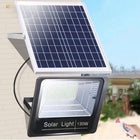


Do More LEDs Mean a Brighter Solar Light?

No—more LEDs do not automatically make a solar light brighter. LED count tells you how many light-emitting components are installed, but it does not reveal how much visible light the complete fixture produces. For a useful comparison, start with verified lumens, then check beam angle, optical design, lighting mode, mounting position and the area the light must serve.
This distinction matters because a compact wall light with 112 LEDs may have no verified lumen value, while another fixture with 24 LEDs may be rated at 450 lumens. Without comparable photometric data, ranking the first light above the second by LED count alone would be guesswork.
LED Count Is a Component Count, Not an Output Rating
An LED is an individual light source, but LEDs differ in size, efficiency, power and operating current. Manufacturers can use many small LEDs, fewer higher-output LEDs, or several LEDs driven below their maximum level to balance heat, battery demand and runtime. Lenses, reflectors and diffusers then redistribute the light before it reaches the ground, wall or tree.
The U.S. Federal Trade Commission’s Lighting Facts guidance treats lumens as the measure of brightness and distinguishes them from watts, which describe energy use. Although that labeling rule concerns covered consumer lamps rather than every integrated solar fixture, the comparison principle is useful: look for a complete-product light-output figure instead of inferring brightness from power or component count.
A stated lumen value is still not the whole installation plan. Lumens describe total visible light output; they do not tell you by themselves whether that light forms a narrow spot, a broad wash or a soft path-level glow.
What to Compare After LED Count
| Specification or Test | What It Helps You Judge | Important Limitation |
|---|---|---|
| Verified lumens | Total visible light output from the fixture | Does not describe beam shape or useful light at a particular surface |
| Beam angle and optics | Whether light is concentrated on a target or spread across a larger area | A narrow beam can create a bright hot spot while leaving nearby areas dark |
| Lighting mode | Whether output is steady, dimmed, motion-responsive or time-limited | The same fixture can look and perform differently in different modes |
| Battery and panel | The energy available to support the selected output and runtime | Battery capacity and panel wattage are not direct brightness ratings |
| Nighttime site test | Actual visibility, glare, shadows, reflections and coverage | Results change with charge, weather, season and surrounding surfaces |
Why Two Solar Lights With Similar LED Counts Can Look Different
Electrical drive and LED efficiency
The controller determines how much electrical power reaches the LEDs. Two fixtures can contain the same number of LEDs but operate them at different current levels. LED packages also vary in efficacy, so equal counts do not establish equal output.
Beam shape and illuminated area
A 180-lumen spotlight can look intense on a tree trunk when its beam is narrowed, while a higher-lumen wall light may distribute light across a garage approach. Neither visual impression makes one universally better. The correct choice depends on whether the task needs concentrated accent light, low-level guidance or broad visibility.
Diffusers, reflectors and mounting
A clear lens, frosted diffuser, reflector depth and fixture angle all change where the light goes. Mounting height matters as well: raising a wall light can enlarge the illuminated area but reduce intensity at the ground and increase glare if the source becomes directly visible.
Mode and available solar energy
Motion-only, dim-to-bright and constant modes create different energy demands. A large battery may support a brighter or longer operating period, but its mAh rating does not state the fixture’s light output. Panel exposure, night length, shade, weather and motion frequency also affect how long the selected mode can be sustained. See What Does mAh Mean on a Solar Light? for the battery distinction.
Current NoxLumin Examples
| Current Product | Verified Output Information | Better Use | What Not to Infer |
|---|---|---|---|
|
112-LED Solar Motion Sensor Wall Light  |
112 LEDs; no verified lumen or photometric value; 3000K or 6500K; four modes | Testing one compact entrance, garage or driveway zone where motion response is useful | Do not assume 112 LEDs make it brighter than a lower-count fixture with a verified lumen rating |
|
Aluminum Solar Motion Sensor Wall Light  |
24 LEDs/450 lumens; 48 LEDs/900 lumens; 60 LEDs/1,100 lumens | Selecting a defined output tier for a side door, porch, garage or wider exterior area | Do not transfer this product’s LED-to-lumen relationship to a different light |
|
Adjustable Solar Tree Spotlight  |
180 lumens; 5°–90° adjustable beam; focused reach listed up to 10 m (33 ft) | Concentrating accent light on a tree trunk, statue, sign or small architectural detail | Do not compare its targeted beam with a broad wall light by lumens alone |
 |
50 lumens per fixture; 2700K; automatic dusk-to-dawn | Warm, low-level guidance beside a path, garden bed or patio border | Do not treat its lower output as a defect or use it as a security floodlight |
The aluminum wall-light family is a useful controlled example because both LED count and maximum output are specified within one product platform: 24 LEDs correspond to 450 lumens, 48 to 900 lumens and 60 to 1,100 lumens. Those versions also pair with 1,500mAh, 3,000mAh and 6,000mAh batteries. This relationship describes those specific configurations only; it is not a universal conversion formula for LEDs.

The 112-LED wall light illustrates the opposite case. Its product data confirms a 2200mAh battery, integrated 1.5W/5V panel, 120° PIR field, listed 5–8 m (16–26 ft) sensing range and four modes, but no verified lumen or photometric measurement. The responsible approach is to test one fixture in the intended zone rather than assigning it an estimated lumen value.
The tree spotlight shows why distribution matters. Its verified 180 lumens can be narrowed or widened from 5° to 90°. Start with the beam confined to the target, and compare the result after dark. The narrow-versus-wide beam guide explains the tradeoff between concentration and coverage.

Choose by the Outdoor Task
- Path guidance: prioritize restrained output, consistent placement and low glare. The 50-lumen pathway light is intended for edge guidance, not broad security coverage.
- Tree or statue accent: prioritize beam control and a solid target. A concentrated 180-lumen beam can be more useful than a broad, brighter wash that misses the feature.
- Side door or compact entrance: select a verified wall-light output tier when you need a defined lumen figure, or test one unit when the listing does not provide one.
- Garage or wider approach: consider the 900- or 1,100-lumen wall-light configurations, but confirm aiming, mounting height, motion response and glare on site.
- Critical or code-required route: do not rely solely on weather-dependent solar lighting; provide a dependable primary source and follow applicable local requirements.

More light is not automatically safer or more useful. DarkSky International’s Five Principles for Responsible Outdoor Lighting recommend directing light only where needed and using the lowest level required. A controlled beam and correct placement can improve useful visibility without lighting the whole yard.
Browse products by installation need in Solar Wall Lights, Solar Pathway & Garden Lights, Solar Lights for Trees & Landscape Uplighting and Outdoor Lights Without Wiring.
A Five-Point Buying Check
- Name the task: identify the exact step, latch, path edge, tree or driveway section that needs light.
- Look for complete-fixture lumens: do not substitute LED quantity, watts, battery capacity or a coverage graphic for measured output.
- Check distribution: compare beam angle, lens design, mounting height and whether the fixture aims at the task.
- Match the control mode: use motion response for intermittent entrances, lower steady output for guidance and a focused mode for accent lighting.
- Test after dark: verify the real target, shadows, glare and spill after a representative day of charging before expanding the layout.
Common Comparison Mistakes
- Ranking products by LED count: counts cannot be compared reliably across different LED packages, drivers and optics.
- Using battery capacity as brightness: mAh describes stored charge under stated electrical conditions, not visible output.
- Ignoring beam angle: the same lumen output can feel very different when concentrated or spread over a large area.
- Comparing unlike modes: a temporary motion-triggered high mode should not be compared with a constant low mode as if they were identical settings.
- Choosing the highest output everywhere: excessive light can create glare, hard shadows and spill without improving the intended task.
- Skipping a site test: wall color, wet pavement, vegetation, mounting height and ambient light can change the result.
FAQ
Do more LEDs mean a brighter solar light?
What do lumens tell me about a solar light?
Can two solar lights with the same lumens look different?
Is a 112-LED solar light brighter than a 60-LED solar light?
Does a larger battery make a solar light brighter?
Why can a 180-lumen spotlight look brighter than a higher-lumen wall light?
How should I compare a solar light when no lumen value is listed?
Get more NoxLumin guides on Google
Add NoxLumin as a Preferred Source to help Google show you more of our outdoor lighting guides in Search and AI experiences.


Leave a comment