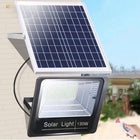
Integrated solar panel wall light mounted on a modern home exterior at dusk Integrated solar panel wall light mounted on a modern home exterior at dusk
Filter

    When Integrated Solar Panels Make Sense

    Integrated designs reduce components and cable routing, making them convenient for paths, garden stakes, open walls and other locations with direct sun. The tradeoff is that the lamp and panel usually cannot be positioned independently.

    Check Shade Before Installation

    A location that looks sunny at one time of day may be shaded for several hours. Seasonal tree cover can also change charging conditions. If the lamp position is consistently shaded, a separate-panel system may be a better fit.

    Solar Lights with Separate Solar Panel for shaded or covered locations.

    Solar Pathway & Garden Lights for simple ground-level installations.

    FAQ

    • Choose stake or disk lights for path edges, compact wall models for entrances, an adjustable integrated tree light for uplighting, and the 6,000-lumen commercial-style unit for broader yard illumination. Integrated construction simplifies the system, but mounting and output still vary widely.
    • The adjustable tree light lets the lamp angle and beam be directed toward a feature while its attached panel remains exposed. Fixed wall, fence, disk, and pathway models offer less independent adjustment, while commercial-style units depend on their bracket. Check adjustment range before choosing the mounting point.
    • Choose a mounting point where the panel receives useful daylight while the lamp and sensor can still face the target. Adjustable tree lights offer more aiming flexibility than fixed wall or stake fixtures. Test both charging exposure and nighttime beam before final fastening.
    • They usually require fewer parts and no panel cable, but the complete fixture may be larger or heavier and its placement is less flexible. Wall and commercial-style units still need secure mounting, while stakes need suitable soil. Simpler wiring does not remove the need for careful site selection.
    • Flower, mushroom, color-changing, flame, disk, fence, and low-output pathway lights are mainly decorative or navigational. Motion wall lights, tree lights, street-style units, and the 6,000-lumen commercial fixture provide more functional illumination. Compare the selected model’s lumens and beam, not panel style alone.
    • The panel is built into or directly attached to the fixture, creating an all-in-one unit without a separate panel cable.
    • Installation is compact and simple with fewer external connections, provided the desired light position also receives strong sunlight.
    • It may operate poorly because the panel shares the fixture location. A separate-panel model is better when the light must be shaded.
    • Face it toward open sky and strong sun, avoiding eaves, trees, and walls, while still aiming the beam correctly.
    • Most do not need mains wiring, but they still need secure stakes, screws, brackets, or poles.
    • Many are outdoor-rated, but exact IP ratings differ. Keep switches and seams above standing water.
    • Clean it regularly, trim shade, remove snow, inspect the angle, and keep the light sensor unobstructed.