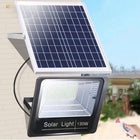
Split-design solar light with a separate wall-mounted solar panel connected to an outdoor LED flood light Split-design solar light with a separate wall-mounted solar panel connected to an outdoor LED flood light
Filter

    How to Choose Solar Lights with a Separate Solar Panel

    A split solar system is useful when the best place for the lamp is not the best place for charging. It lets the light remain under an eave, inside a shed, on a shaded wall, or near dense landscaping while the solar panel moves to a sunnier position.

    Best for Sheds, Workshops, and Detached Garages

    For an indoor lamp supplied by an outdoor panel, the Split-Design Solar Pendant Light is designed around this layout. Plan the panel position, cable route, and lamp mounting point before installation so the cable reaches without crossing doors or active work areas.

    Best for Shaded Trees and Landscape Features

    The Outdoor LED Spotlights with Separate Solar Panel allow the light heads and panel to occupy different positions. This is useful where the target tree, wall, or planting area is shaded but a nearby location receives stronger daylight.

    Best for Flexible Edges and Long Runs

    The Premium Smart Solar COB Rope Light System uses a separate solar supply for flexible accent lighting along steps, railings, edges, and landscape features. Measure the intended route and panel location before deciding on the cable configuration.

    Separate Panel vs Integrated Panel

    Integrated-panel lights reduce components and cable routing, but the fixture itself needs adequate sun. Separate-panel systems add installation flexibility when lighting and charging positions conflict. If the lamp location already receives reliable direct daylight, compare Solar Lights with Integrated Solar Panel as the simpler alternative.

    Cable Route, Mounting, and Panel Direction

    Measure the actual cable path around corners and mounting surfaces rather than using straight-line distance alone. Keep connectors and cables away from doors, vehicle paths, mowing equipment, and standing water where possible. Position the panel for strong daylight and secure both the lamp and panel for the intended outdoor environment.

    Output, Controls, and Battery System

    A separate panel solves a placement problem; it does not by itself guarantee longer runtime or higher brightness. Compare lumen output, battery capacity, panel size, motion or timer modes, remote functions, and expected sun conditions as one complete system.

    Related Separate-Panel Applications

    For indoor and covered utility spaces, browse Solar Lights for Shed & Garage. For tree and feature lighting, see Solar Lights for Trees & Landscape Uplighting. For shaded exterior walls, browse Solar Wall Lights. For higher-output area lighting, see Solar Flood & Security Lights.

    FAQ

    • Choose the split pendant for a shed interior, the adjustable spotlight for a tree or focal feature, the COB rope system for a long decorative outline, and a flood or commercial-style model for broader yard lighting. Panel separation solves placement problems, but each lamp type has a different job.
    • Yes for the split pendant designed for that arrangement, provided the cable reaches and is routed safely through an appropriate opening. Do not assume every separate-panel flood or spotlight is intended as an indoor lamp. Follow the installation and exposure instructions for the specific model.
    • Measure the route from the sunniest practical panel position to the lamp, including corners, vertical rises, and a little service slack. Choose a product whose supplied cable reaches without stretching. Do not splice, substitute, or extend a solar cable unless the manufacturer’s instructions explicitly allow it.
    • Choose separation when the ideal beam or sensor direction conflicts with sunlight—such as under an eave, inside a shed, or beneath tree cover. Choose integrated construction when the whole fixture can face useful sun and you want fewer parts and no interconnecting cable to route.
    • Confirm there is secure space for both panels, that neither is shaded by the lamp, roofline, or the other panel, and that the mounting structure can support the complete assembly. Aim the panels for solar exposure and the lamp for useful coverage; those directions may not be identical.
    • The light can be installed where illumination is needed while the panel is placed in a sunnier location, useful for walls, sheds, pergolas, trees, and covered areas.
    • Distance is limited by the included cable and model design. Confirm the selected variant’s cable length before planning.
    • Choose an open, secure location with strong direct sunlight and avoid roof runoff, deep shade, and moving branches.
    • Avoid sharp bends, pinch points, tension, and trip hazards. Fully seat waterproof connectors and keep them above standing water.
    • Do not mix them unless compatibility is confirmed. Voltage, current, polarity, connector, and charging controls can differ.
    • It improves placement flexibility but cannot replace sunlight. Runtime still depends on weather, panel size, battery, and mode.
    • Clean the panel, inspect cable jackets and connectors, tighten brackets, remove shade and snow, and prevent water from following the cable into the fixture.