


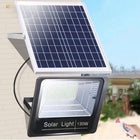


How to Evaluate Solar Lighting for Commercial-Style and Larger Sites
This collection spans several fixture types, so start with the actual project requirement rather than the collection label. Define the area, target illumination, mounting structure, operating schedule, solar exposure, and any site-specific code or approval requirements before selecting a product.
Best for Larger Yards and Open Areas
For high-output remote-controlled area lighting, compare the 720 LED 6000-Lumen Solar Area Light. Review mounting, beam distribution, battery, panel orientation, and service access for the intended site.
Best for High-Output Flood-Lighting Applications
The Dual-Panel 8000-Lumen Solar Flood Light is one of the larger-output systems in this collection. A higher lumen rating still needs to be matched to area dimensions, mounting height, beam shape, and charging conditions.
Best for Wall or General Area Lighting
For a mid-range wall or site-lighting option, compare the 2000–3000 Lumen Commercial Solar Light. Confirm the selected variant and installation requirements on the product page before specifying it for a project.
Pole, Wall, and Flood Configurations
Pole-mounted fixtures can distribute light from greater height, wall-mounted fixtures concentrate coverage near buildings and perimeters, and flood-style fixtures can cover broad or targeted areas depending on beam design. Choose the mounting geometry that fits the site before comparing output numbers.
Output, Coverage, and Mounting Height
Lumens describe total visible light, not how evenly a site will be illuminated. Beam angle, fixture height, spacing, obstacles, surface reflectance, and aiming all affect usable light. For projects with defined illumination targets, use project-specific photometric or lighting-design information rather than estimating from LED count.
Solar Panel, Battery, and Control Strategy
Higher-output systems need adequate daytime charging and stored energy. Compare panel area and orientation, battery capacity, expected daily sun, motion or dusk-to-dawn modes, timer functions, and remote control. Service access also matters when fixtures are mounted above normal reach.
Verify Project Requirements Before Purchase
Product listings do not replace local electrical, structural, permitting, photometric, accessibility, or site-safety review. Verify the individual product specification and any requirements that apply to the installation rather than assuming every item in this collection meets the same commercial standard.
Related Larger-Area Solar Lighting
For elevated installations, browse Pole-Mounted Solar Lights. For security-oriented coverage, see Solar Flood & Security Lights. For large residential and site approaches, browse Solar Lights for Large Yards & Driveways. For high-mounted controls, see Remote Control Solar Lights. For flexible panel placement, browse Solar Lights with Separate Solar Panel.