



Best Lights for Farms and Ranches: Barns, Gates, Equipment Sheds and Power Outages

No single light is best for every farm or ranch location. Use a motion-sensor wall light at entrances, a separate-panel floodlight for a work yard, a split solar pendant for a sheltered barn or equipment shed, and a rechargeable area light for inspections, parked-equipment repairs and outages. Match each fixture to the job, charging location, animal movement and any code or hazardous-location requirement.
Quick Picks for Farm and Ranch Lighting
| Farm or Ranch Zone | Best Starting Type | Current NoxLumin Match | Important Limit |
|---|---|---|---|
| Gate, barn door or equipment-shed entrance | Integrated-panel motion wall light | 450–1,100-lumen PIR solar wall light | The panel and sensor must both face workable directions |
| Defined yard, loading point or building exterior | Aimable light with a separate solar panel | 450–3,000-lumen remote-control solar floodlight | No motion sensor is specified; use AUTO, timer or remote control |
| Sheltered barn bay, tack room or equipment shed | Split solar pendant | Up-to-800-lumen pendant with 5 m cable | Not certified for combustible-dust or other hazardous locations |
| Night checks, parked-equipment work or outage backup | Portable rechargeable area light | 6,000-lumen telescopic lantern with magnetic base | Portable supplemental light, not a permanent safety-lighting system |
How We Chose These Four Lighting Types
The selection is based on five questions: Does the area need continuous or approach-only light? Can a panel receive unobstructed daylight? Must the light stay fixed or move with the worker? Will animals cross the beam? Does the location require specialized electrical equipment?
OSHA notes that farm shops should be well lit and have clear walkways, while its agricultural electrical guidance describes livestock houses as dusty, moist and corrosive. A consumer solar or rechargeable light can provide supplemental illumination, but an IP rating is not approval for a grain bin, manure pit, fuel area, chemical-storage space or combustible-dust location. Use a qualified professional for required fixed wiring and hazardous areas. See OSHA's Agricultural Operations: Hazards and Controls and agricultural electrical guidance.
Best for a Gate or Building Entrance: Solar Motion Wall Light
The NoxLumin Outdoor Solar Motion Sensor Wall Light is the strongest match for a farm gate post, barn side door, equipment-shed entrance or other approach where light is most useful when someone arrives.


The current product offers approximately 450, 900 or 1,100 lumens, paired with 1,500, 3,000 or 6,000mAh batteries. Its PIR sensor is listed at approximately 180 degrees with a 16.4–32.8 ft (5–10 m) detection range. The integrated panel simplifies installation because there is no separate cable, but it also means one mounting position must satisfy three needs: sunlight for charging, a useful sensor view and correct light direction.
Test before final tightening. Livestock or moving vegetation can increase triggering, while roof shade can reduce charging. Aim across the approach rather than into a driver's, rider's or animal's eyes. At a rarely used gate, a motion-focused mode can conserve energy.

Best for a Work Yard or Building Exterior: Separate-Panel Solar Floodlight
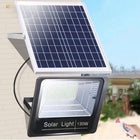
The NoxLumin Outdoor Solar LED Floodlight with Separate Panel is better when the lamp must aim at a defined yard, loading point, shed exterior or parked-equipment zone while the solar panel needs a different, sunnier position.


Five current versions are rated at approximately 450, 1,000, 1,700, 2,000 and 3,000 lumens. Every version includes a 16.4 ft (5 m) panel-to-lamp cable, remote brightness adjustment, dusk-to-dawn AUTO operation and 3-, 5- and 8-hour timer choices. No motion sensor is specified.
Start with the lowest output that makes the task visible. The 450- or 1,000-lumen versions suit compact zones; the 1,700- to 3,000-lumen versions add output for larger individual areas. These are starting matches, not guaranteed coverage dimensions: height, aim, surface reflectance and solar charge change the result.
Measure the routed cable path around posts, eaves and corners rather than using a straight line through open space. Keep the cable away from gates, mower paths, livestock traffic, tires and pooled water. The advertised IP67 lamp rating does not make connectors suitable for standing water or turn the product into certified roadway, loading-dock or life-safety lighting.

Best for a Sheltered Barn or Equipment Shed: Split Solar Pendant
The NoxLumin Split-Design Solar Pendant Light separates the outdoor charging surface from the covered lighting zone. Its 5V/4.5W monocrystalline panel stays outdoors, while the lamp can hang inside an ordinary shed, covered barn bay, tack room or detached workshop. A 16.4 ft (5 m) cable connects the two parts.


The lamp provides up to 800 lumens, adjustable 2700K–6000K light, a 4,400mAh battery and remote dimming. The Motion Sensor version offers three motion-related modes; the Timer Control version offers AUTO, 3H, 5H and 8H operation. Choose motion control for intermittent entry and the timer version for a predictable work period.
Treat one pendant as one work zone, not an entire-barn solution. Position it above a workbench, small feed-preparation area or equipment bay, and add zones where walls, stalls or machinery block light. It does not replace required fixed, emergency-egress or hazardous-location fixtures.
Best Portable Option: Rechargeable Telescopic Area Light
The NoxLumin 14,000mAh Rechargeable Telescopic Lantern is the most flexible option for night checks, temporary outage lighting or hands-free work beside parked equipment. It is rated at 6,000 lumens, has adjustable light heads, a magnetic base, a four-section pole that extends to 43 in, Type-C charging and an IPX5 splash-resistance rating.


The advertised runtime reaches up to 72 hours only at lower settings; maximum brightness uses energy faster. Use stable ground or a clean compatible ferrous surface. Never attach it to moving machinery, hot components or a vibration-prone location. Shut equipment down and follow applicable safety procedures before inspection or repair.

Lighting Around Livestock: Reduce Glare and Abrupt Shadows
More light is not automatically better in a handling lane. Penn State Extension explains that cattle have poor depth perception and may interpret shadows or changes in terrain differently from people; adequate lighting can help movement, but strong contrasts can make animals hesitate. Its guidance for sheep and goats similarly recommends avoiding bright light in the animals' eyes and shadows or bright patches across the floor. See Beef Cattle Facilities: Handling Systems.
At a gate, chute or barn transition, inspect the floor from the animal's direction of travel. Re-aim fixtures that create sharp shadow bands. Several controlled zones may produce a smoother transition than one horizontal high-output beam. Test motion activation during normal handling.
A Practical Farm Lighting Layout
- Mark the work zones: gate latch, side door, loading point, workbench, livestock lane and emergency-light storage location.
- Choose the control: motion for short approaches, timer or AUTO for defined evening periods, and manual portable light for inspections.
- Confirm solar access: inspect the proposed panel location during the charging day and across seasons.
- Test one zone after dark: check glare, shadows, missed areas and sensor behavior from normal travel directions.
- Separate ordinary from regulated areas: use appropriately certified systems wherever codes, combustible dust, corrosive conditions or life-safety functions require them.
DarkSky International recommends lighting that is useful, targeted, no brighter than necessary, controlled and warmer-colored where practical. On a rural property, that means aiming light at the gate or work surface instead of the horizon, using timers or motion settings, and avoiding unnecessary all-night spill into fields and neighboring land. See the Five Principles for Responsible Outdoor Lighting.
Buying Checklist for Farmers and Ranchers
- Define the task before choosing lumens.
- Confirm whether the light needs motion, timer, dusk-to-dawn or manual control.
- Check the complete solar-panel and cable route, not only the lamp position.
- Keep fixtures and cables outside livestock, vehicle, gate and equipment movement paths.
- Use warmer light and lower output where practical around animals and neighboring properties.
- Do not treat an IP rating as hazardous-location, washdown or submersion certification.
- Provide redundancy for critical work rather than depending on one consumer solar fixture.
Browse the current Solar Lights for Shed & Garage, Solar Flood & Security Lights, Solar Lights for Large Yards & Driveways and Outdoor Lights Without Wiring collections to compare the available formats.
FAQ
What type of light is best for a farm or ranch gate?
How many lumens do I need inside a barn or equipment shed?
Can a solar floodlight replace hardwired farmyard lighting?
Are motion-sensor lights suitable around cattle, horses, sheep or goats?
Can a split solar pendant light be installed inside a barn?
Is a rechargeable magnetic lantern suitable for tractor or equipment repairs?
Does IP65, IP67 or IPX5 make a light safe for every agricultural environment?
Get more NoxLumin guides on Google
Add NoxLumin as a Preferred Source to help Google show you more of our outdoor lighting guides in Search and AI experiences.


Leave a comment