


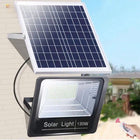


Solar Lights for a Chicken Coop: Chores or Egg Production?

For evening chores around a chicken coop, choose a solar task light with convenient controls, a sunny panel position and a beam directed at your work area. For egg-production lighting, start with the flock's daily light schedule and a system designed to deliver it. These two uses call for different controls and placement.
Begin with the moment you need to see: closing a latch, preparing feed in an adjacent service area, checking equipment, or managing supplemental light for laying hens. That decision matters more than choosing the brightest lamp or the longest advertised runtime.
Two jobs that lead to different purchases
| Your goal | What matters most | Useful starting point |
|---|---|---|
| See a latch or covered work surface during a visit | Light aimed at the task, convenient switching and a suitable installation position | A controllable task light with a sunny charging location |
| Work in a separate feed-preparation or storage area | Hands-free illumination, dimming and separation from the birds' resting area | A split solar pendant over the human work zone |
| Extend the flock's daily light exposure | A planned on/off schedule, repeatable operation and reliable power | A poultry-appropriate system with documented scheduling controls |
| Provide warmth | Equipment specifically designed and approved for heating | A separate heating decision; an LED task light is for visibility |
Write down the job in a sentence before shopping. “I need to see the feed scoop when I arrive after sunset” gives you a clear target. “I want more eggs in winter” calls for a flock-management plan as well as a lighting purchase.
Start with the flock's routine when supplemental light is the goal
The University of Minnesota Extension's cold-weather poultry guidance describes about 14 hours of total daily light for optimal egg production, counting natural daylight together with supplemental lighting. It recommends adding supplemental light before sunrise. It explains that an abrupt evening shutoff can leave chickens unable to find their roosts.
That guidance makes the buying question specific: can the controller deliver the intended morning schedule? Confirm the start time, stop time, daily repetition and behavior after a depleted battery. Review the plan with your local Extension service for your flock and circumstances. Avoid choosing a production-lighting system solely because its packaging says “solar,” “automatic” or “timer.”
Give people and resting birds separate lighting zones
A useful layout begins outside the roosting compartment. Look for a covered entrance, a partitioned service bay or a nearby shed where you prepare supplies. Putting the work light over that surface can help you see your tools while keeping its beam out of the birds' sleeping space.
Imagine a small backyard coop beside a covered storage alcove. The caretaker needs light on the storage lid and doorway latch. A lamp centered above those tasks can be more useful than one mounted above the middle of the run. The run's footprint is not the area you necessarily need to illuminate.
Check the view from the doorway and from any opening toward the roosts. A solid partition may keep light in the service area; open mesh will let it pass through. If the beam reaches the resting compartment, reconsider the lamp position or choose a more localized portable task light for the visit.
For exterior spill, apply the DarkSky and Illuminating Engineering Society lighting principles: direct light where it is useful, use only the output needed and control when it operates.
Make room for the panel, cable and your daily chores
A separate panel is useful when the work area is under a roof but a nearby wall or roof edge receives sun. Assess that charging position at different times of day, including the lower sun angles of the season when you expect to use the light most.
Measure the complete cable route along the building. Include the path around the eave, the entry point and the run to the fixture. A convenient spot on the roof may be much farther away by the routed cable than it appears from the ground. Keep the route clear of access hatches, swinging doors and removable cleaning panels.
Installation also needs to fit the way the coop is cleaned. Put connections where they remain dry and accessible for inspection, with the cable protected from pecking and mechanical damage. University of Minnesota Extension advises keeping wiring away from poultry, water and flammable litter. Use the manufacturer's mounting instructions and suitable fasteners.
Leave the ventilation openings clear. A cable should not force a door to stay ajar, and mounting hardware should not obstruct the regular cleaning route. These practical details often decide whether a proposed installation will be convenient after the first week.

A NoxLumin option for the adjacent sheltered work area
The NoxLumin Split-Design Solar Pendant Light, Timer Control version is a candidate for an ordinary sheltered service or storage area beside the coop. Its separate panel can charge outdoors while the hanging lamp lights the covered work surface.


- Up to 800 lumens with remote dimming lets you adjust output for one defined task zone.
- Adjustable 2700K–6000K light gives a choice of warmer or cooler white light for the work area.
- The 16.4 ft (5 m) connecting cable supports separated panel and lamp placement.
- A 4400mAh battery stores energy from the 5V/4.5W panel.
- The Timer Control version provides AUTO nighttime operation and 3H, 5H and 8H presets.
The Timer Control version suits evening work periods. For scheduled morning flock lighting, choose a controller with documented clock-based daily scheduling. Our solar-light timer guide explains the difference between duration presets and clock schedules.
The alternative Motion Sensor version provides dim-plus-motion, motion-only and constant 50% nighttime modes. If considering it for an approach, assess what will cross the sensor's view. A human-only service entrance is a different situation from a route used by birds. Select the control type for the intended zone rather than assuming both sets of controls come in one fixture.
For this IP65-rated light, choose a sheltered service area that meets the manufacturer's installation requirements. Poultry spaces with persistent dust, moisture or corrosive conditions need equipment specifically suitable for that environment. Our shed and garage pendant guide covers general split-panel placement, while the Solar Lights for Shed & Garage collection offers other formats for nearby utility spaces.

Before choosing the Timer Control pendant, confirm that the panel has a sunny position, the complete cable route fits within 16.4 ft (5 m), and you want a defined evening lighting period. Then place the lamp over the service surface and use the remote dimmer to set a comfortable working level.
Plan for the week you actually use it
A full-charge runtime figure describes stored energy under particular conditions; it does not establish how much energy the panel will collect every winter day. Match expected use to the site's sunlight and selected brightness. For short chores, start at the lowest comfortable setting and finish by switching the work light off.
Try the proposed layout through several ordinary visits before treating it as settled. Can you see the latch without standing in your own shadow? Does opening the storage lid block the beam? Can you reach the control while carrying supplies? Does the light remain confined to the intended area?
Keep a charged portable light available for an unexpected late check or a cloudy spell. That also gives you a way to inspect a different corner without moving the permanent lamp. For a flock-lighting schedule, evaluate the entire power-and-control system for consistent operation rather than relying on an occasional successful night.
Frequently asked questions
Can solar lights be useful around a chicken coop?
Is a solar light with a timer suitable for egg-production lighting?
Should I choose a motion sensor or timer for a coop service area?
Where should the panel for a covered coop work area go?
How bright should a chicken-coop chore light be?
Does an LED solar coop light provide heat?
Can I mount a solar pendant directly over the birds' roosts?
Get more NoxLumin guides on Google
Add NoxLumin as a Preferred Source to help Google show you more of our outdoor lighting guides in Search and AI experiences.


Leave a comment