


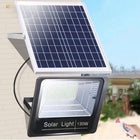


How to Choose Solar Flood and Security Lights
Choose security lighting by the area you need to see, not by the largest lumen number on the page. A garage entrance, side door, driveway apron, and large open yard require different beam patterns, mounting heights, and control modes.
Best for Garage Doors and Access Points
For entrances where light is mainly needed as people approach, the 112 LED Solar Wall Light with Motion Sensor provides a motion-focused wall-light option. This type of fixture can reserve higher output for detected activity instead of using maximum brightness continuously.
Best for Wider Driveways and Yards
For broader area lighting, compare the 4000–6000 Lumen Remote Solar Flood Light. Match its mounting position and beam coverage to the actual driveway, courtyard, or yard rather than assuming one fixture can evenly cover every property shape.
Best for High-Output Large-Area Lighting
For projects that need a larger solar and battery system, the Dual-Panel 8000 Lumen Solar Flood Light is one of the higher-output options in this collection. Verify the mounting structure, panel exposure, and intended coverage before choosing.
Motion-Triggered vs Dusk-to-Dawn Security Lighting
Motion-triggered lighting is useful where high brightness is mainly needed during activity. Dusk-to-dawn operation is better when continuous nighttime visibility is the priority. Some products offer several modes, so check the individual product page for standby brightness, timer behavior, remote functions, and what happens after motion is detected.
Coverage, Mounting Height, and Glare
A concentrated beam can produce strong light in one zone while a wider beam spreads output across more ground. Mounting higher can increase reach but may reduce illumination at ground level. Aim fixtures away from neighboring windows and direct sightlines, and test the final angle after dark where possible.
Battery Capacity and Solar Charging
Higher-output fixtures place greater demand on stored energy. Compare battery capacity together with solar-panel size and placement, selected operating mode, seasonal sun exposure, and expected activation frequency. A large battery cannot compensate for a panel that remains heavily shaded.
Related Security and Area-Lighting Categories
For sensor-specific options, browse Motion Sensor Solar Lights. For property-scale coverage, see Solar Lights for Large Yards & Driveways. For entrance-focused fixtures, browse Solar Wall Lights. For shaded installations, see Solar Lights with Separate Solar Panel. For larger site-lighting choices, browse Commercial Solar Lights.