




IP65 vs IP67 for Outdoor Lights: Which Should You Choose?

IP65 and IP67 outdoor lights protect against different water exposures: IP65 covers water jets, while IP67 covers temporary immersion under standardized test conditions. Both have the same dust-tight classification. The right choice depends on the water exposure, the lighting task and where the solar panel can receive sunlight.
- For a sunny entrance: start with an integrated solar wall light if you want motion response in a compact installation.
- For a shaded lamp position: consider a separate-panel floodlight when the panel can reach a sunnier spot within the supplied cable length.
- For either design: match its stated enclosure protection to the exposure at the mounting point, then compare output and controls.
Read the two numbers before comparing the lights
The IEC 60529 standard classifies protection provided by electrical enclosures. In an IP code, the first numeral concerns solid objects and dust; the second concerns water. Read each position separately.
| Question | IP65 | IP67 |
|---|---|---|
| Dust classification | 6: dust-tight | 6: dust-tight |
| Water classification | 5: water jets | 7: temporary immersion |
| What to compare next | Outdoor application, mounting and lighting features | Outdoor application, mounting and lighting features |
UL's electrical-equipment guide distinguishes jetting from temporary immersion in its explanation of the IP code. These are descriptions of test exposure, rather than brightness classes or expected service life.
Why IP67 does not automatically include IP65
Water jets and immersion challenge an enclosure differently. Passing an immersion test does not, by itself, establish that the enclosure also passed the jet test. EpiSensor's engineering reference explains this distinction and identifies dual ratings, such as IP66/IP67, as evidence of the separate water classifications.
If your application requires both jet and immersion protection, look for documentation covering both classifications. For a normal outdoor wall installation, also check the manufacturer's intended use and mounting instructions.
Start with the job your outdoor light needs to do
Use the actual mounting location to narrow the choice. The following situations call for different layouts even when both products are intended for outdoor use.
A sunny side entrance with people coming and going
Here, motion response may matter more than maximum output. Consider whether you want the light to stay dim between visits or remain off until someone approaches. An integrated-panel wall light keeps the installation compact when the wall receives useful direct sunlight.
For this arrangement, a product listed for outdoor wall use with IP65 protection can be a practical choice. Compare the sensor's direction and the selected mode alongside the enclosure rating. Position the light to serve the approach and door area, with its panel exposed to daylight.
A shaded garage wall with a sunnier panel position nearby
A separate-panel design lets you choose the lamp position for the activity area and the panel position for charging. Measure the actual cable route around the structure, including bends and supported sections, rather than only the straight-line gap between the two parts.
For the NoxLumin floodlight discussed below, that route must fit within the included 16.4 ft (5 m) cable. This installation choice can solve a charging-location problem that neither IP65 nor IP67 addresses.
A location where runoff collects
Move the proposed mounting point away from a drainage depression or concentrated roof discharge before choosing the fixture. For a pond, fountain or another deliberately submerged installation, select a product explicitly designed for that application. Temporary-immersion classification alone is not a recommendation to use an outdoor wall light underwater.
For a rope-light project, the existing IP65 rope-light installation guide covers connections and cut ends in detail. Keep those construction-specific checks separate from the choice between wall-light designs.
Two product examples: compare the design as well as the rating
These current NoxLumin options illustrate two different arrangements. Choose between them by the lighting task and available sun; their IP codes are one part of that decision.
| Feature | Solar Motion Sensor Wall Light | Solar Floodlight with Separate Panel |
|---|---|---|
| Stated enclosure protection | IP65 housing | IP67 lamp housing |
| Solar arrangement | Integrated panel | Separate panel; 16.4 ft (5 m) cable |
| Featured configuration | 60 LEDs; maximum 1,100 lumens | 300 LEDs; approximately 3,000 lumens |
| Main control choice | PIR motion modes and constant-light modes | Remote brightness adjustment, automatic night operation and 3/5/8-hour timers |
| Useful starting application | Sun-exposed entrances and approach paths | Garages, sheds and outdoor activity zones with a separate sunny panel position |
Choose integrated motion lighting for a sun-exposed entrance
The NoxLumin Solar Motion Sensor Wall Light combines an aluminum housing with approximately 180-degree PIR sensing. The featured 60-LED configuration provides up to 1,100 lumens and has a 6,000mAh battery. Its 12.0 in (30.6 cm) width helps you judge the fit above an entrance before ordering.
After dark, dim-to-bright mode keeps a 10% background light and rises to 100% when motion is detected; off-to-bright mode stays off between visits. Both return to their resting state after 30 seconds without detected motion. Use the first for a visible entrance between visits and the second when light is mainly needed as someone approaches.

The illustration above shows the black 60-LED housing. The product photos below show the same wall-light range in different exterior settings and finishes. Choose white or warm-white light and a black or silver housing to suit the space.


Choose a separate panel when lamp placement and sunlight differ
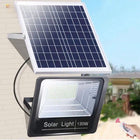
The NoxLumin Solar LED Floodlight with Separate Panel and Remote is featured here in its 300-LED configuration, with approximately 3,000 lumens and an 8,000mAh battery. This is the configuration illustrated in the cover and cable-routing scene. Its separate panel can receive sun while the lamp aims toward a garage approach or outdoor work area.
Use the remote to adjust brightness or choose a 3-, 5- or 8-hour timer for evening activities. AUTO supports operation after dark. Match the timer and brightness to the evening's use and the day's solar charge.


Browse Solar Wall Lights for wall-mounted options, or Solar Flood & Security Lights for broader outdoor lighting choices.
Keep the rating attached to the correct component
Read the wording around the code. “IP67 lamp housing” identifies the lamp enclosure; it should not be extended automatically to a remote control, panel or cable joint. For a separate-panel installation, secure the cable and keep joints out of standing water, following the product's installation guidance.
Choose a cable route that remains accessible and avoids sharp edges, moving gates and mower paths. A tidy route also makes it easier to inspect a connection without dismantling the installation. Use the solar-light cleaning guide when selecting a care method for the panel and lens surfaces.

A practical comparison to make before ordering
Write down the exact model and configuration, then check these four items together:
- Purpose: Is the light for an entrance, an activity area or a decorative feature?
- Control: Will motion response, a timer or automatic night operation best match that purpose?
- Solar layout: Can the integrated panel receive direct sun, or is a separate panel more useful?
- Exposure: Does the product's stated outdoor use and enclosure protection match the proposed mounting location?
For solar lighting, also match the operating schedule to the available charge. A short visit to a side door and several hours around a patio are different demands. Comparing the same intended schedule across products makes output and battery information easier to interpret, while keeping the IP code in its proper role.
Frequently asked questions
What is the difference between IP65 and IP67?
Is IP67 always better than IP65 for outdoor lighting?
Can an IP65 solar wall light stay outside in the rain?
Does an IP67 lamp rating also cover its remote control?
Does an aluminum housing automatically have a higher IP rating than plastic?
Will an IP67 solar light charge better than an IP65 model?
Does a higher IP rating mean a brighter outdoor light?
Get more NoxLumin guides on Google
Add NoxLumin as a Preferred Source to help Google show you more of our outdoor lighting guides in Search and AI experiences.


Leave a comment