




Yard Lighting Without Trenches: Protecting Lawns and Tree Roots

You can add yard lighting without cutting another cable trench across the lawn by choosing integrated solar lights for trees, path edges and existing fences. This removes the need for a buried supply cable between those fixtures. It can reduce disturbance to established turf and avoid a trench through a tree's root area. The trade-off is placement: panels need direct sun, stakes still enter the soil, and small accent lights cannot replace every wired lighting job.
When the Yard Has Already Been Dug Up Enough
An irrigation repair leaves one strip across the grass. Internet or utility work leaves another. Adding landscape lighting can mean lifting more turf, reopening borders and restoring ground that looked finished a few weeks earlier.
The concern is not simply the presence of a buried wire. It is the excavation and restoration around it. Replaced soil can settle differently from undisturbed ground, while disturbed turf may recover unevenly. A shallow groove, raised seam or thin patch can interrupt mowing and make a well-kept lawn look unfinished. These outcomes are possible, not inevitable: installation technique and restoration matter.
Separate two decisions. Existing dips need their cause assessed and appropriate lawn repair. New decorative lighting needs a layout that does not add unnecessary disturbance. Solar lights help with the second decision; they do not level the first problem or replace essential irrigation and utility infrastructure.
A useful starting question is: Can this lighting effect be created from an existing planting border or vertical surface, without crossing the open lawn?

The Root Problem Is Bigger Than the Trunk
A trench aimed toward a tree can intersect roots before the cable reaches the desired spotlight position. Roots extend beyond the small area immediately beside the trunk, and the canopy edge is not a guaranteed boundary. Shallow excavation should not be treated as automatically harmless.
University of Florida IFAS Extension's tree-protection guidance explains that utility trenching can affect many roots and that soil compaction and grade changes can also harm trees. The practical implication for decorative lighting is to change the fixture position or lighting plan before disturbing roots.
Low voltage describes an electrical system; it does not describe how gently a trench is dug. Likewise, a solar label does not make a stake harmless. Consistent with Ask Extension's advice on avoiding root damage, if an installation point meets resistance or a visible root, stop and relocate. Do not cut a root to preserve a symmetrical lighting arrangement. For unavoidable work near a mature tree, involve a qualified arborist.
Choose the Installation Footprint Before the Fixture
| Lighting approach | Ground disturbance | Main condition |
|---|---|---|
| Integrated solar tree or path light | No interconnecting cable trench; a stake still enters the soil | Sunlight, suitable soil and a position that avoids roots and buried services |
| Integrated solar light on an existing fence | Can avoid soil penetration entirely | A stable mounting surface and direct sun at each panel |
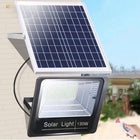
| Solar light with a separate panel | Depends on the connecting-cable route and mounts | The panel-to-lamp cable still needs protection; burial suitability must be verified |
| Wired landscape lighting | Depends on the site and installation method; may involve trenching and restoration | A planned cable route, root protection and appropriate installation |
A well-designed wired system remains worth considering when you need predictable output independent of daily solar charging or can coordinate installation with planned landscaping. A finished lawn with just a few new accent-lighting needs is a stronger case for independent solar fixtures.
For a broader comparison, see integrated solar, separate-panel and rechargeable outdoor lighting.
Three Product Matches for Keeping New Cables Out of the Lawn
For a Tree Accent: Adjustable Solar Tree Spotlight
The NoxLumin Adjustable Solar Tree Spotlight combines an integrated panel and ground stake with a listed 180-lumen output and 5°–90° adjustable beam. It fits a focused trunk or landscape accent without a power-cable run from the house.


Start with one suitable position and test the effect. A narrower beam concentrates the light; widening it spreads the same output over more of the target. The listed reach of up to 10 m is a focused-beam specification, not a promise to brightly illuminate an entire large canopy.
The panel and lamp share a tilting assembly, so the chosen position must support both charging and aiming. Dense shade, exposed roots or a mowing route can make an otherwise attractive position unsuitable. Its IP54 rating does not support immersion; avoid pooling water and direct sprinkler spray. High and Medium modes let you choose the accent effect, with runtime dependent on charging and conditions.
Explore solar lights for trees and landscape uplighting if the site needs a different arrangement. Check each design's cable requirements.

For a Walkway Beside the Lawn: 50-Lumen Adjustable Solar Pathway Lights
The 50-Lumen Adjustable Solar Pathway Lights suit low-level path marking in a sunny soil border. Each fixture operates independently, so moving a light does not require rerouting a shared landscape cable.


The listed height range is 25–60 cm, with 3000K Warm White or 6500K Cool White options and IP65 protection. Choose a height that keeps planting from hiding the light without putting the fixture into mower or foot traffic. Install stakes in firm, well-drained soil beside paving, not through concrete.
The listed runtime is approximately 6–8 hours after a full charge. These are accent and marker lights, not a substitute for stair, security or required safety lighting. An old trench depression in the lawn remains a separate repair issue.
For a Boundary: 60-Lumen Solar Fence Lights
The 60-Lumen Solar Fence Lights with RGB and Warm White can add local boundary glow without placing another stake in the lawn when mounted on an existing suitable fence. Each has an integrated panel and screw mounting, with IP65 protection.


Use steady Warm White for everyday ambience or select the available decorative color settings. The horizontal housing is 12 cm wide by 7.5 cm high; the portrait housing is 7.5 cm wide by 12 cm high. Check the actual flat mounting area, and keep fence caps and foliage from shading the panel.
Choose this option to highlight the fence face or patio edge. A fence-mounted accent light should not be expected to illuminate the center of a wide lawn. Select an available orientation and pack combination after counting suitable mounting points.
A Finished-Lawn Layout That Leaves the Center Open
Consider an illustrative 30-by-40-foot backyard with one mature tree, a path along one side and an existing rear fence. The dimensions describe the example, not a coverage claim.
- Tree: look for a sunny planting-border position with no root conflict, then test one focused accent toward the trunk. Add another only if the effect needs it and another suitable position exists.
- Path: place independent path lights within the adjacent soil border, keeping clear of mower wheels, mower-deck overhang and normal walking space. Let existing roots override perfect spacing.
- Fence: use existing sun-exposed mounting surfaces for local ambience. Keep the open grass free of lights and cables.
This layout avoids connecting the three accents with a cable route across the yard. It also makes later rearrangement possible without reopening a shared trench. For the separate question of visual path-light rhythm, see staggered versus straight path-light layouts.

When a Different Plan Is the Better Choice
If a tree's entire usable planting area is shaded or densely rooted, an integrated ground spotlight may be a poor fit. A separate panel can solve a charging-location problem, but its cable does not disappear. Keep it off mowing and walking routes; verify the manufacturer's installation instructions rather than assuming that an outdoor or IP-rated connection can be buried.
If no suitable position or cable route exists, leave that tree unlit and use an existing fence or another feature as the focal point. Do not add deep soil over roots to make a convenient lighting bed, or bury the root flare while trying to hide an old lawn depression.
Before any ground penetration, identify what is below. Follow 811's before-you-dig process and the instructions for your location. Private irrigation, lighting and other owner-installed lines may need separate locating; check what the locating service covers. A small stake is still a reason to check the site.
The strongest solar-lighting plan starts with ground you can leave undisturbed, sunlight you can actually use and only the accents the yard needs.
Frequently Asked Questions
Can I add yard lighting without digging a cable trench?
Does burying landscape-lighting wire always leave an uneven lawn?
Can a shallow lighting trench damage tree roots?
Are solar tree-light stakes safe to push in anywhere?
How far from a tree should I install a solar spotlight?
Are solar lights with separate panels completely wireless?
Which lights fit a lawn, tree and fence without adding cable trenches?
Get more NoxLumin guides on Google
Add NoxLumin as a Preferred Source to help Google show you more of our outdoor lighting guides in Search and AI experiences.


Leave a comment