




Outdoor Lights Without Wiring: Integrated Solar, Separate-Panel, or Rechargeable?

Outdoor lighting does not always require trenching cable, adding an exterior electrical box, or hiring an electrician. But “outdoor lights without wiring” is a much broader category than it first appears.
Some lights combine the solar panel, battery, and LEDs in one fixture. Others use a separate solar panel connected to the lamp by a low-voltage cable. Portable models may add USB charging so they can move between a patio, campsite, table, or emergency kit.
The right choice depends less on whether a light is “wireless” and more on where the light needs to go, where sunlight is available, how much illumination you need, and whether the fixture should stay permanently mounted or remain portable.
This guide compares the main no-wiring approaches and highlights several options from NoxLumin’s Outdoor Lights Without Wiring collection.
What Does “Outdoor Lights Without Wiring” Actually Mean?
In practical terms, a no-wiring outdoor light does not need to be connected to your home's 120V electrical circuit.
That can eliminate several installation steps associated with conventional outdoor fixtures:
- No new mains electrical circuit
- No buried power cable across the yard
- No exterior junction box for many installations
- No permanent connection to household electricity
- More flexibility when lighting detached or hard-to-reach areas
However, there are still important differences among no-wiring lights.
1. Integrated solar lights
The solar panel, rechargeable battery, and lamp are built into one fixture.
These are usually the simplest option because there is no cable between the panel and light. The tradeoff is that the light itself must be installed where its solar panel can receive sufficient sunlight.
2. Separate-panel solar lights
The lamp and solar panel are separate, with a low-voltage connecting cable between them.
These are particularly useful when the place that needs light is shaded, covered, or indoors while a nearby roof, wall, or open area receives sun.
There is still a cable between the lamp and panel, but there is no connection to household electrical wiring.
3. Portable solar and rechargeable lights
Portable lanterns and similar lights contain their own battery and require no fixed installation. Some can charge from solar power, USB, or both.
They work best when flexibility matters more than permanent illumination.
Which No-Wiring Outdoor Light Type Should You Choose?
A useful way to decide is to start with the installation location.
| Location or Need | Better No-Wiring Type | Why |
|---|---|---|
| Porch or garage wall with good sun | Integrated solar wall light | Simple permanent installation |
| Shaded wall or garden feature | Separate-panel solar light | Panel can be moved into better sunlight |
| Shed or detached garage interior | Split solar pendant | Outdoor panel can power an indoor lamp |
| Tree, statue, or landscape feature | Adjustable integrated spotlight | No cable routing across the yard |
| Patio table or decorative area | Portable solar lantern | Can be moved or hung as needed |
| Camping or emergency use | Solar + USB rechargeable lantern | Multiple charging options and portable design |
The important point is that there is no single “best” wireless outdoor light. The best power architecture depends on the location.
For Porches and Garages: Integrated Solar Wall Sconce
For a wall that receives reasonable daylight, an integrated solar fixture is usually the cleanest installation.
The Elegant Solar Wall Sconce Light combines its solar panel, battery, LEDs, and motion sensor in one wall-mounted unit.
It provides:
- Up to 1400 lumens
- 6000mAh rechargeable battery
- 180° motion detection
- Approximately 5–10 m motion detection range
- Four selectable lighting modes
- 4000K or 6000K variants
- IP65 weather resistance


This type of light is particularly useful beside a garage, porch, side entrance, or backyard door where you want a permanent-looking fixture without extending household electrical wiring.

When an integrated panel is not ideal
The limitation is solar exposure.
If the fixture must sit beneath a deep roof overhang, on a heavily shaded north-facing wall, or underneath dense trees, a built-in panel may not receive enough useful sunlight.
In that situation, separating the panel from the lamp becomes more useful.
For Shaded Areas: Separate-Panel Solar Spotlights
A shaded installation point does not necessarily mean solar lighting is impossible.
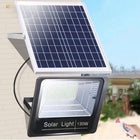
The Outdoor LED Spotlights With Separate Solar Panel allow the lamp and panel to occupy different locations.
The system uses a 5 m / 16 ft connecting cable, so the light can illuminate one area while the solar panel is positioned somewhere with better sun exposure.
Depending on the model, output ranges from approximately 450 to 1700 lumens. The lights also include:
- 44-, 100-, and 170-LED versions
- IP67 outdoor protection
- Remote control
- Adjustable brightness
- 3-, 5-, and 8-hour timer options
- Automatic nighttime operation
- Approximately 6–12 hours of operating time after a full charge


This arrangement can make sense for a shaded garden wall, patio, garage exterior, lawn feature, pathway, or other area where the ideal direction for the lamp and the ideal direction for a solar panel are not the same.

A useful rule
Do not choose the solar panel location based solely on where you want the light.
With a split system, think of them as two separate placement decisions:
Put the lamp where illumination is needed. Put the panel where charging conditions are better.

For a Shed or Detached Garage: Split-Design Solar Pendant Light
Some no-wiring problems are more difficult because the area that needs illumination is actually under a roof.
A shed, detached garage, gazebo, or covered work area may receive little or no direct sunlight inside.
The Split-Design Solar Pendant Light solves that problem by placing the solar panel outdoors while the lamp can hang under a roof or inside a semi-enclosed space.
Its specifications include:
- Up to 800 lumens
- Adjustable 2700K–6000K color temperature
- 4400mAh rechargeable lithium battery
- 5 m / 16.4 ft extension cable
- Remote control
- IP65 rating
- Up to 10–14 hours runtime depending on output and conditions


There are also two control configurations.
One emphasizes motion-sensor operation, while the other provides automatic operation plus 3H, 5H, and 8H timer settings.

This is a different use case from simply attaching a solar wall light outside a shed. The split design lets the solar collector remain outside while useful downward illumination is placed where people actually work, store equipment, or walk.

For Trees and Landscape Features: Integrated Ground-Stake Solar Spotlight
Landscape lighting creates another type of wiring problem.
Running electrical cable to a mature tree, statue, planting bed, or distant landscape feature can require trenching across lawn or soil. A self-contained solar spotlight avoids that infrastructure.
The High-Power Solar Tree Light uses an integrated solar panel and ground-stake design.
Its most useful feature is not simply that it is solar powered—it is the adjustable optical system:
- 5°–90° adjustable beam
- Up to 10 m illumination distance
- 180-lumen output
- 2200mAh rechargeable battery
- Bright and medium modes
- 8+ hours runtime after full charging
- Dusk-to-dawn automatic operation
- IP54 weather resistance


A narrow beam can concentrate light on a trunk, sculpture, column, or architectural detail. A wider beam can spread illumination across shrubs or a broader planting area.
Because there is no separate panel cable, installation stays visually simple. The tradeoff is that the fixture's integrated panel still needs suitable solar exposure.

For Patio Ambiance: Portable Vintage Solar Lanterns
Not every outdoor light needs to provide security or task illumination.
For patio tables, pergolas, steps, garden seating areas, or decorative displays, portability can be more valuable than maximum brightness.
The Vintage Solar Lantern Outdoor is designed around that use case.
It can be placed on a flat surface or suspended using its hanging handle. Features include:
- 1200mAh rechargeable battery
- Solar charging
- USB backup charging
- Automatic dusk-to-dawn operation
- Flickering flame-style mode
- Steady warm-light mode
- IPX5 outdoor protection
- 10–12 hour operating time after a full charge


Because the lantern is not permanently fixed to one location, it can move from a patio table to a pergola, garden gathering area, or seasonal display.

That makes it a better choice when the lighting layout changes frequently.
For Maximum Portability: Solar + USB Rechargeable Camping Lantern
For a fixture that may move beyond the yard entirely, USB charging becomes even more useful.
The Solar & USB Rechargeable Vintage LED Camping Lantern combines an integrated solar panel with Type-C USB charging.
It offers:
- 130-lumen output
- 3000K, 4000K, and 5000K color temperatures
- Stepless brightness adjustment
- 1200mAh lithium-ion battery
- Solar and USB-C charging
- IPX4 splash resistance
- Portable hanging design


This is not intended to replace a high-output security light. Its strength is flexibility.


The same lantern can serve as patio lighting one evening, tent lighting on a camping trip, or portable household illumination when you need a light that is not tied to a wall or electrical outlet.
Integrated Panel vs Separate Panel: The Most Important Decision
For permanently installed solar outdoor lights, this is often the first choice to make.
Choose an integrated solar panel when:
- The light location receives useful sunlight
- You want the fewest visible components
- You do not want a connecting cable
- Installation simplicity is the priority
Choose a separate solar panel when:
- The lamp must be installed in shade
- The light sits beneath a roof or overhang
- You need to aim the lamp independently of the panel
- A nearby sunny location is available for the panel
Choose portable solar + USB lighting when:
- The light needs to move frequently
- You want a backup charging method
- You need patio, camping, or emergency versatility
- Permanent mounting is unnecessary
This distinction matters more than simply comparing lumen numbers.
Before Buying Outdoor Lights Without Wiring
Check these four factors before choosing a fixture.
Sun exposure
Solar lighting still depends on charging conditions. Consider where the panel will actually face during the day, not just where the lamp looks best at night.
Light purpose
Security, task, accent, and decorative lighting require very different outputs and beam patterns.
A 180-lumen focused tree light can make sense for accent lighting, while an entrance or garage may benefit from a substantially brighter wall fixture.
Installation position
Walls, ground stakes, ceilings, hanging hooks, and tabletops solve different problems. Choose the mounting method before choosing purely by appearance.
Control method
Motion sensing, dusk-to-dawn automation, timers, dimming, and remote controls can substantially change how a light behaves after installation.
FAQ: Outdoor Lights Without Wiring
Can you install outdoor lights without electrical wiring?
Yes. Solar-powered and rechargeable outdoor lights can operate without being connected to a household electrical circuit. Depending on the design, they may use an integrated solar panel, a separate solar panel, USB charging, or a combination of charging methods.
Are solar lights completely wireless?
Integrated solar lights can be completely self-contained. Split solar systems use a cable between the solar panel and lamp, but they still do not require connection to household mains electricity.
Are separate solar panels better than built-in panels?
Not universally. Built-in panels provide simpler installation, while separate panels are more flexible when the light itself must be installed in shade, under a roof, or in another location with poor solar exposure.
What type of no-wiring light is best for a garage?
For an exterior garage wall with good sun exposure, an integrated solar wall light can be convenient. For a detached garage interior or covered space, a split system with an outdoor solar panel and indoor lamp can be more appropriate.
Can outdoor solar lights work under a porch roof?
The lamp can, but the solar panel still needs adequate charging conditions. A split-panel system is often more practical when the fixture must remain beneath a deep porch roof or overhang.
Are rechargeable lanterns a replacement for outdoor security lights?
Usually not. Portable lanterns are better suited to localized, decorative, camping, or emergency illumination. A dedicated wall-mounted motion-sensor fixture is generally more appropriate when security-oriented coverage is the primary goal.
What should I look for before buying outdoor lights without wiring?
Start with the lighting location, available sunlight, required brightness, beam pattern, mounting method, weather rating, and preferred controls. Then decide whether an integrated solar panel, separate panel, or portable rechargeable design best matches the installation.
Final Takeaway
“Outdoor lights without wiring” describes several very different lighting systems.
An integrated solar wall light can simplify a sunny porch or garage installation. A separate-panel spotlight can move the charging surface away from a shaded lamp location. A split pendant can bring solar-powered illumination beneath a shed or garage roof. Ground-stake spotlights eliminate cable runs through landscape beds, while portable solar and USB lanterns prioritize flexibility.
Instead of asking only “Which wireless light is brightest?”, start with a more useful question:
Where does the light need to be, and where can its energy come from?
Once those two locations are clear, choosing the right no-wiring outdoor light becomes much easier.
Explore the full Outdoor Lights Without Wiring collection to compare wall lights, landscape lights, solar spotlights, portable lanterns, pathway lights, and other cable-free outdoor lighting options.
Get more NoxLumin guides on Google
Add NoxLumin as a Preferred Source to help Google show you more of our outdoor lighting guides in Search and AI experiences.


Leave a comment