




A Zone-by-Zone Solar Lighting Plan for Entries, Fences, Trees, and Patio Edges

A complete solar yard-lighting plan should assign a different fixture to each outdoor job instead of making one bright light cover the property. Use a solar COB rope light for continuous edges, an adjustable tree light for focal features, compact fence lights for the perimeter, and a motion-sensor wall light at a garage or door. A small yard may need only two layers; a larger property can use all four.
Start With Outdoor Zones, Not Fixture Counts
Divide the property by task before choosing pack sizes or rope length. A patio edge needs a continuous line, a tree needs an aimed beam, a fence benefits from repeated markers, and a garage entrance needs brighter responsive light. Separating those jobs preserves contrast and prevents uniform overlighting.
| Outdoor zone | Lighting task | Product match | Practical position | Main limitation |
|---|---|---|---|---|
| Patio, pergola, steps, or a defined garden edge | Create a continuous low-level outline | Solar COB rope light | Under a step lip, railing, or protected edge where the light is visible but the rope is not underfoot | Every connector and cut end must remain sealed; the selected cable still has to reach a sunny panel position |
| Tree, statue, large shrub, or façade detail | Add depth and a focal point | Adjustable solar tree light | In stable soil outside the walking route, aimed at the feature rather than toward a window | The integrated panel needs useful sun, and the IP54 fixture should not sit in standing water |
| Fence, deck rail, garden wall, or patio boundary | Mark the perimeter with repeated pools of light | Solar fence lights | On sound vertical surfaces with the top solar panel exposed | At 60 lumens, these are boundary and ambiance lights rather than substitutes for entrance or security lighting |
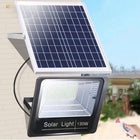
| Garage, back door, side gate, or service entrance | Provide brighter arrival and task lighting | Motion-sensor solar wall light | Where the integrated panel receives sun and normal travel crosses the tested sensor zone | Maximum brightness, battery size, and mounting guidance vary by the selected 24-, 48-, or 60-LED version |
| Shaded decorative edge near a sunny open area | Separate the lit location from the charging location | Solar COB rope light with separate panel | Rope in the shaded zone and panel within the selected 16.4–32.8 ft (5–10 m) cable reach | The cable must be routed securely and the panel cannot be placed beyond the purchased connection length |
Coordinate the Controls Before You Coordinate the Look
The four systems should not behave identically. Patio edges and fence markers can use restrained evening light, a tree spotlight can preserve one focal composition, and a garage light is usually more useful in a motion-responsive mode than at maximum output all night.
The current NoxLumin Premium Smart Solar COB Rope Light System supports dusk-to-dawn operation plus 5-, 8-, and 10-hour timers. The tree light offers High and Medium modes, the fence light changes between Warm White and Dynamic RGB, and the wall light provides Dim-to-Bright, Constant On, Off-to-Bright, Emergency Constant On, and Off. Use steady low-level light for orientation, optional color for events, and motion-controlled brightness for arrivals.


This approach follows DarkSky International's Five Principles for Responsible Outdoor Lighting: make lighting useful, targeted, no brighter than necessary, controlled, and warm-colored where practical. Warm White across the rope, tree, fence, and wall fixtures creates the most coherent everyday scene. RGB fence lighting can be reserved for a party or seasonal event without changing the functional layers.
Two Whole-Yard Layouts
A compact fenced backyard
Start at the back door with a motion-sensor wall light for the landing. Add a short Warm White rope run beneath a patio step or outer railing, off the walking surface. Put compact fence lights only on the darkest boundary section. If there is an ornamental tree or sculpture, one aimed tree light can become the focal point viewed from the house.
If the rope already reveals the fence, omit fence lights. If there is no meaningful focal feature, omit the tree light. A plan is complete when each active zone has the right light—not when every product type is installed.

A larger front, side, and backyard
Use the motion-sensor wall light at the garage or side entrance. Aim tree lights at selected front-yard features, not every trunk. In the backyard, place Warm White fence lights along the occupied patio boundary and reserve RGB for gatherings. Use rope light on a pergola, rail, or steps where a continuous line communicates the space better than separate fixtures.
Keep the side yard quiet unless it is a real route. A motion light at the gate may be enough; using all four types in one narrow corridor can create glare without improving navigation.

Make a Daylight Map Before a Nighttime Layout
Observe the property in the morning, around midday, and later in the afternoon. Note where fences, eaves, trees, and shrubs shade each panel. The U.S. Department of Energy's residential solar guidance explains that tree cover and excessive shade affect solar suitability. Applying that basic shading check to small outdoor-light panels is a practical inference; actual charging depends on the product and site.
The tree, fence, and wall fixtures use integrated panels, linking lighting and charging locations. The rope system instead provides a 16.4–32.8 ft (5–10 m) connection cable to a separate panel. This can serve a shaded edge only when the cable remains within its selected length and avoids walkways, doors, and garden tools.
How the Four Current Products Fit Their Roles

Continuous edge layer: The rope system offers White and Warm White, 320 COB LEDs per meter, 16.4–164.0 ft (5–50 m) configurations, and matched 5,000–25,000mAh LiFePO4 storage. The 5–25 m options use one run; 30–50 m versions use two runs through a splitter. Measure before selecting a length. IP65 applies when connectors and cut ends are properly sealed; it is not an immersion rating. See the IP65 rope-light guide for weather boundaries.

Focal layer: The NoxLumin High-Power Solar Tree Light is listed at 180 lumens with a 5°–90° beam, up to 10 m of focused reach, a 2200mAh battery, and 8+ hours after a full charge under suitable conditions. Fully seat its ground stake in stable soil outside foot traffic and aim only at the subject. See the tree-trunk versus canopy guide for aiming.

Perimeter layer: The NoxLumin Solar Fence Light is a compact 12 × 7.5 cm (4.7 × 2.9 in), 60-lumen fixture with Warm White and Dynamic RGB, dusk-to-dawn control, IP65, and 10+ hours after a full charge under suitable conditions. Current pack availability differs by orientation. Keep its real compact scale; it marks a boundary rather than replacing a large wall light.

Arrival layer: The NoxLumin motion-sensor wall light ranges from 450 lumens with a 1500mAh battery to 1100 lumens with a 6000mAh battery. Its listed sensor zone is 16.4–32.8 ft (5–10 m) and greater than 180°, but real performance depends on placement. Select output for the entrance and test approaches from both directions.

Run One Day Test and One Night Test
- Confirm that every panel receives useful daylight without foliage or eave shade.
- Mark the rope and cable route before fastening or cutting anything.
- Aim the tree light while checking windows, seating, streets, and neighboring property.
- Test several fence lights before mounting the full available pack.
- Walk through the wall light's sensor zone from each real approach.
- At night, lower or redirect any layer that causes glare or crosses the property boundary.
Common Whole-Yard Planning Mistakes
- Using every fixture everywhere: Repetition without a task makes a yard flat and overlit.
- Running all layers at full output: Boundaries and entrances need different brightness.
- Mixing colors without a plan: Use Warm White as the everyday base and RGB for events.
- Designing only after dark: A useful beam still fails if its panel is shaded.
- Confusing IP54 or IP65 with immersion protection: Keep fixtures and connections out of standing water.
- Ignoring scale and controls: Keep fence lights compact, rope thin, and assign every timer, mode, or sensor a purpose.
Verified options for these roles are grouped in the Outdoor Lights Without Wiring, Solar Landscape Accent Lighting, and Solar Flood & Security Lights collections.
Frequently Asked Questions
Do I need rope, tree, fence, and motion-sensor lights in every yard?
Which solar lights should stay on through the evening?
Should all four outdoor lighting layers use Warm White?
What should I do if the best lighting position is shaded?
Can a solar tree light replace a motion-sensor wall light?
Are 60-lumen solar fence lights bright enough for security?
Can IP54 and IP65 solar lights remain outside all year?
Get more NoxLumin guides on Google
Add NoxLumin as a Preferred Source to help Google show you more of our outdoor lighting guides in Search and AI experiences.


Leave a comment