




Solar Shed Light vs Rechargeable Lantern: Which to Choose?

Choose a solar shed light for a fixed overhead zone with a practical outdoor panel location; choose a rechargeable lantern when the work moves, you need manually controlled lighting during the day, or permanent mounting is inconvenient. For a detached garage or backyard shed, the best choice depends on when and where you need light, not simply which product lists more lumens.
Start with the Visit, Not the Fixture
Think about your last few trips to the shed. Picking up garden tools after sunset, sorting stored equipment on a dark afternoon and working beside a bicycle outside the door are different lighting jobs. An overhead fixture works well for repeated nighttime visits to the same area. A portable lantern can follow the second and third tasks, provided you bring it charged.
This comparison focuses on one installed solar pendant and one manually controlled rechargeable lantern. Neither requires a connection to household power at the point of use, but only the pendant uses a separate solar panel. The lantern considered here recharges through USB-C; it is not a solar-charging lantern.
| Decision | Split solar pendant | Rechargeable lantern |
|---|---|---|
| Where the light stays | One wall or ceiling location | Moves between shed, garage and outdoor tasks |
| Energy preparation | Outdoor panel needs suitable direct sun | Battery needs planned USB-C charging |
| Daytime tasks | Daytime operation is not verified for this model | Manual controls suit a dark daytime work area |
| Physical setup | Secure mounts and a protected panel-to-lamp cable route | Stable standing base or compatible magnetic surface |
| Light placement | Overhead downward illumination | Adjustable panels on a stand up to 110 cm tall |
| Main limitation | Fixed coverage and weather-dependent charging | Must be present, charged and safely positioned |
Three Questions That Can Rule Out the Wrong Choice
Will you need light before sunset?
A windowless shed can be dark at noon while the yard remains bright. That does not establish whether a solar fixture will switch on. The current product listing describes nighttime motion modes, a constant nighttime mode and nighttime timer operation. Its remote control is not evidence of an unrestricted daytime override. For regular daytime sorting or maintenance, the manually controlled lantern is the clearer fit.
Can the panel and lamp be connected without an awkward route?
The pendant has a 16.4 ft (5 m) connecting cable. Measure the route along the structure, not the straight-line distance through a wall. As an illustrative planning example, 6 ft along an exterior wall, 3 ft through a suitable, protected cable entry and 5 ft along a ceiling already use 14 ft, leaving only 2.4 ft for turns and remaining routing. This is cable budgeting, not an installation specification.
Keep the route clear of door hinges, sharp edges and standing water. A convenient lamp position does not compensate for a panel tucked beneath an opaque roof. If a suitable sunny panel location cannot be reached safely within the supplied cable, consider the rechargeable option rather than assuming an unverified extension will work.
Does the task stay in one place?
A pendant remains useful when the same clear floor area or storage zone is visited repeatedly. A lantern makes more sense if one evening involves the shed, the next a garage shelf and the next an outdoor equipment check. One portable lamp can serve those places sequentially; it cannot illuminate separate occupied zones simultaneously.
Product Match: Fixed Overhead Light for Repeat Visits
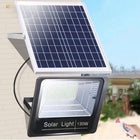
The NoxLumin Split-Design Solar Pendant Light provides up to 800 lumens, remote dimming and adjustable 2700K–6000K light. Its separate 5V/4.5W panel measures 7.17 × 5.0 inches, while the lamp can be wall-mounted or ceiling-hung in a shed, detached garage or covered utility space.


The 4400mAh battery and listed 10–14-hour runtime are not a guarantee of full output every night. Charging is listed at approximately 8–10 hours of suitable direct sunlight. The U.S. Department of Energy explains that available solar radiation varies with location, season, time of day, landscape and weather. Check the panel position across the day and reassess it when nearby trees or seasonal shadows change.
Choose the control variant deliberately. Motion Sensor offers dim-plus-motion, motion-only and constant 50% nighttime output. Timer Control offers AUTO nighttime operation and 3-, 5-, or 8-hour timer settings. Both provide remote dimming and color adjustment. For longer stationary visits, consider the continuous-light options rather than assuming movement will always keep a motion-only mode active.
This is a match for a defined zone, not a promise that one fixture will light every corner behind shelving. It is less suitable when you cannot mount the hardware, cannot reach a sunny panel position or need verified daytime illumination. Compare related designs in Solar Lights for Shed & Garage.

Product Match: Portable Light for Changing Jobs
The NoxLumin 6000-Lumen Rechargeable Camping Lantern has four adjustable light panels, a 14000mAh battery and USB-C charging. The pole adjusts from about 11.2 to 43.3 inches (28.5–110 cm). Each panel can tilt up to 180 degrees and rotate up to 270 degrees, allowing you to redirect light when the job changes.


Use the four-leg base on a firm, level surface. The magnetic base requires compatible ferrous metal; a wooden shed wall or aluminum door is not a magnetic mounting point. Check stability before extending the pole, and keep the base outside the walking route. Its maximum height is still well below a ceiling fixture, so position it beside the task rather than expecting overhead coverage.
The current runtime table distinguishes settings and panel counts. Warm-white operation is listed at approximately four hours with four panels, or seven hours with one panel. Do not combine the maximum 6000-lumen claim with the longest runtime from another setting. Listed full charging takes about seven hours, subject to adapter, cable, temperature and remaining charge. Charging a phone from the lantern also consumes energy otherwise available for lighting.
This model suits someone who will recharge and return it to an accessible storage location after use. Khaki and Army Green share the listed performance specifications. It is less convenient for unattended automatic lighting or a shed you regularly visit without bringing equipment. Other portable options are grouped in Camping Lights.

Why 800 vs 6000 Lumens Does Not Settle the Decision
ENERGY STAR identifies lumens as a measure of light output. The lantern's higher maximum does not establish how much useful light reaches a particular shelf or work surface. Height, panel direction, obstructions and your own position affect the result.
Imagine an 8-by-10-foot storage shed with shelves along two walls. A pendant may illuminate the central floor while shelf lips shade the contents below. Moving a lantern beside the shelf may make labels easier to see, even at a reduced setting. Conversely, placing a bright lantern low behind your body can cast a strong shadow over the work. These are layout examples, not measured coverage claims.
For fine detail or work requiring uninterrupted visibility, evaluate lighting at the actual surface and keep an appropriate backup available. Neither advertised lumen output nor battery capacity alone establishes task suitability.
A Practical Ownership Check
- Choose the pendant when the location stays fixed, nighttime use dominates and a sunny panel position is reachable.
- Choose the lantern when you need daytime manual control, move between jobs or want to avoid permanent mounting.
- Consider both only when needed: use the pendant for a fixed zone and the lantern for shelf inspection or tasks outside that zone.
- Plan maintenance: inspect the pendant's panel and cable route, and maintain a charging routine for the lantern. The pendant's listed IP65 rating and lantern's IPX5 rating do not make either submersible.
Before purchasing, decide where the light will sit, who will operate it and how it will be ready for the next visit. Those practical answers are more useful than choosing the largest battery or brightest advertised setting.
Frequently Asked Questions
Is a solar pendant light or rechargeable lantern better for a shed?
Can the NoxLumin solar pendant light a dark shed during the day?
Does the solar pendant need electrical wiring?
Does the 6000-lumen lantern replace an overhead shed light?
Which rechargeable lantern runtime should I use for planning?
Can a magnetic lantern attach to any shed wall?
Is buying both types of light necessary?
Get more NoxLumin guides on Google
Add NoxLumin as a Preferred Source to help Google show you more of our outdoor lighting guides in Search and AI experiences.


Leave a comment