




How to Choose Solar Lights for Earlier Fall Sunsets

Short answer: For earlier fall sunsets, choose solar lights by matching four things: the panel’s real daytime sun exposure, the number of hours you actually need light after dusk, the control mode, and the lighting job. A lower-output dusk-to-dawn path light can make sense for route guidance, while a motion-controlled wall light can reserve brighter output for arrivals. If the light itself must sit under an eave or inside a shed, a separate solar panel can be more useful than a larger battery in the wrong location.
Earlier sunsets change the energy budget, not just the switch-on time
The seasonal problem is two-sided: the light may need to turn on earlier, while the panel can receive less useful solar energy. The U.S. Department of Energy explains that solar radiation at the ground changes with season, time of day, local landscape, and weather, and that mid-latitude locations such as the United States receive shorter days and more slanted sunlight as winter approaches. For a small solar light, that makes the exact panel position more important in October than it may have appeared in midsummer.
A larger battery does not solve a shaded-panel problem, and a long listed runtime does not guarantee performance if the light runs at maximum output from early dusk onward.
Start with the lighting job
Choose the job first, then the product format. Earlier darkness does not mean every zone needs more light. DarkSky International’s Five Principles for Responsible Outdoor Lighting recommend using light only where it is needed, directing it where needed, keeping levels no brighter than necessary, using controls, and choosing warmer light where possible. That approach is especially useful in fall because every unnecessary hour at high output also uses stored battery energy.
| Lighting job | Better starting control | Panel design to consider | Main fall question |
|---|---|---|---|
| Walkway or garden-edge guidance | Dusk-to-dawn at modest output | Integrated panel if the route receives direct sun | Can the listed runtime cover the hours you actually need? |
| Garage, side door, or driveway arrival | Motion-only or dim-plus-motion | Integrated panel only if the mounting wall is sunny enough | Can the sensor view the approach without sacrificing panel exposure? |
| Shed, gazebo, or covered work area | Motion or a defined timer period | Separate panel | Can the panel stay in sun while the lamp stays under cover? |
| Decorative patio or landscape accent | Low output, timer, or limited evening use | Integrated or separate panel depending on shade | Is the light serving a real evening use, or simply staying on longer than needed? |
Compare charging time and runtime as a pair
Product pages often list charging time and runtime separately, but fall selection is easier when you read them together. First, estimate how much direct, unobstructed sun the proposed panel position can realistically receive after nearby trees, eaves, fences, and rooflines cast their longer seasonal shadows. Then compare that with the product’s listed charging conditions. Finally, compare the listed runtime with your actual evening schedule rather than assuming you need light until dawn.
For example, NoxLumin’s 50-Lumen Adjustable Solar Pathway Lights list approximately 4–6 hours of direct sunlight for charging and about 6–8 hours of runtime after a full charge. That can fit a path used from early dusk through the late evening, but shade, weather, and seasonal sunlight can reduce runtime. If your fall requirement is only from 6 p.m. to 11 p.m., judge the fixture against that five-hour job rather than treating “all night” as the default requirement.


Battery capacity still matters, but it is not a standalone score. Panel exposure, output level, control logic, battery condition, and motion-trigger frequency all affect nighttime performance. For battery labels, see What Does mAh Mean on a Solar Light?.
Use controls to spend stored energy where it matters
Dusk-to-dawn is useful for low-level path marking because the job itself is continuous orientation. A garage entrance is different: full brightness may be useful for a short arrival but unnecessary for the rest of the night. In that case, motion-only or dim-plus-motion can be a better fall strategy than keeping a higher-output light at full power from dusk onward.
The current 112-LED Solar Motion Sensor Wall Light illustrates this distinction. It uses a 2200mAh battery, an integrated 1.5W/5V panel, a 120° PIR sensor with a listed 16–26 ft (5–8 m) range, and four modes. Its constant strong mode is listed for about four hours and constant weak for about eight hours; runtime in motion modes varies with trigger frequency and charging conditions. For fall, its strongest selection argument is control flexibility, not the LED count.


Browse the Motion Sensor Solar Lights collection when the main job is an entrance or activity zone rather than continuous path guidance.

Integrated panel or separate panel?
An integrated solar light puts the panel, battery, and lamp in one fixture, so one mounting position must satisfy sunlight, beam direction, sensor view, and mounting needs. A garage wall under a deep eave may be excellent for the beam and PIR sensor but poor for charging.
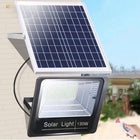
A separate-panel design moves the solar collector away from the lamp. The Split-Design Solar Pendant Light uses a separate 5V/4.5W panel and a 16.4 ft (5 m) cable, so the panel can remain outdoors while the lamp serves a shed, garage, barn, gazebo, or covered work area. It is listed at up to 800 lumens with a 4400mAh battery, 2700K–6000K adjustment, about 8–10 hours of suitable direct-sun charging, and roughly 10–14 hours of runtime after suitable charging.


That long listed charging period is important. The separate panel gives placement flexibility, but it does not create sunlight. For a fall installation, choose this format only if you can place the panel where it can actually receive strong daylight for a large part of the day. If the entire property zone is heavily shaded, a different power source may be more dependable.

Choose brightness for the task, not for the season
Earlier sunset does not make a walkway require security-light output. The current 50-lumen adjustable pathway light is intended for path marking and landscape accent, not floodlighting, stairs, code-required safety lighting, or security. Its 25–60 cm adjustable height can help keep the head and panel above low planting.
At an entrance, use brighter controlled light only where it improves useful visibility. For a shed or covered work area, up to 800 lumens may support a defined entry, circulation, or workbench zone, while larger spaces can require additional lighting.
For pathway products, compare current options in Solar Pathway & Garden Lights. The collection separates low-profile disks, stake-style path lights, decorative stakes, and focused landscape lights by their actual role instead of treating every solar fixture as interchangeable.
Use a fall buying checklist before you order
- Check the exact panel location at several times of day. Do not judge fall sun exposure from a summer memory.
- Define the hours you really need light. Early-evening guidance, late-night security response, and all-night decoration are different energy demands.
- Match the control mode to the job. Use low-level dusk-to-dawn where continuity matters and motion or timers where bright light is intermittent.
- Read charging and runtime claims together. A long runtime assumes suitable charging conditions.
- Separate the panel when the lamp location is shaded. Confirm the supplied cable reaches the sunny position safely.
- Choose verified brightness data when available. Do not use LED count as a substitute for lumens.
- Plan for seasonal variability. Treat listed runtime as condition-dependent, not a nightly guarantee.
- Keep critical lighting independent. Do not use a solar fixture as the sole source for code-required, emergency, or critical security illumination.
How this differs from fall maintenance
If you already own outdoor solar lights, the better next step may be maintenance rather than replacement. The existing fall and winter preparation guide covers cleaning panels, checking seasonal shade, repositioning stakes, protecting cables, and testing installed zones. This article is different: it is a pre-purchase decision guide for choosing the right panel layout, control mode, output, and runtime before buying or adding fixtures.
If cloudy conditions are your main concern, also see Do Solar Lights Charge on Cloudy Days?. If you are comparing automatic operating behavior, What Does Dusk-to-Dawn Mean on Solar Lights? explains how photocell-based operation differs from motion and timer modes.
FAQ
Do solar lights need more battery capacity in fall?
Are motion-sensor solar lights better for shorter fall days?
Should I choose dusk-to-dawn or motion-sensor solar lights for fall?
Is a separate solar panel better when fall shadows get longer?
How much direct sun should I plan for before buying a solar light?
Will a higher LED count make a solar light better for fall?
Can solar lights replace hardwired safety or security lighting during longer fall nights?
Get more NoxLumin guides on Google
Add NoxLumin as a Preferred Source to help Google show you more of our outdoor lighting guides in Search and AI experiences.


Leave a comment