


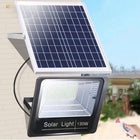


How to Light an Outdoor Trash Bin Area Without Wiring

To light an outdoor trash bin area, choose an integrated solar motion light for a sunny mounting spot, or a separate-panel light for a shaded lamp position with a sunny panel location within cable reach. Keep the light clear of moving lids and bins. Neither requires household electrical wiring, but a separate-panel model still uses a panel-to-lamp cable.
The Light Has to Work While the Bins Move
The space needed around the bins changes as lids open and carts move. A closed lid becomes a tall obstruction when raised. A cart pulled forward occupies the place where you were standing. A screen gate may block both the light and the motion sensor as it swings open. A photograph of neatly parked bins cannot tell you whether the layout works on collection night.
Consider an example with two wheeled carts on a 6-foot-wide pad beside a garage. The useful lighting area includes the handles, the ground in front of the carts and the turn onto the driveway. That pad size is a planning example, not a light-coverage specification. Measure your actual carts and their full movement instead of assuming a universal clearance.
| Position | What can go wrong | What the lighting plan should allow |
|---|---|---|
| Bins parked, lids closed | The wall looks bright but the handles remain in shadow | Light reaches the gripping points and the ground where you stand |
| One lid fully open | The lid blocks the beam or sensor | A fixed mounting position outside the lid's movement and shadow |
| Cart tipped onto its wheels | The user or cart blocks the only light | Visibility along the first part of the rolling route |
| Screen gate open | The gate hides the approaching person or catches a cable | Clear sightlines and a cable route entirely on fixed surfaces |
Two Separate Tests: Nighttime Visibility and Daytime Sun
A useful lamp position is not automatically a useful solar-panel position. Bin screens, garage overhangs and vegetation may shade a compact wall light for much of the day. Look at the exact mounting spot with the bins in their normal positions. Also consider whether a lid commonly left open would cast shade on the panel.
An integrated panel must charge at the lamp's mounting spot. A separate panel can charge elsewhere, within reach of its supplied cable. Use those constraints to narrow the choice before comparing output.
| Decision point | 112-LED motion wall light | 170-LED separate-panel floodlight |
|---|---|---|
| Sunlight at the site | The wall-mounted fixture needs direct sun on its built-in panel. | The lamp can sit in shade if the separate panel receives unobstructed sun and the installed cable route fits within 5 m (16.4 ft). |
| Listed charging time | Approximately 4–6 hours in direct sunlight. | Approximately 8–9 hours; place the panel in strong, unobstructed sunlight. |
| Lighting controls | Two motion-responsive modes and two constant-output modes. | Remote brightness adjustment, dusk-to-dawn operation and 3/5/8-hour timers; no motion sensor is specified. |
| Typical visit | Motion operation suits a quick bag drop; a constant mode may suit longer sorting sessions. | Remote control suits planned sorting or cleaning sessions when you can select the brightness and operating period in advance. |
These are product-listed charging estimates, not guaranteed daily results or promises of all-night operation. Actual charging and runtime vary with weather, seasonal shade, panel orientation, battery condition and the selected lighting mode. If neither an integrated panel nor a reachable separate panel can receive adequate sun, choose another power source.
For Brief Visits: A Compact Motion Wall Light
The NoxLumin 112-LED Solar Motion Sensor Wall Light is a candidate for a sun-exposed garage or exterior wall beside a bin pad. Its body measures 7.5 × 6.0 × 1.8 inches (190 × 153 × 45 mm), with a built-in 1.5W/5V panel and a 2200mAh battery. Warm White at 3000K and Cool White at 6500K use the same body and controls.


Its four modes offer motion-activated bright light, dim light that brightens with motion, constant high output and constant low output. Motion-activated lighting suits a quick bag drop. For sorting recycling or wiping a lid, a short trigger period can be inconvenient: the listed bright period is approximately 13–15 seconds, extending with continued motion. Check whether normal activity keeps it on; do not assume a person standing still will continuously retrigger it.
The listed PIR angle is 120°, with a 16–26-foot range. Those figures describe detection, not guaranteed illumination. There is no verified lumen figure for this model. Position the sensor to see the approach before you reach the bins, then check the response with the screen gate both open and closed. A lamp hidden behind a tall cart may miss the approach even at a short distance.
The listed mounting-height range is 6.5–13 feet; use it as an initial reference. Within that range, choose a position that clears the lid's full movement and receives direct sun, following the mounting instructions. Higher is not automatically better. Listed runtimes are about four hours in constant high-output mode and eight hours in constant low-output mode; runtime in motion-activated modes depends on activity and charging conditions.

For a Shaded Pad: Put the Solar Panel Somewhere Else
The NoxLumin Outdoor Solar LED Floodlight with Separate Panel & Remote — 170 LED offers a different solution. The 170-LED version is listed at approximately 1,700 lumens, with a 3,000mAh battery and a 6V/3W panel. Consider this version for a bin area that opens onto a driveway or a wider rolling route. Aim it at the working area and use the remote to reduce brightness for a small enclosure; the higher output does not remove shadows cast by lids or carts.


Product-series images are shown for reference; use the specifications above for the 170-LED version discussed here.
The 170-LED lamp face measures approximately 5.5–5.7 inches wide by 5.1 inches high (14–14.5 × 13 cm); its separate panel is about 5.3 × 8.7 inches (13.5 × 22 cm). The two product size graphics differ on lamp width, so allow for 14.5 cm (5.7 inches) when checking clearance.
Mount the lamp on its bracket to aim toward the working area. Secure the separate panel to an appropriate fixed building surface where it receives sun, with its collecting face exposed. Do not suspend it from a bin, moving gate or fence panel.
Every variant includes a 16.4-foot (5 m) panel-to-lamp cable. Measure the installed route, including bends and the climb to the panel, rather than the straight-line gap. For example, a route using 6 feet along a wall and 7 feet upward consumes 13 feet before connector placement and service slack. That leaves only about 3.4 feet of the supplied length; it is not a reason to pull the cable tight.
Use the remote to select the brightness and operating mode before sorting recycling. A 3-, 5- or 8-hour timer selected for an evening task may finish before a later trip to the bins. Confirm the setting and available charge; this model does not list a motion sensor that could turn it back on when you approach. Browse the separate-panel solar lights collection when charging location is the deciding constraint.

A Clear Rolling Route Matters More Than an Extra Fixture
Keep lights, mounting brackets and cables outside the area used by the cart's wheels, body and your hands. Stake lights placed beside a narrow pad can become obstacles when a loaded cart turns. Decorative fence or rope lights may help outline the enclosure, but a visible outline does not establish that the handle and footing are adequately lit.
Try the routine with a closed lid, an open lid and a cart moving toward the driveway. Look for the darkest ground patch and any bright emitter directly in your eyes. If the open lid creates a large shadow, consider moving the light sideways on the fixed wall before adding output. This is a layout check, not a prescribed setback that fits every bin.
DarkSky and the Illuminating Engineering Society's lighting principles recommend targeted light, the lowest useful level and controls that limit unnecessary operation. For a bin pad, aim at the task and nearby footing without lighting a neighbor's windows. Lighting can improve visibility; it does not guarantee security or animal deterrence.
Keep the Setup Useful After Collection Day
Return the carts to positions that leave the sensor, lamp and panel clear. Recheck the arrangement if a larger recycling cart replaces an older one. Keep panel surfaces clear of debris, and revisit sunlight exposure as seasonal shadows change. For related placement considerations, see the solar light pre-installation checklist.
The 112-LED wall light is IP65-rated, while the separate floodlight's lamp housing is rated IP67. These ratings do not establish resistance to a pressure washer or cleaning chemicals. Keep cable joints out of standing water and avoid directing a bin-cleaning jet at the equipment. Where uninterrupted lighting is essential, use a suitable reliable lighting system instead of depending solely on weather-sensitive solar charging.
Frequently Asked Questions
What type of solar light suits an outdoor trash bin area?
Where should the light go relative to the bin lids?
Is 1,700 lumens too bright for a trash bin area?
Does the NoxLumin separate-panel floodlight detect motion?
Is the 112-LED wall light guaranteed to stay bright while I sort recycling?
Can I put a solar panel on the lid of a trash bin?
Does a 5 m cable reach a panel 5 m away?
Get more NoxLumin guides on Google
Add NoxLumin as a Preferred Source to help Google show you more of our outdoor lighting guides in Search and AI experiences.


Leave a comment