


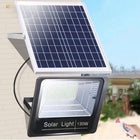


Can a Solar Motion Sensor Light Detect Through a Window?

A PIR solar motion sensor light should not be expected to detect a person reliably through ordinary window glass. PIR sensing depends on changes in thermal infrared energy reaching the sensor, and glass or acrylic between the person and sensor can prevent correct infrared transmission. Mount the fixture outdoors with an unobstructed view of the approach. Radar sensing can behave differently and may work through some nonconductive materials, but through-glass performance depends on the sensor, glass and installation, so it must not be assumed from the word “radar” alone.
This matters at sliding patio doors, glass storm doors, garage windows and enclosed porches. A homeowner may be able to see a visitor clearly while a PIR light inside the window sees little useful change in infrared energy. Putting an integrated solar light behind glass can also weaken charging, making an indoor-behind-window layout a poor default for both sensing and power.
Why PIR and Human Vision See a Window Differently
A person sees through a clear window because visible light passes through it. A passive infrared, or PIR, sensor is not a camera. It responds to changes in infrared energy across detection zones, commonly when a warmer moving body crosses the sensor’s field of view.
Panasonic’s official PaPIRs reference specification explains that its pyroelectric infrared sensor detects variations in infrared rays and warns that glass, acrylic or similar material between the target and sensor may prevent correct infrared transmission. That is why closing a glass door can stop a PIR fixture from responding even though the person outside remains visually obvious.
Do not treat an occasional response through glass as dependable. Window construction, sensor angle, temperature and travel direction can change the result. A listed PIR range applies to a suitable, unobstructed installation—not to a sensor behind a window.
PIR vs Radar Near a Window
| Sensor Type | What It Responds To | Expected Through Ordinary Glass | Better Starting Layout |
|---|---|---|---|
| PIR | Changes in thermal infrared energy across detection zones | Not reliable; glass can block correct infrared transmission | Mount outdoors with a clear view across the approach |
| Radar | Reflected radio-frequency energy from movement | May pass through some nonconductive materials, but performance is product- and material-dependent | Mount outdoors as specified, define the intended zone and test for both missed and unwanted triggers |
| Photocell | Ambient light level for day/night switching | Not a motion-detection technology | Keep nearby porch lights and reflections from confusing nighttime switching |
Texas Instruments’ technical paper on 60-GHz mmWave sensing notes that mmWave sensors can detect people and objects through materials including glass and drywall. That establishes an important technology difference, but it does not certify every radar light for detection through every window. NoxLumin’s current radar-light listing provides a nominal angle and range for outdoor use, not a verified through-glass range.
See PIR vs Radar Motion Sensor Solar Lights for the broader comparison. For this window decision, exterior mounting is the reliable starting point for either type.
Better Layouts for Glass Doors and Windows
Place a PIR light beside the glass, not behind it
Mount the fixture on stable exterior siding or masonry beside the door or window. Aim the sensor across the expected walking direction rather than directly at the point where a person first appears. Crossing motion often creates a clearer change across PIR zones than moving straight toward the sensor.
Keep the sensor lens clear of door trim, shutters, deep eaves, plants and open door panels. The light beam should cover the latch, step or immediate path without shining through the glass into indoor living space. Test the final view after dark from every normal approach.
Separate the sensing job from the indoor viewing position
The sensor does not need to sit where the resident can see it. Let an exterior fixture detect the approach and illuminate the outdoor task area; the resident can observe the lit entry through the window.
Keep an integrated solar panel in useful outdoor sun
All three products discussed below combine the lamp, sensor and solar panel in one fixture. Their mounting location must therefore satisfy three conditions at once: useful daylight on the panel, a clear sensing field and a controlled light direction. Mounting the unit indoors behind glass compromises that design. Use the site checks in Do Solar Lights Work in the Shade? to assess the outdoor charging position.
Current NoxLumin Product Match
| Current Product | Verified Sensor and Power Details | Best Window-Area Role |
|---|---|---|
|
112-LED Solar Motion Sensor Wall Light  |
120° PIR; listed 5–8 m (16–26 ft) range; 2200mAh battery; integrated 1.5W/5V panel; four modes; IP65 | One defined back door, patio door or compact garage-side approach |
|
Aluminum Solar Motion Sensor Wall Light  |
Approximately 180° PIR and 5–10 m (16.4–32.8 ft) range; 450/900/1,100 lumens; 1,500/3,000/6,000mAh; four active modes plus Off; IP65 | Glass patio doors, wider garage entries and exterior walls needing a selectable output |
|
Solar Radar Wall & Pillar-Top Light  |
1400 lumens; 180° radar sensing; typical 5–10 m (16.4–32.8 ft) range; 6000mAh; integrated 5V/6W panel; four modes; IP65 | A sun-exposed porch, gate pillar or garage-front zone where radar response is preferred |
The 112-LED model offers 3000K or 6500K. The aluminum PIR model provides verified 450-, 900- and 1,100-lumen tiers with warm-white or white light. The radar model offers 4000K or 6000K and wall or pillar-top mounting.
Choose output by the outdoor task, not by the amount of glass nearby. DarkSky International’s Five Principles for Responsible Outdoor Lighting recommend targeted, low-level and controlled light. Aim the beam downward, use motion-only or dim-to-bright operation when appropriate, and avoid illuminating an entire glass facade when only the step and latch need light.
Browse related options in Motion Sensor Solar Lights, Solar Wall Lights and Wall & Security Lights.
Test Before Drilling
Secure the fixture safely near the proposed outdoor position without blocking the panel or sensor. Use the intended mode, follow the manual’s charging preparation and test after natural dusk.
- Approach from each direction people actually use, including from behind an open storm or patio door.
- Cross the sensing field at walking speed and then approach more directly.
- Close the glass door and confirm the sensor remains outdoors with an unobstructed exterior view.
- Watch for unwanted responses to traffic, pets, moving vegetation or activity visible to a radar zone beyond the intended path.
- Check that the light reaches the step or latch without creating glare in the glass.
- Repeat on another representative night before making permanent holes.
A published angle and range describe nominal conditions, not a hard boundary. Mounting height, approach direction, ambient temperature and surrounding objects affect PIR response; material properties and the configured zone affect radar response. If the position misses visitors or detects beyond the intended area, move or re-aim the fixture rather than relying on the window to shape the sensing field.
Common Mistakes Near Glass
- Mounting the entire solar light indoors: the glass can disrupt PIR sensing and reduce useful charging input.
- Using the clear view as proof: visible transparency does not mean thermal infrared reaches a PIR sensor correctly.
- Applying the open-air range through glass: listed detection distance assumes a suitable installation, not a window barrier.
- Assuming every radar sensor penetrates every window: frequency, glass construction, angle and product configuration matter.
- Aiming at the glass: reflected light can create glare while the intended outdoor step remains poorly lit.
- Ignoring the door swing: an open door can block the sensor, panel or beam even when the closed-door layout looks correct.
- Choosing maximum output first: start with the lowest mode that makes the outdoor task visible.
FAQ
Can a PIR solar motion sensor light detect through window glass?
Why can I see a person through the window when the PIR sensor cannot?
Will a radar solar light detect motion through glass?
Where should I mount a solar motion light near a glass patio door?
Does the listed motion-sensor range apply through a window?
Can reflected light from glass cause problems?
Can I mount an IP65 solar wall light indoors behind a window to protect it from rain?
Get more NoxLumin guides on Google
Add NoxLumin as a Preferred Source to help Google show you more of our outdoor lighting guides in Search and AI experiences.


Leave a comment