




Decorative Solar Wall Lights vs Motion Lights: Which Does Your Wall Need?

Choose decorative solar wall lights when you want an exterior wall to become a visual feature. Choose motion lights when you want responsive illumination as someone approaches a door, gate, or patio entrance. Use both when the same wall serves those two purposes: an accent pattern adds atmosphere, while a separate motion light serves the arrival area.
Decorative describes the lighting effect, while motion sensing describes how a light is controlled. Some fixtures combine both; this guide compares up-and-down accent lamps with motion-responsive entrance lights.
What should this wall do after dark?
Picture the wall from two positions: the place where you sit and the route you use to reach it. From a patio chair, you may want to see the texture of brick or a repeating pattern along a boundary. While carrying groceries toward a side door, you want light on the landing, nearby objects, and door hardware.
| Decision | Decorative up-and-down light | Motion-responsive wall light |
|---|---|---|
| Main job | Emphasize the wall and create a deliberate visual pattern. | Provide useful light when people approach or move nearby. |
| Where to look | The illuminated wall surface and its relationship to windows and trim. | The landing, approach, and other surfaces used during arrival. |
| Control priority | Automatic nighttime accent lighting. | A motion-only, dim-plus-motion, or constant setting suited to the activity. |
| Placement priority | A clear wall area, consistent orientation, and a sun-exposed panel. | A clear sensor view, useful light distribution, and a sun-exposed panel. |
| Best pairing | An entrance that already has suitable functional illumination. | A decorative backdrop that serves a separate visual purpose. |
Choose decorative lighting for the wall itself
Up-and-down fixtures create patterns close to the mounting surface. On a textured wall, those patterns can reveal small shadows in brickwork or stucco. On a smooth wall, their shape becomes the main visual detail. Look at the wall finish and available uninterrupted surface before deciding how many lights to use.
A pair can frame a selected feature, while a repeated arrangement can connect several wall sections. Keep the fixtures in the same orientation so their light patterns look intentional. For an up-and-down effect, the emitting edges must face upward and downward; rotating the housing can change the pattern into a sideways effect.
Use the decorative layer where you will actually enjoy seeing it. Beside a seating area, check the view from a chair as well as from standing height. Place the accent pattern away from bedroom windows and keep its upper portion on the wall rather than extending beyond the building edge.

Choose motion lighting for arrivals and short outdoor tasks
A motion-responsive wall light suits a side entrance, gate approach, or patio access point where the need for brighter light changes through the evening. The sensor handles activation, leaving your hands free when you arrive with bags or equipment.
Match the mode to the activity. Motion-only bright suits brief visits to a side door and keeps the light off between activations. Dim-plus-motion adds a lower background glow that brightens for movement. Constant lighting suits a planned period on a patio where people may sit relatively still. Select the appropriate setting from the modes offered by the model.
The sensor's view and the illuminated area need separate attention. Position the light so normal approaches pass through the sensing field, then check that the landing and door hardware are visible after activation. A sensor detecting movement does not, by itself, tell you where the light falls.

When combining both makes sense
Consider a patio wall with a seating area at one end and a side entrance at the other. Small up-and-down lamps can create a restrained backdrop near the seats. A motion light near the entrance can brighten the arrival area without turning the whole wall into a continuously bright surface.
Assess that arrangement in two states: the accent lights by themselves, and the combined scene when the motion light activates. If the brighter light overwhelms the decorative pattern, give the fixtures more distinct jobs or positions. You may prefer the accent lights farther along the wall rather than directly beside the motion fixture.
Coordination also means keeping light out of other fixtures' daylight sensors and away from neighboring windows. Choose compatible light colors where the two layers are seen together, while allowing the entrance fixture to serve its practical purpose.
DarkSky International and the Illuminating Engineering Society recommend targeted light, suitable brightness, and controls that match when illumination is needed. Apply those principles by keeping the entrance light on your own approach and choosing a restrained decorative pattern. Where upward light would escape past a wall, a downward-only design is the better fit.
Three NoxLumin options, matched to the job
10-LED decorative wall lamps: a compact accent pattern
The 10-LED solar decorative wall lamps suit repeated up-and-down accents on an exterior wall. Their black ABS housings contain an integrated solar surface, and the fixtures are rated IP65. Choose Warm Light or White Light, with packs of 1, 2, 4, 8, 10, or 12.
The housing measures approximately 3.94 × 2.24 × 0.91 in (10 × 5.7 × 2.3 cm). In the horizontal up-and-down arrangement, the long edge runs across the wall. This small format works as a series of accent points; select the pack for the number of wall details you want to emphasize.


Aluminum motion-sensor wall light: three output choices
The aluminum solar motion-sensor wall light offers three configurations for matching the fixture size and maximum output to your entrance or patio. Use the housing width to check the available wall space, then select the output for the activity.
| Configuration | Maximum output | Battery capacity | Housing width |
|---|---|---|---|
| 24 LEDs | 450 lumens | 1,500mAh | 4.53 in (11.5 cm) |
| 48 LEDs | 900 lumens | 3,000mAh | 8.90 in (22.6 cm) |
| 60 LEDs | 1,100 lumens | 6,000mAh | 12.05 in (30.6 cm) |
The compact 24-LED configuration fits smaller mounting areas; the 48- and 60-LED versions offer larger housings and higher maximum output for entrances and outdoor activity. All share an anodized aluminum main housing, IP65 protection, PIR sensing, and four active lighting modes plus manual Off. Black or silver finishes and white or warm-white light make it easy to coordinate with the wall.


112-LED motion-sensor wall light: flexible everyday modes
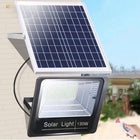
The 112-LED solar motion-sensor wall light offers dim-plus-motion, motion-only bright, constant strong, and constant weak modes. It combines a 2,200mAh rechargeable battery with an integrated solar panel and a 120° PIR sensor. Warm White (3000K) and Cool White (6500K) versions are available.
Its approximately 7.5 × 6.0 × 1.8 in (19 × 15.3 × 4.5 cm) housing suits an exterior doorway or patio access area. Choose the 112-LED design for its compact, nearly square format and four everyday modes. Choose the aluminum range when you want to select among three housing widths and maximum output levels. Explore both in the Solar Wall Lights collection.


Make the charging location part of the choice
All three designs carry their solar panels on the fixture. Their mounting position therefore determines both lighting placement and daytime charging. Check the exact panel location during the day, including shadows from eaves, climbing plants, and nearby walls. An attractive mounting point is most useful when its charging surface also receives direct sun.
Use fixings suitable for the wall material and follow the supplied installation instructions. For a deeper placement check, see the sunlight, mounting-height, and PIR-range checklist. Keep this purchase decision focused on the job: wall detail, responsive arrival light, or a coordinated combination.
Frequently asked questions
What is the difference between decorative solar wall lights and motion lights?
Do decorative solar wall lights detect motion?
Can a solar motion light provide a steady background glow?
Should I use decorative and motion lights on the same wall?
Is a 112-LED wall light brighter than a 60-LED wall light?
How do I choose a solar wall light for a narrow space beside a door?
Do solar wall lights need household electrical wiring?
Get more NoxLumin guides on Google
Add NoxLumin as a Preferred Source to help Google show you more of our outdoor lighting guides in Search and AI experiences.


Leave a comment