


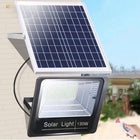


Solar Floodlights vs Spotlights: Light an Area or Highlight a Feature?

Choose a solar floodlight when the job is to illuminate a defined outdoor area, such as the usable space beside a garage or patio. Choose a solar spotlight when the job is to make one tree, statue, or architectural feature stand out. Check the actual light distribution, panel arrangement, and controls before comparing lumen numbers: a concentrated accent and a broader area light solve different visibility problems.
Floodlight and spotlight describe the intended light distribution. Separate-panel and integrated-panel describe the power arrangement. Treat these as two separate choices when comparing individual models; the panel layout alone does not define the lighting category.
Decide What Should Be Visible After Dark
Describe the result you want in one sentence. “I want to see the patio furniture and the space around it” is an area-lighting task. “I want the tree beside the patio to remain visible from my seat” is an accent-lighting task. The same yard can need both, but one fixture does not automatically fulfill both jobs.
A Wider Beam Does Not Automatically Make a Spotlight an Area Light
The names “floodlight” and “spotlight” are useful starting points, but product names alone do not describe the complete result. Some spotlights have adjustable optics. A wider setting can wash a nearby shrub or wall detail, while a tighter setting can isolate a smaller subject.
That flexibility does not create additional light output. A fixture still distributes its available output across the chosen pattern. For a patio, inspect the space people actually use: can you distinguish the seat, table edge, and surrounding ground, or is only the decorative object obvious? For a landscape feature, ask whether the desired texture remains visible without lighting the whole background.
Once you have chosen an accent fixture, our narrow versus wide beam guide covers the finer optical choice. This comparison focuses on which job to assign to each fixture.
Match the Lamp Position to the Charging Position
A wall-mounted lamp may need to sit beneath a roof overhang while its solar panel needs an open, sunny position. With a separate-panel system, those can be two different locations. With an integrated spotlight, the aiming location and charging location are coupled.
The U.S. Department of Energy explains that available solar radiation changes with location, time of day, season, landscape, and weather. Check the intended panel position during the day, including shade from the structure and nearby vegetation, rather than judging it from the nighttime view.
For a separate-panel installation, measure the cable route along the surfaces it will follow, including bends around an exterior corner. The straight-line gap between panel and lamp can underestimate the cable needed. Keep the route away from traffic and mower paths. For an integrated light, try another suitable stake position if aiming toward the feature turns the panel away from useful sunlight.

Two Current NoxLumin Designs, Two Different Strengths
| Decision point | 300-LED Outdoor Solar LED Floodlight with Separate Panel and Remote | Adjustable Solar Tree Spotlight |
|---|---|---|
| Intended job | A defined patio, garage-approach, or other activity zone | One tree, statue, sign, or landscape detail |
| Listed light output | Approximately 3,000 lumens for the recommended 300-LED configuration | 180 lumens per fixture |
| Panel and aiming | Separate panel and lamp can be positioned independently | Integrated panel and lamp head share one tilting assembly |
| Installation | Adjustable mounting bracket; included 16.4 ft (5 m) panel-to-lamp cable | Ground stake in suitable soil; no lighting wiring required |
| Everyday control | Remote ON/OFF, brightness adjustment, AUTO dusk-to-dawn operation, and 3/5/8-hour duration presets | On-fixture controls; High and Medium output modes; dusk-to-dawn operation once enabled |
For a defined activity zone: the 300-LED separate-panel floodlight
The 300-LED Outdoor Solar LED Floodlight with Separate Panel and Remote is the configuration recommended here. It lists an 8,000mAh battery and a separate 6V/6W solar panel. Place the lamp where it is useful, choose a sunny charging position for the panel, and use the adjustable bracket to aim toward the activity zone.


The 300-LED configuration's lamp face is approximately 10.24 in (26 cm) wide by 8.66 in (22 cm) high. Its separate solar panel is approximately 9.25 in (23.5 cm) wide by 13.78 in (35 cm) high.
For one landscape feature: an integrated ground-stake spotlight
The Adjustable Solar Tree Spotlight suits a tree, statue, sign, or smaller exterior detail viewed from a chosen direction. It offers a 5°–90° adjustable beam and Warm White or White variants, so choose the beam setting and color around the feature you want to emphasize.


Its 7.48 in (19 cm) stake is part of the fixture's approximately 11.81 in (30 cm) total height. The overall dimension includes the portion inserted into soil; it is not the installed height above ground. Place it in suitable soil clear of roots and walking or mowing lines, and reposition it if the stake meets resistance.
After setting the aiming angle, check the panel's daytime exposure at that same setting. The listed charging time is approximately 6–8 hours in direct sunlight, with 8+ hours of runtime after a full charge; actual duration varies with conditions and mode.

Controls Can Decide Which Design You Will Actually Use
A remote is useful when the floodlight is mounted beyond easy reach or you want to change brightness from a patio seat. Keep the tree spotlight's on-fixture controls accessible when placing it among plants. Motion sensing is not specified for this floodlight.
The floodlight's 3/5/8-hour timer selects an operating duration; it does not guarantee that every night's charge will support that setting. Available runtime depends on accumulated sunlight and the selected brightness. A clock-time schedule is not specified for this model. Choose a duration and output that match the period you need, then check performance under the site's actual daylight conditions.
Judge Glare from the Places People Will Stand or Sit
DarkSky's responsible outdoor lighting principles favor useful, carefully targeted light at the lowest necessary level, controlled for the times it is needed. Apply that to the actual view, not just to how bright the yard looks in a photograph.
Aim an area light into its assigned zone rather than horizontally across a property boundary. Aim an accent light so its useful beam stays on the feature. Check from the garage entrance, patio chair, and neighboring sightline. If the bright source dominates the view, change its aim or position and use a supported lower setting. A pale wall may reflect enough light to make further output unnecessary.
Utah State University's outdoor-lighting guidance emphasizes improving visibility while avoiding glare and light trespass. These principles guide placement; they are not a claim that either product has a particular certification.
When the Same Yard Needs Both
Imagine a patio with a small tree beside it. The area light's job is to make the occupied patio zone readable. The spotlight's job is to give the tree definition from the seating position. Keep each source responsible for its own target rather than aiming both across the entire yard.
Evaluate the functional zone first, then decide whether the tree still needs an accent. If the area light already gives the tree enough definition, a second fixture may add little. If the ground is readable but the tree disappears into the background, a restrained accent can add depth without raising the brightness of the whole scene.
Weather protection also differs: the floodlight's lamp housing is listed IP67, while the spotlight is listed IP54. Protect cable connections according to the product instructions and avoid standing water or immersion; the floodlight housing's rating is not proof that every connector or part of the system has the same rating.
Make the Purchase Around the Missing Job
- Choose an area-lighting design when several objects or a usable ground zone need illumination together.
- Choose an accent design when one feature should stand out while its surroundings remain quieter.
- Check charging and installation together: verify a sunny panel position, a suitable mount or soil location, and any required cable route.
- Check everyday control: decide whether accessible on-body controls or a remote better suit the location.
Browse Solar Flood and Security Lights for area-oriented options and Solar Lights for Trees and Landscape Uplighting for feature-oriented options. Select by the individual product's verified design rather than treating the collection name as a specification.
Frequently Asked Questions
What is the main difference between a solar floodlight and a solar spotlight?
Can a wide-beam solar spotlight replace an area floodlight?
Which solar light arrangement suits a shaded garage wall?
Are more LEDs or more lumens enough to choose an outdoor solar light?
Can the solar panel and head of the adjustable tree spotlight tilt independently?
Does a solar floodlight automatically detect movement?
Can I use a solar floodlight and spotlight together without overlighting the yard?
Get more NoxLumin guides on Google
Add NoxLumin as a Preferred Source to help Google show you more of our outdoor lighting guides in Search and AI experiences.


Leave a comment