




Best Solar Light Designs for a North-Facing Garage or Shed

The best solar-light design for a consistently shaded north-facing garage is usually a separate-panel system: place the lamp where light is needed and the panel on a nearby surface with useful direct sun. For a shed interior, choose a split solar pendant. Use an integrated wall light only when its exact position—or a nearby return wall—has proven solar exposure.
Choose by panel access, safe cable reach, task-appropriate output, controls and installation limits—not brightness alone.
Quick Picks
| North-Facing Job | Best Design | Current NoxLumin Match | Why It Fits |
|---|---|---|---|
| Shaded garage wall, driveway apron or exterior work zone | Separate-panel floodlight | Outdoor Solar LED Floodlight with Separate Panel | The lamp and 2W–6W panel can use different positions, connected by a supplied 5 m (16.4 ft) cable |
| Garage corner with a sunny return wall | Integrated-panel motion light | Outdoor Solar Motion Sensor Wall Light | One fixture combines the panel, lamp and PIR sensor when one sunny position can serve all three jobs |
| Inside a shed, garage, barn or covered workspace | Split solar pendant | Split-Design Solar Pendant Light | The panel stays outdoors in sun while the pendant illuminates one defined interior or covered zone |
If no safe panel location receives enough sun, use another dependable power source—especially for a critical exit or code-required route.
Why North-Facing Garages and Sheds Need a Different Design
A north-facing wall is not an automatic failure, but general daylight should not be treated as strong direct sun. The U.S. Department of Energy explains that solar radiation varies with location, time of day, season, landscape and weather in Solar Radiation Basics. Eaves, trees and nearby buildings can further reduce a small panel’s input.
The DOE also notes that unshaded south-facing roofs are commonly the strongest starting orientation for residential solar, while other directions can still work. A solar-light panel is much smaller, but it benefits from the same clear exposure principle. See the Homeowner’s Guide to Solar.
The real question is whether the panel can charge in sun while the lamp serves the north-facing task. A separate panel solves this conflict directly; an integrated light needs a proven sunny position that can also aim and sense correctly.
How We Chose the Best Designs
- Charging flexibility: a separate panel lets the lamp and panel use different positions.
- Usable cable reach: a 5 m (16.4 ft) cable must cover the protected route around corners, not just straight-line distance.
- Output and controls: a driveway, side door and workbench need different light levels and operating methods.
- Installation limits: shade, weather protection, door movement, glare and cable safety affect the final choice.
Best Overall for a Shaded Garage Exterior: Separate-Panel Solar Floodlight
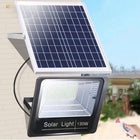
The NoxLumin Outdoor Solar LED Floodlight with Separate Panel is the strongest match when a garage wall remains shaded. Its lamp can serve a side door, driveway edge or work area while the panel uses a sunnier adjacent wall, roof edge or post.


Five current configurations span approximately 450–3,000 lumens, 1,000–8,000mAh LiFePO₄ batteries and 2W–6W panels. The supplied lamp-to-panel cable is 5 m (16.4 ft). Controls include AUTO, ON and OFF, remote brightness adjustment, and 3-, 5- or 8-hour timers. No motion sensor is verified for this product, so do not select it expecting PIR-triggered operation.
Choose the lowest output that reveals the task. The lamp is listed IP67, but the installation is not submersible. Secure the cable away from vehicles, sharp edges and pooled water.

Best for a Sunny Garage Corner: Integrated Solar Motion Wall Light
The NoxLumin Outdoor Solar Motion Sensor Wall Light is the simpler no-cable option when a sunny return wall can overlook the north-side approach. Its panel, lamp and approximately 180° PIR sensor share one mounting point.


The current family includes 24 LEDs at up to 450 lumens with a 1,500mAh battery, 48 LEDs at up to 900 lumens with 3,000mAh, and 60 LEDs at up to 1,100 lumens with 6,000mAh. It offers four active modes plus Manual Off, Black or Silver finishes, White or Warm White light, and an IP65 rating. Its listed motion range is approximately 5–10 m (16.4–32.8 ft).
The listing calls for about six hours of strong direct sun under favorable conditions. A larger battery cannot rescue a shaded panel. Temporary-mount and test the panel, sensor view and beam before drilling.

Best for a North-Facing Shed Interior: Split Solar Pendant Light
The NoxLumin Split-Design Solar Pendant Light is the best match inside a shed, detached garage, barn, gazebo or covered workspace. Its 18.2 × 12.7 cm monocrystalline panel stays outdoors in sun while the pendant hangs inside, connected by a 5 m (16.4 ft) cable.


It provides up to 800 lumens, remote 2700K–6000K adjustment, a 4,400mAh battery and a 5V/4.5W panel. Listed charging is about 8–10 hours and runtime about 10–14 hours, but actual results vary.
Motion Sensor and Timer Control are separate variants. Choose Motion for brief entry or Timer for a known work period. One pendant suits one defined zone; a large divided shed may need another layout.
Browse more structures in Solar Lights with Integrated Panels, Solar Lights with Separate Panels and Solar Lights for Shed & Garage. For a broader discussion of trees and building shade, see Do Solar Lights Work in the Shade?.

Three Layouts That Usually Make Sense
A garage door on a fully shaded wall
Mount a separate-panel floodlight over the driveway apron or side-door task, then route its cable to a sunnier adjacent surface. Measure around trim and corners. Use a timer or automatic light control; this model has no verified motion sensor.
A north-facing entrance beside a sunny side wall
Place the integrated motion light on the sunny return wall. Confirm direct sun, a clear PIR view and a downward beam. Check that an open door does not block the panel, sensor or light.
A shed with a shaded front and sunny side
Hang the split pendant over the workbench or circulation zone and mount its panel on the sunny exterior wall. Protect the cable at penetrations and away from hinges, sharp bends and water.
Buying Checklist Before Permanent Installation
- Map actual sun: inspect the panel surface morning, midday and afternoon; repeat in a less favorable season when possible.
- Measure the routed cable: include corners, drip loops and protected fastening.
- Name the task: choose output for the latch, workbench or driveway apron—not the building’s total size.
- Match the control: decide between motion, timer, remote brightness and automatic dusk operation.
- Temporary-test first: charge as specified, then test for two or three representative nights before drilling.
- Keep a backup: do not rely only on weather-dependent solar lighting for a critical route.
DarkSky International’s Five Principles recommend useful, targeted, low-level and controlled outdoor light. Aim down and use the lowest effective output.
Common Mistakes
- Treating bright sky as direct sun: diffuse daylight may contribute energy but should not be assumed to match strong direct exposure.
- Choosing the largest battery first: capacity stores energy; it cannot correct a poor panel location.
- Expecting motion control on the floodlight: no motion sensor is verified for the separate-panel floodlight described here.
- Combining pendant features that belong to different variants: Motion Sensor and Timer Control must be selected separately.
- Extending the supplied cable without approval: unverified splices can add loss and compromise weather protection.
- Testing only in summer: high sun and long days can hide a location that undercharges in winter.
FAQ
What is the best solar-light design for a north-facing garage?
What is the best solar light for inside a north-facing shed?
Can an integrated solar wall light work on a north-facing wall?
Is a separate solar panel better for a shaded garage or shed?
How much cable length should I plan for a separate-panel solar light?
Does a larger battery fix poor solar-panel placement?
Will a sunny separate panel guarantee all-night runtime?
Get more NoxLumin guides on Google
Add NoxLumin as a Preferred Source to help Google show you more of our outdoor lighting guides in Search and AI experiences.


Leave a comment