




How Far Can Solar Motion Sensor Lights Detect? Range, Angle, and Placement

A solar motion sensor light can detect movement only inside its stated distance and viewing angle, and those two numbers describe different parts of the coverage zone. For the current NoxLumin Outdoor Solar LED Wall Light, the listed sensing distance is 16.4–32.8 ft (5–10 m) and the listed sensing angle is more than 180°. Treat those figures as the outer limits of a testable zone—not a promise that every person, pet, vehicle, or movement will trigger the light at every point within it.
Distance and Angle Answer Different Questions
| Specification | What it describes | What it does not guarantee |
|---|---|---|
| Detection distance | How far outward the sensor may respond under suitable conditions | Reliable activation at the maximum distance in every temperature, direction, or mounting position |
| Detection angle | How wide the sensor can watch from side to side | A perfect semicircle with equal sensitivity at every point |
| Light beam or illuminated area | Where the LEDs cast visible light after activation | The same shape or size as the motion-detection zone |
A wide angle can watch a gate and the nearby approach at the same time, while a longer distance can detect movement farther down a driveway. Neither specification substitutes for the other. A fixture may illuminate a broad wall but detect motion only in a more limited sensor zone, or it may detect movement outside the area where its light is usefully aimed.
What 16–33 Feet and More Than 180° Mean in a Real Yard

At a garage, the near part of the zone may include the apron and side door, while the far part may reach toward the driveway. At a side gate, the same wide angle can unintentionally include a public sidewalk, moving branches, or a neighbor's driveway.
Visualize the sensor zone as a three-dimensional fan. Mounting height and tilt determine where it intersects the ground. Pointed too high, it may watch above a short walkway; pointed too low, its useful reach may end near the wall.
Panasonic's technical guidance for passive infrared sensors explains that performance depends on representative operating conditions and that detection tests specify factors such as target size, speed, temperature difference, and crossing of detection zones. Panasonic also notes that changing mounting angle changes the field of view. Those principles help explain why a listed range is a starting envelope that should be tested at the actual property rather than treated as a surveyed boundary.
Why the Direction of Travel Matters
Passive infrared sensors respond to changes in infrared energy across their sensing zones. Movement across the view often creates a clearer change than walking directly toward the center. Panasonic's reference material for a 10 m PIR sensor warns that movement parallel to the sensor's depth axis may not be detected in some cases.
For a driveway or side path, choose a position where normal travel crosses part of the viewing fan. A small change in location or direction can improve the crossing path while the LEDs remain aimed down at your own property.
Four Conditions That Change Practical Coverage
1. Mounting height and tilt
The current NoxLumin variants carry different installation guidance: the 24 LED version is listed for installation below 2 m, the 48 LED version for 2–3 m, and the 60 LED version above 3 m. Follow the selected variant's instructions, then test the ground intersection rather than assuming a higher position always increases reach. The existing solar motion-light mounting-height guide covers that decision in more detail.
2. Walls, posts, plants, and parked vehicles
A post, corner, hedge, gate panel, or vehicle can block part of the view. Do not solve an obstruction by aiming across a property line. Recheck after seasonal growth or a change in parking.
3. Background and target temperature
PIR performance can change when the moving target and background have a smaller temperature difference. Panasonic's PIR specifications also identify sudden hot or cold airflow, small animals, sunlight, and vehicle headlights as possible influences. These are reasons to test in the season and time period when the light will be used—not reasons to assume the sensor has failed.
4. Solar charging
Detection geometry and stored energy are separate issues. The sensor may be aimed correctly while the light performs inconsistently because the integrated panel is shaded. The U.S. Department of Energy's solar guidance explains that shade affects solar suitability. Keep the panel clear of an eave, tree canopy, dirt, leaves, and snow, and verify that the selected wall receives useful daytime sun.
Coverage Plans for Three Common Locations
| Location | Detection priority | Placement approach | Boundary to avoid |
|---|---|---|---|
| Garage entrance | People crossing the apron and approaching the service door | Use a corner or side position that lets normal travel cross the viewing fan | Do not aim the sensor or beam into the street or a neighboring driveway |
| Narrow side yard | Gate opening and movement along the private path | Test a wall position where the path crosses the near-to-middle portion of the zone | Mask or redirect coverage away from moving shrubs, HVAC exhaust, and the next property |
| Back door or patio | Door approach and immediate step or landing | Prioritize the occupied approach rather than the farthest possible range | Avoid direct glare toward seating, windows, or the camera line of sight |
More range is not automatically better. A sensor that reaches a sidewalk or neighboring activity can activate more often than useful. DarkSky International's Five Principles for Responsible Outdoor Lighting recommend useful, targeted, low-level, controlled, and warm-colored light. A motion sensor supports control, but only when the detection zone and beam remain focused on the area that actually needs light.
How to Test the Detection Zone Before Final Mounting

Use a temporary, secure test position that does not damage the wall or create a falling hazard. After charging the light and selecting the intended motion mode, test at dusk or night from the real travel paths. Have one person observe while another walks across the zone at several distances.
- Mark the near, middle, and far test points within the stated 16.4–32.8 ft (5–10 m) range.
- Approach once across the field of view and once directly toward the sensor.
- Test the gate, garage door, steps, and any turn in the path separately.
- Check whether street traffic, neighboring movement, pets, branches, or equipment enters the zone.
- Confirm that the light beam lands on your walkway or entry rather than into windows or the sky.
- Repeat after a weather or seasonal change if performance becomes different.
If the light activates without a useful target, reduce or redirect the watched area before increasing height or adding another fixture. The existing solar motion-light false-triggering guide provides a separate troubleshooting process.
When the NoxLumin Wall Light Makes Sense
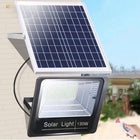
The current NoxLumin Outdoor Solar LED Wall Light with Motion Sensor is a no-wiring, integrated-panel fixture for outdoor walls at garage entrances, doorways, patios, fences, barns, and paths. Its current product data lists a PIR sensor, more than 180° sensing angle, 16.4–32.8 ft (5–10 m) sensing distance, IP65 ingress protection, and five modes: Dim-to-Bright, Constant On, Off-to-Bright, Emergency Constant On, and Off.


The 24 LED configuration is listed at 450 lumens with a 1500mAh battery, the 48 LED version at 900 lumens with a 3000mAh battery, and the 60 LED version at 1100 lumens with a 6000mAh battery. White and Warm White are available in black and silver housings. All current variants are available for sale, but brightness and battery size do not expand the stated sensor angle or guarantee maximum-distance detection.


This product fits a sunny wall position that can watch a private approach without including unnecessary public or neighboring activity. It is not a substitute for an alarm, camera, code-required egress lighting, or professional security design. Related options are available in the Motion Sensor Solar Lights and Outdoor Lights collections.
Common Range and Angle Mistakes
- Using maximum range as a guarantee: The outer number is not equal sensitivity at every point.
- Confusing detection with illumination: The sensor zone and LED beam are different shapes.
- Aiming straight down a path: Direct approach may be less reliable than movement crossing detection zones.
- Including the sidewalk: Extra coverage can mean extra activation rather than better security.
- Ignoring summer growth: Leaves and branches can shade the panel or change the watched area.
- Testing only once: Temperature, parking, weather, and landscaping can change practical performance.
- Choosing constant-on mode by default: Use the lowest useful light level and a controlled mode when motion activation fits the task.
Frequently Asked Questions
How far can a solar motion sensor light detect?
What does a 180-degree motion sensor angle mean?
Is it better to walk across or toward a PIR motion sensor?
Does mounting a solar motion light higher increase its detection range?
Can a motion sensor light detect through a fence, wall, or hedge?
Why does a solar motion light work differently in hot weather?
Does a bigger battery or brighter LED increase motion detection distance?
Get more NoxLumin guides on Google
Add NoxLumin as a Preferred Source to help Google show you more of our outdoor lighting guides in Search and AI experiences.


Leave a comment