


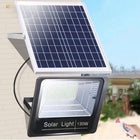


Can Solar Garden Lights Get Wet from Sprinklers?

Solar garden lights rated IP65 or IPX5 can handle normal rain and incidental sprinkler splash, but they should not sit in standing water or face a sprinkler’s strongest close-range jet. Treat the rating as protection for the enclosure under defined test conditions—not a promise that every irrigation layout is safe. Keep the fixture in firm, well-drained soil, leave the solar panel exposed to sun, and run each irrigation zone before choosing the final position.
What IP65 and IPX5 Actually Tell You
The International Electrotechnical Commission’s IP-rating overview explains that an IP code grades an enclosure’s resistance to dust or liquids. Its first position describes solids protection and its second describes water protection; IEC 60529 defines the classification.
| Rating | Solids Position | Water Position | What It Does Not Mean |
|---|---|---|---|
| IP65 | 6: a stated dust-protection level | 5: protection assessed against water jets under defined conditions | It does not make the light submersible or suitable for a flooded low spot |
| IPX5 | X: no solids rating is declared in that position | 5: the same stated water-ingress level as IP65 | The X does not upgrade water protection, and the 5 does not authorize immersion |
For sprinkler decisions, the shared final digit matters: both IP65 and IPX5 products in this guide are listed for rain and splashes, not immersion or standing water. IP65 adds a declared solids-protection level; it is not a license to mount the product closer to a high-pressure nozzle.
Why Sprinkler Exposure Varies From One Yard to Another
A distant head may create brief overspray, while a tilted or broken head can direct a concentrated stream at one fixture daily. The U.S. Environmental Protection Agency’s Sprinkler Spruce-Up guidance recommends checking tilted, broken or leaking heads, directing water toward the landscape and avoiding excessive pressure. Repair the water pattern before relying on an enclosure rating.
Drainage is a separate limit. Water can collect around a stake after the spray ends, especially in compacted soil or a depressed bed edge. Raise or relocate the light if a puddle remains; mulch does not fix a base installed below grade.
Iowa State University Extension’s drip-irrigation guide explains that drip systems deliver water slowly to soil and can keep spaces between plants drier than sprinklers. This does not change an IP rating, but it can separate the wet root zone from a drained lighting position.

Choose the Fixture Shape as Well as the Rating
| Current NoxLumin Product | Verified Structure | Better Irrigated-Garden Role | Main Water-Placement Limit |
|---|---|---|---|
|
50-Lumen Adjustable Solar Pathway Light  |
IP65; 25–60 cm adjustable black post; 50 lumens; top solar panel; ground stake | Path or bed-edge guidance where the head can be raised above low foliage and soil splash | Requires firm, well-drained soil; not for standing water or a direct high-pressure stream |
 |
IPX5; 27 in (68.6 cm); 20 flower heads per stake; 600mAh; dusk-to-dawn | Decorative clusters in watered flower beds and borders | Panels must remain clear of foliage; decorative output is not task or hazard lighting |
|
Solar Mushroom & Jellyfish Garden Stake Light  |
IP65; one 70 cm (27.6 in) stake; 6, 8 or 10 flexible branches; Warm White or RGB | A raised decorative focal point beside a drip line or outside a spray head’s core pattern | Flexible branches need clearance from irrigation hardware, paths, mowers and pooling |
|
8-LED Solar Disk Pathway Light  |
IPX5; 11.7 cm diameter; 1.5 cm disk thickness; 13 cm total height; 600mAh; ground stake | Low-profile marking along a drained garden or driveway edge | Its near-ground panel is more exposed to puddles, soil splash, grass and sprinkler residue |
How the Four Current Designs Change the Decision
Adjustable pathway lights: use height to reduce splash
The current 50-lumen pathway fixture adjusts from 25 to 60 cm and uses a flat rectangular lamp head on a square black post. Raising the head can move the LEDs and panel away from low foliage and soil splash, but the stake still belongs in firm, drained ground. Its 1000mAh battery, 3000K or 6500K choice and listed 6–8-hour runtime do not change the IP65 limit. The listing calls for about 4–6 hours of direct, unobstructed sun.

Delphinium lights: protect the small panels from foliage and residue
Each Delphinium stake is 27 inches tall with 20 assorted-color flower heads illuminated by warm LEDs. It is listed IPX5, charges in about 6–8 hours of direct sun and has a stated 8–12-hour runtime after a full charge; conditions can change that result. Use these as decorative accents, not as the only light for a step or hazard. Space the 4-, 8- or 12-pack layout so leaves do not cover the small integrated panels.

Mushroom and jellyfish lights: allow movement without tangling
One selected unit is one 70 cm stake, not six, eight or ten separate fixtures. Those numbers describe the flexible branch count. The translucent mushroom-style caps and green branches are offered in Warm White or RGB Color Changing, with IP65 protection and automatic dusk-to-dawn operation. Keep the branches away from sprinkler risers and moving heads so irrigation hardware does not catch or repeatedly strike them.

Disk lights: drainage matters more near ground level
The current disk light has a brushed stainless-steel ring, a central top panel and eight LEDs around it. Although it is IPX5, its 1.5 cm-thick disk sits close to the surface, so runoff, mud and cut grass can cover the panel. Install the 13 cm-tall staked assembly in loosened, well-drained soil outside tire and mower paths. It is not a drive-over fixture and should not be used for stair or broad-area security lighting.
Browse related options in Solar Pathway & Garden Lights, Decorative Outdoor Solar Lights, Ground-Inserted Solar Lights and Outdoor Lights Without Wiring.
A Six-Point Irrigation-Site Check
- Run every zone: watch one complete irrigation cycle in daylight and mark the strongest jet, overspray edge and runoff direction.
- Inspect the heads: correct tilted, clogged, broken or leaking sprinkler components before placing lights.
- Check after shutoff: return several minutes later and look for pooling around each proposed stake position.
- Match the profile: use a taller fixture where soil splash is frequent; reserve disk lights for level or slightly raised, fast-draining edges.
- Protect solar access: keep panels clear of leaves, mulch, grass, mineral residue and the shadow of nearby plants.
- Temporary-test first: charge the lights as specified, place them without permanent modification and compare the result through several irrigation and night cycles.
Layouts for Common Irrigation Types
Pop-up lawn sprinklers
Keep lights outside the immediate circle around each riser and away from the strongest part of the arc. A fixture should not block the head from extending or prevent head-to-head landscape coverage. Use the adjustable pathway light where a taller marker is helpful; use disks only in a drained edge that does not collect runoff.
Drip lines and soaker hoses
Route tubing toward plant root zones while placing stakes in adjacent firm soil. Pin or cover tubing as recommended so it cannot wrap around a stake or create a trip point. Delphinium or mushroom lights can add decorative height, but their panels still need clear direct sun.

Patio planters and raised beds
Confirm that the container drains and that runoff cannot pool around a switch or base. A tall flower stake can work in a substantial planter with firm soil; a low disk should not be balanced loosely on the rim or pushed into saturated potting mix. None of these soil stakes includes hard-surface mounting hardware.
Common Mistakes
- Reading “IP65” as “waterproof”: the rating does not authorize submersion or perpetual flooding.
- Comparing IP65 and IPX5 only by the first character: both share water digit 5; the difference shown here is the solids position.
- Installing before running irrigation: a damaged or misdirected head can change the real exposure completely.
- Putting disks in depressions: a shallow puddle can remain long after a short sprinkler cycle.
- Letting mulch cover the panel: better splash control is not useful if the solar surface cannot charge.
- Assuming sprinkler water cleans the light: mineral spots and soil residue can reduce panel and lens performance.
- Using decorative lights for hazards: flower, mushroom and disk lights are not substitutes for dependable step, security or code-required lighting.
FAQ
Can solar garden lights get wet from sprinklers?
Is IP65 better than IPX5 for sprinkler exposure?
Can IP65 or IPX5 solar lights sit in standing water?
Should I point sprinkler heads away from solar lights?
Where should solar disk lights go near irrigation?
Does sprinkler water clean the solar panel?
Are decorative solar flower lights suitable for wet garden beds?
Get more NoxLumin guides on Google
Add NoxLumin as a Preferred Source to help Google show you more of our outdoor lighting guides in Search and AI experiences.


Leave a comment