


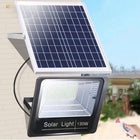


How to Light Deck Stairs Without Wiring

The most practical way to light deck stairs without wiring is to divide the route into three jobs: continuous orientation along a handrail, low-level markers at posts or landings, and controlled light at the upper entry. Solar rope, fence and motion wall lights can cover those jobs without trenching or a mains cable, but decorative fixtures should not replace lighting required by a local code, permit or safety plan.
Map Three Lighting Jobs Before Choosing Fixtures
| Deck-Stair Zone | Better Solar Design | What It Does | Main Limitation |
|---|---|---|---|
| Handrail or connected outer edge | Solar COB rope light | Creates a continuous line that helps reveal the route and changes in direction | The rope and cable must stay off treads and away from pinch points |
| Newel posts, rail sections or landings | Individual solar fence lights | Marks separate boundaries without running a cable between fixtures | Every integrated top panel needs useful daylight |
| Upper landing, door or deck entrance | Solar motion wall light | Adds controlled light when a person approaches the transition | The panel, lamp and sensor share one housing and cannot be aimed independently |
DarkSky International’s Five Principles for Responsible Outdoor Lighting recommend useful, targeted, low-level, controlled and warmer-colored light. On deck stairs, that means keeping light on the rail, posts and landing rather than aiming it into neighboring windows or the sky.
Current NoxLumin Product Match
| Current Product | Verified Structure | Better Deck-Stair Role | Important Limit |
|---|---|---|---|
|
|
320 COB LEDs/m; 5–50 m illuminated rope; separate 5 m or 10 m connection cable; remote timers | Secure beneath a handrail or along a protected structural edge for a continuous warm-white guide | Long 30–50 m configurations use two rope runs and a splitter; they are not one uninterrupted line |
|
|
60 lumens per fixture; integrated top panel; dusk-to-dawn; landscape or portrait housing | Mark a sunny post, rail end or landing boundary with warm white light | Each fixture charges independently, so a shaded post can perform differently from a sunny one |
|
Outdoor Solar Motion Sensor Wall Light
|
450, 900 or 1,100 lumens by configuration; integrated panel; approximately 180° PIR; four active modes | Serve the upper landing or door where the fixture can receive sun and sense the approach | It must be positioned for both charging and detection; it is not a separate-panel design |


A Six-Step Deck-Stair Lighting Plan
Step 1: Inspect the route after dark
Walk the route from both directions without carrying anything. Note the upper and lower landings, turns, rail ends, gate or door hardware, and places where the stair edge visually disappears. Do not plan only from a daytime photo; shadows, nearby porch lights and reflective surfaces change the nighttime result.
Step 2: Mark the essential transitions
Give priority to the first and last step, direction changes and the door or gate at the top. A decorative line along every rail can look attractive, but a clear transition is usually more useful than adding equal brightness everywhere. Keep any fixture outside the walking width and away from hand placement.
Step 3: Assign one lighting layer to each job
Use rope light for a connected rail or protected edge, fence lights for separate sunny posts, and a motion wall light for the upper landing. You may not need all three. A short stair with a well-lit door may only need low-level post markers, while a long stair with a turn can benefit from a continuous guide plus a controlled landing light.
Step 4: Map sunlight and cable routes separately
Integrated fence and wall lights must receive useful daylight where the complete fixture is mounted. A rope-light system separates the solar panel from the illuminated rope, so measure the glowing route and the unlit panel-to-rope route as two different lengths. The U.S. Department of Energy explains that solar radiation at a location varies with time of day, season, weather and the local landscape. Check proposed panel positions across the day rather than judging them from one bright moment.
Step 5: Mock up positions before drilling
Temporarily mark the intended fixture locations without creating a trip hazard. Confirm that a wall-light sensor covers the actual approach. Check that fence-light panels are not hidden by a rail cap or foliage. For rope light, plan gentle curves and non-crushing clips.
Step 6: Install, charge and retest over several nights
Follow the product instructions and protect every cable, connector and mounting point. Let the systems charge in their intended positions, then evaluate the stair from both directions at night. Recheck after cloudy weather and as seasonal shade changes. If a critical stair or exit cannot remain dependably visible, use an appropriate primary lighting solution rather than relying on decorative solar products alone.
Best for a Continuous Rail: Solar COB Rope Light
The current NoxLumin Solar COB Rope Light uses 320 COB LEDs per meter to create an approximately 180° continuous line. Configurations provide 5–50 m (16.4–164 ft) of illuminated rope and a separate 5 m or 10 m (16.4 or 32.8 ft) unlit connection cable.

For stairs, mount the rope beneath a handrail, along the inside of a rail or on another protected structural edge. Do not lay it across treads, riser noses or a route where shoes, furniture or a gate can crush it. The 10 × 5 mm rope follows straight sections and gentle curves. Cut only at marked 5 cm (2-inch) points and reseal every cut end and connector. Remote controls provide 5-, 8- and 10-hour timers.
Measure carefully before ordering. The illuminated length follows the rail; the connection cable reaches from the solar panel to the start of the rope. Configurations from 30 to 50 m use two rope runs connected through a splitter. For more detail, use the solar rope-light measuring guide and the panel-distance and cable guide.

Best for Posts and Landing Edges: Solar Fence Lights
The current NoxLumin Solar Fence Light provides 60 lumens per fixture and mounts with screws to a suitable post or rail surface. Warm White is the better everyday starting mode for a restrained deck-stair layout; the selectable RGB, Flash and Fade options are decorative effects rather than an improvement in stair visibility.

Landscape housing measures 12 × 7.5 × 5.5 cm, while Portrait measures 7.5 × 12 × 5.5 cm. Both use an integrated top solar panel and dusk-to-dawn operation. Mount each fixture level, keep the panel free of rail caps and foliage, and confirm that the chosen pack and orientation are currently available.

Best for the Upper Landing: Solar Motion Wall Light
The current Outdoor Solar Motion Sensor Wall Light offers three output configurations: 24 LEDs at 450 lumens, 48 LEDs at 900 lumens or 60 LEDs at 1,100 lumens. The matching battery capacities are 1,500mAh, 3,000mAh and 6,000mAh. White and Warm White options are available.


Its PIR is listed at approximately 180° with a 5–10 m (16.4–32.8 ft) detection range. Four active modes cover dim-to-bright, constant-on, off-to-bright and temporary continuous high output, plus manual off. For a landing, test whether the light triggers before a person reaches the transition. Motion-controlled modes can reserve stored energy for arrivals instead of keeping maximum output on all night.
Because the panel, lamp and sensor share one aluminum housing, the wall position must satisfy all three requirements: daylight for charging, useful downward light and a clear approach for detection. A deep roof overhang can make an otherwise convenient mounting point unsuitable.

Browse Solar Fence, Deck & Railing Lights, Solar Porch & Patio Lights, Solar Wall Lights and Outdoor Lights Without Wiring.
Common Mistakes to Avoid
- Putting flexible light on the walking surface: route rope and cable along protected structure, not across treads or landings.
- Choosing a panel position from one time of day: rail shadows, roofs and foliage can change throughout the day and season.
- Blocking the handrail: fixtures and clips should not interfere with a secure grip.
- Mounting the motion sensor without testing: check the actual approach from both directions and reposition the fixture if activation is late or inconsistent.
- Using decorative modes as the visibility plan: flashing or color-changing effects can distract from step edges and transitions.
- Assuming one bright landing light solves the entire route: rails, turns and posts can still create deep shadows.
- Treating solar accent lights as required safety lighting: verify local requirements and provide a dependable primary source where necessary.
FAQ
What type of solar light works best for deck stairs?
Can solar rope lights be installed directly on stair treads?
Can solar fence lights be mounted on deck posts?
Where should a solar motion light go near deck stairs?
Will solar lights work on deck stairs under a roof?
Is warm white or cool white better for deck stairs?
Can decorative solar lights replace required deck-stair lighting?
Get more NoxLumin guides on Google
Add NoxLumin as a Preferred Source to help Google show you more of our outdoor lighting guides in Search and AI experiences.


Leave a comment