


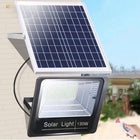


How Far Can a Solar Panel Be from Outdoor Rope Lights? Cable Length Guide

For the current NoxLumin Solar COB Rope Light system, the solar power unit can be placed 16.4–32.8 ft (5–10 m) from the beginning of the illuminated rope, depending on the connection-cable option selected. That measurement is the actual routed cable path—not the straight-line distance between two points. Measure the illuminated rope route and the unlit panel-to-light route separately before choosing a configuration.
This separate-panel arrangement is useful when the patio, pergola, fence, railing, steps, or landscape edge needs light but the same location does not receive enough useful daytime sun. The rope can remain in the shaded lighting zone while the solar panel is positioned in a more open location, provided the selected connection cable reaches without being stretched, placed in traffic, or routed through standing water.
Two Different Distances Control the Layout
A solar rope-light project has two independent measurements. Combining them into one number is one of the most common ordering mistakes.
| Measurement | What It Covers | Current NoxLumin Options |
|---|---|---|
| Rope-light length | The route that produces visible light | 16.4–164.0 ft (5–50 m) |
| Connection-cable length | The unlit route from the solar power unit to the start of the rope light | 16.4–32.8 ft (5–10 m) |
A 32.8 ft (10 m) connection cable does not add 32.8 ft of illumination. Likewise, selecting a longer rope does not move the solar panel farther away unless the selected configuration also includes the required connection-cable length.
Use the existing solar rope-light measuring guide to calculate the illuminated route. Then measure the panel-to-rope route as a separate line item.
What Does a 5–10 m Connection Cable Change?
The current NoxLumin Solar COB Rope Light offers connection cables in 1 m increments from 5 to 10 m. The purpose of these options is placement flexibility, not added brightness or illuminated length.
| Cable Range | Useful Starting Scenario | Check Before Ordering |
|---|---|---|
| 5 m / 16.4 ft | Panel and rope start are in the same patio, fence, or landscape zone | Include vertical rise, corners, and a non-tensioned route |
| 6–7 m / 19.7–23.0 ft | Panel needs to move beyond a small overhang, shrub, or shaded section | Measure around structures rather than diagonally through them |
| 8–10 m / 26.2–32.8 ft | Rope is under a pergola or along a shaded route while the panel is farther into an open area | Confirm the cable can be secured away from feet, tires, mower blades, and pooled water |
Choose the shortest listed cable that reaches the planned solar-panel position along the safe, real-world route. Excess cable does not improve charging, while a cable that is too short can tempt the installer to stretch it across a corner or place the panel back in shade.
If the measured route falls close to an available cable length, select the next option about 1 m (3.3 ft) longer when that option is available within the 10 m range. This planning allowance helps absorb small measurement errors, final panel-position adjustments, turns, and vertical rises without stretching the cable. Secure any unused slack along a protected edge; do not leave it loose in a walkway or water-collection point.
Measure the Routed Path, Not the Straight-Line Distance
A straight measurement across a yard can underestimate the cable needed. The cable may need to travel down a post, behind a railing, around a doorway, along a wall edge, or from ground level to a higher panel position.
- Mark the intended beginning of the illuminated rope.
- Choose a panel location with useful daylight and minimal routine obstruction.
- Trace the actual safe cable route between those points.
- Include vertical rises, turns, structural edges, and enough length to avoid tension.
- When possible, add about 1 m (3.3 ft) as a planning allowance for final positioning and measurement error.
- Compare the resulting distance with the available 5, 6, 7, 8, 9, and 10 m options.
For example, a straight-line gap of 18 ft may become a routed distance of more than 20 ft after following a post and railing. Adding about 3.3 ft of planning allowance can move the practical selection from a tight 6 m option to a 7 m (23.0 ft) or 8 m (26.2 ft) cable, depending on the measured route. This is a layout example, not a universal measurement: trace the actual property and keep secured slack out of traffic.

Layout Example: A Shaded Pergola
A covered pergola is a strong use case for a separate-panel system. The warm-white rope can follow the inside beam, lower railing, or step edge while the panel remains outside the covered area. The connection cable bridges the unlit distance between them.
Do not count the cable section as part of the pergola's illuminated perimeter. If the pergola requires 40 ft of visible light and the panel route measures 24 ft, those are two separate selections: a suitable rope length and a connection cable long enough for the 24 ft route plus an appropriate planning allowance.
The U.S. Department of Energy notes that solar potential depends on factors including shading, direction, tilt, and location. A small outdoor-lighting panel is not the same as a rooftop array, but the underlying placement lesson still applies: moving the panel out of persistent shade is more useful than placing it beside the light merely because that route is shorter. See the DOE's Solar Rooftop Potential guidance.
For additional shade-related placement limits, see Do Solar Lights Work in the Shade?.

Layout Example: Fence, Railing, or Steps
For a fence or railing, the panel may be able to remain near the beginning of the rope. Measure along the structure instead of across open space, and keep the black connection cable visually separate from the glowing rope.
For steps, the cable should approach the beginning of the illuminated run from outside the normal walking line. The 10 × 5 mm rope can follow straight sections and gentle curves, but it should not be sharply bent, twisted, or crushed. The unlit connection cable should also remain outside places where shoes, wheels, tools, or maintenance equipment can damage it.
Browse Solar Fence, Deck & Railing Lights for other formats when a continuous rope is not the best fit.
Long Rope Configurations May Use Two Runs
The 5–25 m NoxLumin configurations use one continuous rope-light run. The 30–50 m configurations use two runs connected to the solar power system through a 1-to-2 splitter:
| Selected Total Length | Supplied Rope Arrangement |
|---|---|
| 30 m / 98.4 ft | Two 15 m runs |
| 35 m / 114.8 ft | One 15 m run and one 20 m run |
| 40 m / 131.2 ft | Two 20 m runs |
| 50 m / 164.0 ft | Two 25 m runs |
This structure matters before installation. A 50 m selection should not be planned as one uninterrupted 50 m line around several disconnected areas. Both supplied runs share the same solar power system and control schedule. Use separate systems when two areas need independent timers or cannot be reached as one coordinated layout.

Panel Placement Still Controls Charging
The current configurations use matched solar panels and 5,000–25,000mAh LiFePO4 energy-storage systems, depending on rope length. Panel sizes range from 230 × 345 mm to 350 × 700 mm. These matched components do not eliminate the effect of shade, seasonal sun angle, clouds, dirt, temperature, or panel orientation.
The 5-, 8-, and 10-hour remote settings request a lighting schedule; they are not guaranteed runtime promises. A longer timer setting uses stored energy for longer, while limited daytime charging can reduce actual performance.
DarkSky International recommends using outdoor light only where and when needed, controlling its operating period, and choosing warmer-colored light where practical. For a decorative patio or pergola, Warm White combined with a shorter timer may be a more responsible starting point than running White light for the maximum period every night. See the Five Principles for Responsible Outdoor Lighting.
Weather Protection Applies to the Complete Route
The current system is listed as IP65 when connectors and cut ends are properly sealed. IP65 does not permit immersion or installation in standing water. Avoid low points where rainwater collects, and do not leave a connector where roof runoff repeatedly lands on it.
The rope can be cut every 2 in (5 cm), but only at marked cutting points. Every cut end must be properly resealed before outdoor use. Cutting elsewhere or leaving a cut end open changes the installation from the verified product configuration.
For a fuller explanation, read What Does IP65 Mean for Outdoor Rope Lights?.
Current NoxLumin Product Match
| Specification | Current Verified Range | Why It Matters |
|---|---|---|
| Rope length | 5–50 m / 16.4–164.0 ft | Defines the illuminated route |
| Connection cable | 5–10 m / 16.4–32.8 ft | Defines the unlit panel-to-rope route |
| Light color | White or Warm White | Supports visibility-oriented or softer decorative layouts |
| LED density | 320 COB LEDs/m | Produces a continuous line with fewer visible dark gaps |
| Timer | 5, 8, or 10 hours | Controls the requested nightly schedule |
| Cut interval | 5 cm / 2 in at marked points | Allows final shortening when cut and resealed correctly |


 Compare the current options on the Solar COB Rope Light product page. Other products that separate the lighting position from the charging position are available in Solar Lights with Separate Solar Panels.
Common Cable-Planning Mistakes
- Adding rope and cable lengths together: only the rope produces visible light.
- Measuring a diagonal straight line: the installed cable normally follows structural edges and vertical changes.
- Ordering the exact measured length with no allowance: when an available option permits it, reserve about 1 m for final positioning, turns, and measurement error.
- Choosing the panel location after ordering: identify the usable solar position before selecting cable length.
- Stretching a short cable: the route should not place tension on connectors.
- Crossing a walkway or mower path: move or protect the route instead of treating the cable as traffic-resistant.
- Assuming a third-party extension is equivalent: compatibility, sealing, polarity, and electrical performance have not been verified.
- Planning 30–50 m as one continuous rope: those configurations use two runs and a splitter.
- Using IP65 as permission for standing water: sealed outdoor use is not the same as immersion.
FAQ
How far can the solar panel be from the start of the rope light?
Is the connection cable part of the illuminated rope-light length?
Should I choose a 5 m or 10 m connection cable?
Can the rope light be under a pergola while the solar panel is in the sun?
Can I add a third-party extension cable beyond 10 m?
Are the 30–50 m rope-light options one continuous run?
Can the solar COB rope light be cut after installation?
Get more NoxLumin guides on Google
Add NoxLumin as a Preferred Source to help Google show you more of our outdoor lighting guides in Search and AI experiences.


Leave a comment