


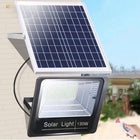


What Does Dusk-to-Dawn Mean on Solar Lights?

Dusk-to-dawn on a solar light means that ambient-light sensing allows the fixture to switch on after the surroundings become dark and switch off when daylight returns. It describes the automatic switching window—not a guarantee that the light will remain at full brightness until sunrise. The actual operating time still depends on how much solar energy was collected, the selected mode, light output, night length, weather, shade and battery condition.
That distinction prevents a common buying mistake. The current collection includes pathway, fence, garden-decor, rope, spotlight, pendant and high-output area-lighting formats. Each can use darkness as part of its control logic, yet some glow steadily, some wait for motion, some follow a timer, and some combine AUTO operation with remote control.
Simple Definition: Darkness Enables the Nighttime Mode
A dusk-to-dawn light uses a light-sensitive control, often called a photocell or ambient-light sensor, to distinguish brighter daytime conditions from darker nighttime conditions. During the day, a solar fixture normally keeps its LEDs off while its panel charges the battery. After the detected light level drops sufficiently, the controller permits the selected nighttime behavior. When daylight returns, the LEDs switch off and charging resumes.
“Dusk” and “dawn” are not fixed clock times. Trees, buildings, eaves and weather can change when a sensor experiences darkness. The U.S. Department of Energy’s Solar Radiation Basics also explains that solar radiation varies with location, time, season, landscape and weather. Those factors affect nighttime energy even when switching works correctly.
Sensor location and response delay vary by design. With a separate-panel system, do not assume the panel face is the only sensor; identify the specified sensing area and test the complete installation.
Dusk-to-Dawn, Motion, Timer and Manual Controls Compared
| Control Type | What Starts or Limits the Light | Good Fit | What It Does Not Guarantee |
|---|---|---|---|
| Dusk-to-dawn | Ambient darkness enables the light; daylight switches it off | Low-level path, border or decorative lighting | Full output or sufficient battery until sunrise |
| Photocell plus motion | Darkness enables the system; motion changes or starts output | Doors, garage approaches and occasional traffic | Continuous illumination without motion |
| Timer after dusk | The light starts at night, then stops after a selected interval | Patios, sheds or tasks needed for a known period | Operation for the entire night |
| Manual on/off | A person commands the light directly | Temporary work or testing | Automatic switching when nobody is present |
A product can combine several controls. Read its mode descriptions instead of treating “automatic” as one universal behavior.
All 16 Dusk-to-Dawn Solar Lights Compared
The current Dusk-to-Dawn Solar Lights collection covers sixteen different lighting jobs. Choose by the area that must be lit, the amount and direction of light required, whether the solar panel can receive useful daylight, and what the light should do after darkness is detected.
| Current Product | Verified Attributes | Better Fit | Key Limitation or Decision |
|---|---|---|---|
 |
50 lumens, 2700K, 800mAh, IP65, integrated panel | Warm, steady guidance beside a path or garden border | Ground-stake placement and daily panel exposure must work from the same position |
|
50-Lumen Adjustable Solar Pathway Lights  |
50 lumens, 25–60 cm adjustable height, warm or cold white, IP65 | Paths or beds where fixture height needs to match plants and sightlines | Greater height does not replace adequate spacing or solar exposure |
|
8-LED Solar Disk Pathway Lights  |
Low-profile disk form, warm or cold white, IPX5, 4- or 8-pack | Subtle edge markers along garden paths and driveway borders | Not intended to provide broad task or security illumination |
 |
30 lumens, 800mAh, automatic on/off, 2/6/12 packs | Low-level walkway, patio and lawn guidance | Use them as markers rather than a substitute for an area light |
 |
60 lumens, steady warm white plus RGB effects, dusk-to-dawn, IP65 | Fence, deck and patio-edge accent lighting | Each integrated panel needs direct sun; some pack/style combinations may be unavailable |
|
Adjustable Solar Tree Spotlight  |
180 lumens, 5°–90° adjustable beam, up to 10 m reach, High/Medium | Trees, statues, signs and defined landscape accents | Aim the complete beam at a solid target and avoid spill beyond the property |
|
Solar Mushroom & Jellyfish Garden Stake Lights  |
Warm white or RGB, 6/8/10 branches, 70 cm, IP65, auto on/off | Decorative planting beds, lawns and party accents | Decorative output is not a replacement for path or task lighting |
|
Solar Delphinium Flower Lights  |
27-inch garden stakes, IPX5, 4/8/12 packs, listed 8–12-hour runtime | Flower beds and decorative garden groupings | Runtime is conditional on charge, weather, season and battery condition |
|
7-Color-Changing Solar Garden Lights  |
Seven-color decorative effect, automatic on/off, listed 10–12-hour runtime | Yard, walkway and patio decoration | Color-changing light is decorative and may not provide clear route guidance |
 |
Auto on/off, flickering-flame or stable-light modes, IPX5, hanging or tabletop use | Patios, tables, hooks and decorative evening ambience | Choose stable light when visibility matters; flame simulation is primarily decorative |
 |
320 LEDs/m, 16.4–164 ft options, IP65, remote timer | Pergolas, railings, fences, tree trunks and long landscape edges | Measure both the illuminated run and panel cable route; do not create trip or pinch hazards |
|
Split-Design Solar Pendant Light  |
Up to 800 lumens, 2700K–6000K dimming, separate panel, 16.4 ft cable | Sheds, detached garages, barns, gazebos and covered work areas | The panel belongs outdoors while the lamp serves the covered or enclosed area |
|
Separate-Panel Solar LED Floodlight  |
Approximately 450–3,000 lumens, 5 m cable, AUTO, remote brightness, 3/5/8-hour timers | A shaded entrance or work zone with a sunnier panel position nearby | No verified motion sensor; selecting a timer intentionally ends operation before dawn |
|
Intense Remote-Operated Solar Flood Light  |
4,000–6,000-lumen configurations, automatic dusk-to-dawn, remote control | Garage, courtyard, roof or larger outdoor area | High output requires careful mounting, aiming and brightness control |
 |
720 LEDs, 6,000 lumens, 6,800mAh battery, built-in panel, remote control | Large yard or garden zones needing high-output area lighting | The lamp and integrated panel must share one position that works for both charging and aiming |
|
Commercial Dual-Panel Solar Flood Light  |
8,000 lumens, 25,000mAh battery, two 35 × 35 cm panels, auto dusk-to-dawn, aluminum housing | Large defined outdoor zones with open panel exposure | Plan structural mounting, glare control and the dual-panel footprint before installation |
Choose by Lighting Job, Not by the Words “Dusk-to-Dawn”
Paths, driveway edges and garden borders
Start with the lowest-output format that makes the route readable. The 30- and 50-lumen post lights provide a visible point above planting, the adjustable-height version can clear low foliage, and disk lights keep a lower profile. Install stakes only in firm, well-drained soil—not in pavement or concrete—and keep them outside vehicle, mower and snow-removal routes. Test the pattern after dark before adding more fixtures.

Fence, patio and decorative garden zones
Fence lights, mushroom or jellyfish stakes, delphinium flowers, color-changing garden lights and the vintage lantern are primarily accent or decorative formats. Their automatic switching reduces daily attention, but it does not turn them into security lighting. Use steady warm or stable light where orientation matters; reserve RGB, color-changing and flickering-flame effects for ambience. Keep integrated solar surfaces free of eaves, leaves and dense foliage.

Trees, pergolas and long landscape features
The adjustable tree spotlight concentrates light on one defined subject, while the COB rope light traces a long shape. For a spotlight, make sure the full beam terminates on your own tree, sign or statue. For rope light, measure the actual route around turns and supports rather than the straight-line distance. Secure the rope and panel cable away from sharp edges, moving gates and walking surfaces.
Sheds, entrances and larger outdoor areas
A split pendant separates an outdoor charging panel from a lamp inside a shed or covered structure. A separate-panel floodlight applies the same placement advantage to an outdoor target and adds remote brightness plus fixed timers. The three higher-output area lights serve larger zones, but higher lumen ratings increase the importance of aiming, mounting stability and glare control. Use no more light than the task requires, and do not rely on weather-dependent solar lighting as the only light for a code-required or safety-critical route.

Why a Dusk-to-Dawn Solar Light May Switch Off Before Sunrise
The sensor can perform correctly while the battery still runs out early. Think of the system as an energy budget: daytime charging supplies energy, and nighttime brightness and duration consume it. Any of the following can change the balance:
- Insufficient charging: clouds, seasonal sun, tree shade, an eave, dirt or snow can reduce the energy collected.
- Longer nights: the fixture may be asked to operate longer in winter while receiving a shorter charging window.
- Higher output: a brighter constant mode generally places more demand on stored energy than a lower or intermittent mode.
- Frequent motion: repeated triggers can keep a motion-responsive light at its brighter level for more of the night.
- A selected timer: a 3-, 5- or 8-hour setting is designed to end before dawn on many nights.
- Battery condition: rechargeable batteries lose usable capacity as they age.
- Loose or damaged connections: a separate-panel system also depends on a secure panel-to-lamp cable path.
Battery capacity alone cannot predict runtime. For a fuller explanation, see What Does mAh Mean on a Solar Light?.
Why It May Not Turn On at Dusk
First confirm that the power switch is active and the intended mode—not OFF or a completed timer—is selected. Then examine what the light sensor experiences. A porch lamp, streetlight, vehicle light or bright reflection can make the location appear brighter to the sensor than the surrounding yard. In some installations, the fixture may turn on later than nearby lights or cycle when its own light reflects back toward the sensing area.
Do not test every model by covering the solar panel unless its instructions identify that procedure. The ambient-light sensor may be elsewhere, and some controls include a response delay. Follow the manual, darken the specified sensing area, and allow the stated response time. Test at the installed position again after natural dusk.
If the fixture turns on during a controlled darkness test but performs poorly at night, investigate charging rather than the switch threshold. Check the exact panel position at several times during the day and use the placement guidance in Do Solar Lights Work in the Shade?.
Choose the Control by the Job
| Lighting Job | Better Starting Mode | Reason |
|---|---|---|
| Mark a garden path all evening | Low-output dusk-to-dawn | Provides consistent guidance without broad floodlighting |
| Show a garage or side-door approach when occupied | Motion-only or dim-plus-motion | Reserves brighter output for activity |
| Light a patio or shed for a planned session | 3-, 5- or 8-hour timer | Ends operation after the useful period |
| Illuminate a critical exit or code-required route | Dependable primary lighting plus backup | Weather-dependent solar performance should not be the only safeguard |
DarkSky International’s Five Principles for Responsible Outdoor Lighting recommend using light only when needed, keeping it no brighter than necessary and controlling it with tools such as timers or motion detectors. Dusk-to-dawn is convenient, but it is not automatically the best mode for every zone. Browse the complete Dusk-to-Dawn Solar Lights collection and compare products by lighting job, output, panel arrangement, mounting method and nighttime control.
A Practical Troubleshooting Checklist
These checks do not need to be performed in a rigid sequence:
- Confirm the main switch, remote state and selected mode.
- Give a new or depleted fixture the charging preparation specified by its manual.
- Clean the panel and identified sensor surface with a suitable soft method.
- Remove temporary shade and check for nearby artificial light or strong reflections at night.
- For separate-panel equipment, inspect the full cable route and seated connectors without opening sealed housings.
- Use the same mode for two or three representative charging days before comparing runtime.
- If a critical area remains unreliable, provide another dependable source of illumination.
FAQ
What does dusk-to-dawn mean on a solar light?
Do dusk-to-dawn solar lights always stay on all night?
Is dusk-to-dawn the same as a motion sensor?
Can a porch light stop a solar light from turning on?
How can I test a dusk-to-dawn solar light during the day?
Is a timer better than dusk-to-dawn operation?
Does a separate solar panel change dusk-to-dawn operation?
Get more NoxLumin guides on Google
Add NoxLumin as a Preferred Source to help Google show you more of our outdoor lighting guides in Search and AI experiences.


Leave a comment