


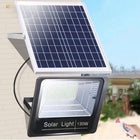


Which Solar Outdoor Light Do You Need? 6 New Arrivals Compared for Yard, Garage & Garden

The right solar outdoor light depends less on which fixture has the longest feature list and more on what kind of light the space actually needs. Use a directional spotlight for a tree or statue, a continuous rope light for steps or architectural edges, low-profile markers for a path, repeated wall-mounted lights for a fence, a motion-sensor fixture for an entrance, and a split-panel pendant light for a shed, garage, gazebo, or other covered space.
That is the most useful way to compare the six products currently in NoxLumin's New Arrivals: Best Solar Outdoor Lights & Garden Decor collection. They are not six competing versions of one light. They create six different lighting patterns and solve six different installation problems.
Six Solar Lighting Jobs at a Glance
| Lighting job | Best-fit light type | Why it fits | Key NoxLumin specification |
|---|---|---|---|
| Highlight a tree, statue, or vertical feature | Adjustable solar spotlight | Directs a controlled beam toward one target | 180 lm, 5°–90° beam, up to 10 m range |
| Trace steps, railings, pergolas, fences, or curves | Solar COB rope light | Creates a continuous line of light | 320 COB LEDs/m, 5–50 m light runs, 5–10 m panel cable |
| Add repeated light along a fence or deck edge | Solar fence light | Creates compact, repeated pools of boundary light | 60 lm, warm white + RGB, IP65 |
| Mark a walkway or driveway edge | Solar disk pathway light | Stays low to the ground and repeats along a route | 8 LEDs, 600mAh battery, IPX5 |
| Light an entrance when someone approaches | Motion-sensor solar wall light | Responds to movement instead of staying at full output continuously | 112 LEDs, 120° PIR, 16–26 ft detection, 4 modes |
| Light a shed, garage, gazebo, or covered work area | Split solar pendant light | Lets the solar panel stay outside while the lamp hangs under cover | Up to 800 lm, 5 m cable, 2700K–6000K, 4400mAh |

Start with Light Shape, Not Just Brightness
A common mistake when comparing outdoor lights is to rank them mainly by brightness. That works poorly when the fixtures distribute light in completely different ways. A focused 180-lumen spotlight aimed at a tree serves a different purpose from an 800-lumen pendant pointing downward over a work area, and neither replaces a thin illuminated line running along a stair edge.
DarkSky International's Five Principles for Responsible Outdoor Lighting recommend using light where and when it is needed, directing it toward the intended area, avoiding unnecessarily high light levels, and using controls such as timers or motion sensors where appropriate. Those principles are useful here because choosing the right fixture starts with defining the lighting job instead of simply adding more light.
For a Tree or Landscape Feature: Use a Directional Solar Spotlight
If the target is vertical—a mature tree, trunk, statue, column, or landscape feature—the High-Power Solar Tree Light is the most appropriate option in this collection.
Its defining feature is not simply its listed 180-lumen output. The optical system adjusts from a narrow 5° beam to a wide 90° beam, with a maximum illumination distance of up to 10 meters. A narrower beam concentrates light on a trunk or smaller architectural feature, while opening the beam allows broader coverage over a canopy, shrub mass, or wider surface.


The fixture uses a 2200mAh rechargeable battery, offers two brightness modes, and is rated IP54. NoxLumin lists 6–8 hours of charging under direct sunlight and 8+ hours of operation after a full charge.

This is a poor substitute for pathway marking or broad garage lighting because its strength is aiming. If you are deciding how narrow or wide the beam should be, the related guide Narrow vs Wide Beam Solar Spotlights goes deeper into that decision.
For Steps, Pergolas, Railings, and Long Edges: Use Solar COB Rope Light
The Premium Smart Solar COB Rope Light System solves a problem none of the other five fixtures can solve well: producing one continuous illuminated line over a long or curved surface.
The rope uses 320 COB LEDs per meter and provides approximately 180° illumination. Available configurations run from 5 to 50 meters (16.4 to 164 ft), with corresponding LiFePO4 energy-storage capacities from 5,000mAh to 25,000mAh depending on the selected system.


This makes it useful along patio steps, pergola framing, railings, fences, garden edges, and even selected tree outlines where a point-source fixture would leave gaps between illuminated areas.
An especially useful installation detail is the separate solar panel arrangement. The connection between the lighting run and solar power system can be selected from 5 to 10 meters (16.4–32.8 ft). That means a shaded stair, fence, or pergola does not necessarily force the solar panel into the same shaded location—the panel can be positioned farther away where daylight is better.

The system also provides dusk-to-dawn operation and remote timer choices of 5, 8, or 10 hours. The rope can be cut at marked 5 cm (2 in) intervals, and the system is rated IP65 when connectors and cut ends are properly sealed.
If the project involves measuring a long installation run, see How Much Solar Rope Light Do You Need? before choosing the rope length.

For a Fence or Decorative Boundary: Use Compact Solar Fence Lights
When the goal is not one uninterrupted line but a rhythm of repeated lights along a fence, wall, deck, or patio boundary, the 60LM Solar Fence Lights are a better match than rope lighting.
Each fixture is approximately 12 × 7.5 cm (4.7 × 2.9 in), mounts with screws, and provides a 60-lumen output. Warm white works for everyday boundary lighting, while the RGB mode provides a more decorative option for parties, holidays, or seasonal use.


NoxLumin lists 4–6 hours of charging, 10+ hours of working time after a full charge, and an IP65 rating.

The key decision between rope lights and fence lights is therefore visual structure. Choose rope light when you want a continuous illuminated edge. Choose individual fence lights when you want visible spacing between compact fixtures and repeated pools of light.
For Walkway and Driveway Edges: Use Low-Profile Solar Disk Lights
The 8-LED Solar Pathway Disk Lights are designed around a different visual goal: low-level route marking without adding a tall fixture beside the path.
Each disk uses eight LEDs, a 600mAh battery, stainless-steel and plastic construction, and a removable in-ground spike. They operate automatically after dark and carry an IPX5 rating.


NoxLumin also lists a 100 kg pressure-capacity specification. That does not mean the safest installation is directly in a normal vehicle tire path. For a driveway, the more conservative placement is along the edge where the lights can mark the route without being repeatedly driven over.

Compared with a fence light, the disk keeps the visual source close to ground level. Compared with the tree spotlight, it sacrifices long-range aiming in favor of repeated low-position markers.
For a deeper comparison of low-profile disks and taller stake lights, see Solar Disk Lights vs Stake Path Lights.
For a Garage Entrance or Exterior Door: Use a Motion-Sensor Solar Wall Light
If the lighting job begins when a person approaches, the 112 LED Solar Wall Light with Motion Sensor is more appropriate than a continuously glowing decorative light.
The PIR system has 120° detection angle and a 16–26 ft (5–8 m) sensing range. Four operating modes let the fixture balance motion response and longer-duration illumination for different entrances, garages, patios, and side-yard conditions.


The light uses a 2200mAh rechargeable battery and a 1.5W / 5V monocrystalline solar panel. NoxLumin lists 4–6 hours of charging, 8–12 hours of working time depending on mode and conditions, and an IP65 rating.

This is the best choice among these six when the core requirement is event-based lighting: someone walks toward a garage, exterior door, side gate, or similar approach area and the lighting behavior changes in response.
For a Shed, Garage, Barn, or Gazebo: Use a Split Solar Pendant Light
The Split-Design Solar Pendant Light should not be treated as an ordinary bedroom or kitchen pendant in this comparison. Its key application is a covered or semi-enclosed space where the lamp needs to be under a roof while the solar panel needs to remain outdoors.
The system separates the lamp and monocrystalline solar panel with a 5-meter (16.4 ft) cable. The light produces up to 800 lumens, adjusts from 2700K warm white to 6000K cool white, and uses a 4400mAh rechargeable battery. NoxLumin lists approximately 8–10 hours of charging and up to 10–14 hours of runtime depending on brightness level and operating conditions.


This split architecture is useful for garden sheds, detached garages, barns, gazebos, porches, patios, and similar structures because the panel can receive daylight outside while the lamp provides broad downward illumination underneath or inside the covered space.
There are also two control styles. Style 1 emphasizes sensor-based operation with three sensing modes. Style 2 provides AUTO operation plus 3H, 5H, and 8H timer settings. Both use remote control.

If you are choosing between those two control approaches specifically for a shed, the related article Motion Sensor vs Timer Solar Pendant Lights covers that decision in more detail.

Rope Light or Fence Light? Wall Light or Pendant Light?
Some of these products can appear interchangeable until you define the actual job:
- Rope light vs fence light: choose rope light for a continuous glowing line; choose fence lights for separate illuminated points.
- Tree spotlight vs pathway disk: choose the spotlight when the target is above ground and needs aiming; choose disks when the route itself needs low-level markers.
- Wall light vs pendant light: choose the motion wall light for an exterior approach or entrance; choose the split pendant when the working or activity area is underneath a roof and needs broad downward illumination.
Weather Ratings Also Differ
Do not assume every product in an outdoor-lighting collection has the same ingress-protection specification. The High-Power Solar Tree Light is listed as IP54, the pathway disks as IPX5, and the rope light, fence lights, motion-sensor wall light, and split pendant system as IP65.
These ratings should be considered together with the installation position and the manufacturer's instructions. For example, the COB rope-light system specifically depends on connectors and any cut ends being properly sealed for its intended outdoor installation.
A Simple Buying Checklist
- Identify the target: vertical feature, long edge, fence boundary, walking route, entrance, or covered workspace.
- Decide whether the light should be focused, continuous, repeated, ground-level, motion-triggered, or downward-facing.
- Check panel exposure: the lamp's ideal nighttime position may not be the panel's ideal charging position.
- Use split-panel products when needed: the rope-light system offers 5–10 m panel separation, while the pendant uses a 5 m cable.
- Choose controls by behavior: motion sensing suits approach areas, while timers are useful when you want a defined evening schedule.
- Compare the actual weather rating: IP54, IPX5, and IP65 are not interchangeable descriptions.
- Check the selected variant before ordering: light color, control style, pack size, rope length, cable length, and availability vary by product.
FAQ
Which type of solar light is best for a large tree?
When should I choose solar rope lights instead of solar fence lights?
Are solar pathway disk lights suitable for driveway edges?
What solar light should I use around a garage?
Can a split solar pendant light work in a shed or garage without hardwiring?
Do all six NoxLumin solar lights have the same weather rating?
Should I choose motion sensing or timer control for outdoor solar lighting?
Get more NoxLumin guides on Google
Add NoxLumin as a Preferred Source to help Google show you more of our outdoor lighting guides in Search and AI experiences.


Leave a comment