




How to Layer Solar Outdoor Lighting for a Safer, Better-Looking Backyard

A backyard lighting plan works best when it does more than make the entire yard uniformly bright. The most practical approach is to layer three types of light: low-level guidance along paths, focused accent lighting on selected landscape features, and brighter controlled lighting at entrances or other security-sensitive areas. Solar fixtures can handle all three jobs without trenching electrical cable, provided that each fixture has a clear purpose, an appropriate brightness level, and enough sunlight for charging.
What Does Layered Outdoor Lighting Mean?
Layered outdoor lighting uses different fixtures, mounting heights, beam patterns, and control modes to serve different parts of a yard. Instead of relying on one powerful porch or garage light, the layout separates the property into functional zones. This improves navigation, creates visual depth, and reduces the temptation to over-light the entire space.


A simple residential plan usually includes:
- Path and circulation lighting for walkways, steps, gates, and transitions between outdoor areas.
- Accent and landscape lighting for trees, planting beds, stonework, statues, and architectural features.
- Entry and security lighting for garage doors, side doors, driveways, and access points.
DarkSky International recommends that outdoor light should have a clear purpose, be directed only where needed, use the lowest useful light level, be controlled with timers or motion sensors, and use warmer colors where practical. These principles fit naturally with a layered solar-lighting plan because every zone can be designed around a specific task rather than maximum brightness. See the DarkSky lighting principles.
Key Takeaways
- Start with safe movement routes, then add a small number of focal points, and finish with controlled security lighting.
- Use lower-output fixtures near the ground and reserve high-output fixtures for entrances, large targets, or wide coverage.
- Beam direction and shielding can matter as much as lumen output because glare can reduce useful visibility.
- Warm white light generally suits paths, patios, trees, wood, and stone; cooler light is better reserved for selected security zones.
- Check solar-panel exposure separately from the ideal light-head position, especially under trees or beside shaded walls.
- Test the layout for several nights before permanently fixing every fixture.
1. Plan the Path and Circulation Layer
The circulation layer covers the routes people actually use: a front walk, side gate, path to a shed, patio steps, or the transition between a driveway and an entrance. Its purpose is guidance, not floodlighting.
Walk the property after sunset with a flashlight and note where the route becomes unclear, where the ground changes level, and where a visitor would naturally pause. Place path lights near those decision points. On a curved walkway, stagger the fixtures instead of placing matching lights directly opposite one another. Staggering creates overlapping pools of light while avoiding a rigid runway appearance.
Low-output path lights are often more suitable than spotlights because they sit close to the ground and only need to reveal edges and obstacles. NoxLumin's Solar Garden Lights Outdoor, 30LM use a warm 2700K filament-style source and dusk-to-dawn operation. That combination is suited to walkways, lawns, patio borders, and planting edges where a soft residential appearance is more useful than intense output.

2. Add the Accent and Landscape Layer
Accent lighting gives the yard depth after dark. It can emphasize a mature tree, specimen shrub, stone wall, sculpture, or textured architectural surface. The strongest results usually come from selecting a few meaningful focal points rather than lighting every plant equally.
For a mature tree, start with two fixtures aimed from different directions. Moderate beams preserve bark texture and natural shadow better than one overpowering beam aimed straight at the trunk. A third fixture may help with a very large canopy, but it should add dimension rather than flatten the tree with uniform light.
Beam control is important. A narrow beam can emphasize a trunk, column, or statue, while a wider beam can cover a canopy, wall, or broad planting area. The High-Power Solar Tree Light provides an adjustable 5°–90° beam and an illumination distance of up to 10 meters, allowing the same fixture type to serve narrow and wider targets. Its ground-stake installation and dusk-to-dawn operation suit trees, statues, paths, and garden features without fixed wiring.


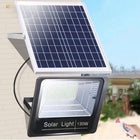
For larger targets or locations where the light head must sit in shade, a separate-panel system is more practical. The Outdoor LED Spotlights With Separate Solar Panel family offers output options from 450 to 1700 lumens, an IP67 rating, remote control, timer settings, and a five-meter cable between the light and panel. That separation allows the spotlight to remain near a shaded tree or wall while the panel is positioned in stronger sunlight.

3. Finish With the Entry and Security Layer
Garage doors, side entrances, gates, and driveways may need substantially more brightness than a path or planting bed. However, maximum output does not need to remain active all night. Motion-triggered modes, dim-to-bright operation, and timers make stronger light available when someone approaches while limiting unnecessary continuous illumination.
Mount a motion-sensor light where a person is likely to move across the sensor's detection field instead of only walking directly toward it. Aim the beam so that it covers the door, handle, nearby ground, and approach route without shining into windows, neighboring properties, or open sky.
For an entrance that also needs a decorative fixture, the Elegant Solar Wall Sconce Light provides up to 1400 lumens, four operating modes, a 180° motion sensor, and warm-white or cool-white options. It is suited to porches, patios, and garage walls where appearance and stronger illumination both matter.

For a compact security zone, the Solar Wall Light With Motion Sensor, 112 LED offers four modes, a 120° sensing angle, a 16–26 ft detection range, a 2200mAh battery, and an IP65 rating. It fits side doors, smaller garage areas, gates, and driveways where motion-controlled lighting is more useful than constant maximum output.

How Bright Should Each Layer Be?
Brightness should follow the function of the zone. Path lights can operate at relatively low output because they are close to the ground. Accent lights need enough intensity to reach the target, but beam concentration is often more important than raw lumens. Entry and security lights can use the highest output, preferably with motion control or a lower standby mode.
| Lighting layer | Primary purpose | Preferred light behavior | Common mistake |
|---|---|---|---|
| Path and circulation | Reveal route edges, steps, and obstacles | Low-level, warm, overlapping pools of light | Using fixtures that are too bright or spaced like a runway |
| Accent and landscape | Create depth and highlight selected features | Adjustable beam, moderate output, visible texture | Lighting every plant equally or aiming directly into the eye |
| Entry and security | Reveal doors, vehicles, movement, and approach routes | Higher output with motion, timer, or dim-to-bright control | Leaving maximum output on all night or creating glare |
More lumens do not always improve visibility. A poorly aimed high-output fixture can create glare, make nearby shadows appear darker, and distract the eye from steps or obstacles. If a bare LED or intense hotspot is visible from normal eye level, lower the aim, reposition the fixture, or reduce the output.
How Should You Coordinate Color Temperature?
Warm white light, generally around 2700K to 3000K, works well for paths, patios, trees, wood, stone, and planting areas because it creates a softer residential appearance. Neutral or cooler white light can improve perceived clarity at garage entrances and selected security zones, but using cool white everywhere can make the yard look flat or overly commercial.
A balanced layout might use warm white for path lights and tree uplights, then reserve a neutral or cool white option for a motion-triggered garage or side-door fixture. Consistency within each zone is usually more important than making every fixture on the property the same color.
How Do Solar Charging Conditions Affect the Layout?
Solar fixtures are independent, but they are not placement-independent. The light head may be in the ideal location while the panel is shaded by the house, fence, tree canopy, or summer foliage.
Before final installation, check the charging location from late morning through the afternoon. A panel that receives direct sun in winter may become shaded when trees leaf out. A spotlight under a dense canopy may need a separate panel connected by cable so the charging surface can remain in an open area.
- Face the panel toward the strongest available daily sunlight.
- Avoid locations where roof runoff, leaves, mulch, or soil repeatedly cover the panel.
- Clean the panel periodically because dust and debris reduce charging efficiency.
- Expect runtime to vary with season, weather, brightness setting, and motion activity.
- Test the fixture for several nights before drilling permanent mounting holes.
Suitable and Unsuitable Use Cases
| Situation | Suitable approach | Less suitable approach |
|---|---|---|
| Curved backyard walkway | Staggered low-output solar path lights | High-output spotlights aimed along the path |
| Large mature tree | Two or three adjustable uplights from different directions | One intense beam placed directly against the trunk |
| Tree located in shade | Separate-panel spotlight with the panel in a sunny area | Integrated-panel fixture placed entirely under the canopy |
| Garage side entrance | Motion-sensor wall light aimed at the door and approach | Decorative path lights used as the only security lighting |
| Patio used for relaxing | Warm, shielded, moderate light | Cool-white security lighting at full output throughout the evening |
Common Layered-Lighting Mistakes
- Starting with the brightest fixture: Powerful security lights can overpower every decorative and path layer.
- Ignoring the view from inside: A fixture that looks acceptable outdoors may create glare through a bedroom or kitchen window.
- Aiming beams into open sky: Light should land on the path, object, wall, or entry it serves.
- Using decorative lights for security: Low-output garden fixtures can guide movement but may not reveal a person, vehicle, or door clearly.
- Placing the panel only for appearance: A visually discreet panel is not useful if it cannot receive adequate sunlight.
- Installing everything permanently on the first night: Solar charging and nighttime beam behavior should be tested under real conditions.
Practical Backyard Lighting Checklist
- Walk every commonly used route after dark and mark steps, turns, gates, and obstacles.
- Select only two or three landscape focal points for accent lighting.
- Identify doors, driveways, and concealed approaches that need controlled security light.
- Assign one clear purpose to each fixture before choosing brightness.
- Check panel sunlight independently from the desired light-head location.
- Use warm light for most residential landscape zones and reserve cooler light for selected tasks.
- Aim fixtures below eye level and away from neighboring windows and open sky.
- Observe the layout from the patio, yard, street, and inside the home.
- Run the system for several nights, then adjust spacing, beam angle, and operating modes.
Explore Relevant Solar Outdoor Lighting
For additional fixtures and installation formats, browse NoxLumin's Outdoor Lights and Solar Energy Lights collections. Choose products by zone and function rather than trying to make one fixture type perform every job.
Frequently Asked Questions
What are the three main layers of backyard lighting?
The three main layers are path and circulation lighting, accent and landscape lighting, and entry or security lighting. Path lights guide movement, accent lights create depth around selected features, and controlled security lights provide stronger illumination at doors, gates, garages, and driveways.
How bright should solar path lights be?
Solar path lights usually need only enough output to reveal walkway edges, changes in elevation, and nearby obstacles. Low-level overlapping pools of light are generally more comfortable and useful than bright fixtures that create glare or a rigid runway effect.
Should backyard solar lights be warm white or cool white?
Warm white light around 2700K to 3000K generally suits paths, patios, trees, wood, stone, and planting areas. Neutral or cool white can be reserved for selected garage, driveway, or security zones where clearer task visibility is more important.
Can a solar spotlight work under a large tree?
A solar spotlight can work under a large tree when its panel receives enough direct sunlight. If the canopy shades the fixture, use a model with a separate solar panel and place the panel in a sunnier location while keeping the light head near the tree.
How do motion-sensor solar lights fit into a layered lighting plan?
Motion-sensor solar lights belong in entry and security zones. They can remain off or at a lower standby level when an area is empty, then provide stronger illumination when someone approaches a garage, side door, gate, or driveway.
Get more NoxLumin guides on Google
Add NoxLumin as a Preferred Source to help Google show you more of our outdoor lighting guides in Search and AI experiences.


Leave a comment