Residential solar lighting scene with pathway lights, wall light and landscape lighting for the Solar Energy Lights collection Residential solar lighting scene with pathway lights, wall light and landscape lighting for the Solar Energy Lights collection
Filter

    How to Choose Solar Lights by Application

    Choose the lighting job first, then match the solar system to the site. Paths need low-level guidance, walls and entrances need functional or sensor-driven light, trees need directional beams, sheds may need a separate outdoor panel, and large yards need wider coverage and higher output.

    Best for Paths and Garden Edges

    For low-profile route marking, the 8-LED Solar Disk Pathway Lights are suited to walkway, deck, and driveway edges where continuous guidance matters more than broad-area brightness.

    Best for Doors and Exterior Walls

    For automatic entrance lighting, the 112 LED Solar Wall Light with Motion Sensor is a practical option for garage doors, entrances, and exterior access points.

    Best for Trees and Landscape Features

    For a focused adjustable beam, the High-Power Solar Tree Light is intended for trees, statues, paths, and landscape features where directional light is more useful than a wide flood pattern.

    Integrated vs Separate Solar Panels

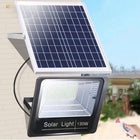
    Integrated-panel lights simplify installation where the fixture itself receives good daylight. Separate-panel systems are better under eaves, inside sheds, on shaded walls, or near tree cover because the panel can be positioned independently. Compare Integrated-Panel Solar Lights and Separate-Panel Solar Lights based on the actual charging location.

    Motion Sensor vs Dusk-to-Dawn vs Timer Control

    Motion sensing is useful when brighter light is mainly needed during activity. Dusk-to-dawn control suits automatic all-night visibility at an appropriate output level. Timer control is useful for patios, sheds, or decorative applications that only need light for a defined period. Check each product because supported modes vary.

    Brightness, Battery, and Solar Exposure

    Lumens, beam distribution, battery capacity, panel size, selected mode, weather, season, and shade all influence real-world performance. Battery capacity should not be treated as a standalone runtime guarantee, and high output is not always desirable near windows, seating, or narrow paths.

    Browse Solar Lights by Project

    For home-focused applications, browse Residential Solar Lights. For entrances and exterior walls, see Solar Wall Lights. For paths and gardens, browse Solar Pathway & Garden Lights. For sheds and detached garages, see Solar Lights for Shed & Garage. For large properties, browse Solar Lights for Large Yards & Driveways.

    FAQ

    • Choose low-output stake or disk lights for paths, wall-mounted motion lights for entrances, adjustable spotlights for trees and landscape features, a split pendant for an interior shed, and higher-output flood or street-style lights for broader visibility. The location, mounting surface, and required beam matter more than battery size alone.
    • A model with a separate solar panel is usually easier to place because the lamp can stay in shade or under cover while the panel sits in direct sun within the supplied cable length. Integrated-panel lights work best where the whole fixture can receive sunlight. Solar is a poor fit if no suitable panel location exists.
    • Choose motion for intermittent security or entry lighting, a timer for a planned evening window, a remote when you need accessible mode changes, and basic dusk-to-dawn operation for automatic decorative or pathway lighting. Available controls differ by product and variant, so confirm the exact model before ordering.
    • Generally no. Flower, mushroom, lantern, fence, disk, and many pathway lights are designed for ambiance, edging, or navigation rather than broad security coverage. For a driveway or large yard, compare higher-output wall, flood, spotlight, or street-style models and plan more than one fixture where shadows or obstacles divide the area.
    • Avoid relying on solar lighting where the panel will remain heavily shaded, where winter sun is consistently insufficient, or where uninterrupted maximum brightness is critical. A hardwired fixture may be more appropriate for permanent primary lighting. Solar performance varies with sunlight, selected mode, temperature, and seasonal conditions.
    • Match the fixture to the task, then compare lumens, battery, panel design, runtime, beam, controls, mounting, and weather rating.
    • Most perform best with about 6–8 hours of direct sunlight. Avoid roof shade, trees, walls, and nearby artificial light.
    • Runtime depends on battery, brightness, mode, weather, season, and motion activity. Use the selected product’s stated runtime.
    • Many use dusk-to-dawn sensors, while some add motion, timers, remotes, or manual controls. Modes vary.
    • Integrated panels simplify installation but require sun at the fixture. Separate panels allow the light to be installed in shade while the panel remains sunny.
    • No. Outdoor ratings vary from IP54 to IP67 or IPX categories. Follow each model’s exposure limit and avoid submersion.
    • Clean panels and lenses, remove shade and snow, inspect seals and connectors, and verify the main switch and operating mode.