


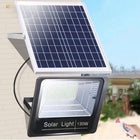


How Bright Should a Solar Security Light Be for a Garage, Driveway, or Side Yard?

Quick Answer: How Bright Should a Solar Security Light Be?
The right solar security light is not automatically the model with the highest lumen rating. Use the lowest output that clearly reveals steps, faces, doors, and vehicle edges. As a practical starting point, 450–900 lumens can suit a compact doorway, 1,100–1,400 lumens a garage entrance or medium side yard, and about 2,000 lumens a broader driveway. These are selection tiers, not building-code requirements: beam shape, mounting height, aiming, sensor behavior, and solar charging matter as much as the lumen number.
Why Lumen Ratings Do Not Tell the Whole Story
Lumens measure total visible light output. The U.S. Department of Energy recommends comparing lumens when evaluating brightness, but a lumen number does not tell you exactly where that light will land. A narrow, well-aimed beam may make a doorway easier to see than a higher-output fixture that spreads light into the sky, neighboring windows, or empty lawn.
Responsible outdoor lighting guidance from the National Park Service and DarkSky International emphasizes using only the light needed, directing it toward the task area, and controlling it with timers or motion sensors. That approach is useful for home security lighting because excessive glare can make the source look bright while reducing visibility in the darker area beyond it.
Light the Task, Not the Entire Property
Replace the vague goal “make the driveway brighter” with a specific task: finding a keyhole, recognizing someone at the garage, seeing a curb while reversing, or monitoring a side gate. A compact entry needs controlled light near the door; a two-car driveway may need broader coverage or two fixtures; a narrow side yard needs careful shielding. Better placement is often more useful than a larger lumen number.
Key Takeaways
- Choose brightness by task area: a doorway, garage apron, driveway, and side yard do not need the same output.
- Beam placement matters: useful light on the ground and entry points is more valuable than uncontrolled brightness.
- Mounting height changes the result: a higher fixture spreads light farther but may require more output to maintain useful illumination below.
- Solar capacity must support the mode: constant-high operation consumes more stored energy than motion-activated operation.
- Motion controls reduce unnecessary light: they can reserve higher output for the moments when people or vehicles enter the detection zone.
- More is not always better: glare, light trespass, and overexposed camera footage can result from excessive or poorly aimed light.
Five Factors That Determine the Right Brightness
1. Size and Shape of the Area
Measure from the mounting wall to the farthest point that must remain visible. Note vehicles, columns, corners, and landscaping that can block the beam. One broad fixture may suit an open garage wall, while two moderate fixtures can reduce shadows around parked vehicles.
2. Mounting Height
As mounting height increases, light generally spreads across a larger area and becomes less concentrated at ground level. One NoxLumin motion-sensor wall-light family provides manufacturer guidance that pairs a 450-lumen version with installation below 2 meters, a 900-lumen version with 2–3 meters, and a 1,100-lumen version with installation above 3 meters. Treat those figures as product-specific guidance, not a rule for every fixture, because optics and beam distribution differ.
3. Beam Direction, Shielding, and Glare

Aim light at the route, door, gate, or vehicle area rather than the sky. Check the result from the approach path and nearby windows. If the LEDs are painfully visible at eye level, lower the angle, add permitted shielding, or select a lower-output mode.
4. Motion Sensor Range and Lighting Mode
Motion-activated bright mode reserves power for detected activity. Dim-to-bright mode maintains orientation light, while constant modes suit longer occupancy but demand more battery capacity. Verify that the sensor covers the actual approach direction.
5. Solar Exposure and Battery Capacity
Shade from eaves, trees, fences, or buildings reduces available energy. A high-output fixture in constant mode can dim early if its panel receives limited sun. In marginal locations, prioritize a larger battery, motion-based operation, or a panel position with reliable exposure.
Practical Brightness Tiers for Residential Areas

| Area | Practical Starting Tier | What to Prioritize | When to Increase Output |
|---|---|---|---|
| Front or side doorway | 450–900 lumens | Controlled beam, facial visibility, low glare | High mounting position, dark wall finishes, or a longer approach |
| Single garage entrance | 900–1,400 lumens | Wide sensor coverage, even light across the apron | Vehicles block the beam or the fixture must cover both door and driveway |
| Narrow side yard or gate | 900–1,400 lumens | Downward aiming, controlled spill, reliable detection | The passage is long or has steps and obstacles |
| Wide driveway or open yard edge | Around 2,000 lumens or multiple fixtures | Coverage uniformity, remote adjustment, battery capacity | One fixture leaves dark zones behind vehicles or landscaping |
These ranges are practical comparison points rather than mandatory standards. Test the lowest suitable mode first, then increase output only if the actual task area remains difficult to see.
How NoxLumin Solar Security Light Options Compare
| Option | Store Data | Control and Detection | Best-Fit Scenario |
|---|---|---|---|
| Outdoor Solar LED Wall Light | 450, 900, or 1,100 lumens; 1,500mAh, 3,000mAh, or 6,000mAh battery by version | Five modes; approximately 5–10 m sensing distance and more than 180° sensing angle | Choosing output by mounting height for a doorway, garage entrance, patio, or side wall |
| Elegant Solar Wall Sconce | 1,400 lumens; 6,000mAh battery; 5V 6W solar panel | Four modes; approximately 5–10 m and 180° motion detection | A garage, porch, or courtyard needing security light with a more architectural wall-sconce form |
| Solar Outdoor Waterproof Motion Sensor Light | 2,200mAh normal-bright or 6,600mAh high-bright configuration; 26 × 12.5 × 12 cm and 28 × 13 × 12.5 cm versions. | Motion sensor, remote control, dimming, and selectable 3000K, 4000K, or 6000K color temperature | Wall, gate, fence, entry, address-sign, or patio lighting where adjustable brightness and color temperature are useful; verify actual coverage after installation |
| 108 COB Solar Sensor Street Lamp | 108 COB light source, IP65 protection, and polycrystalline solar panel. | Remote control, microwave human-body detection, and three lighting modes | Garden paths, patios, side entrances, sheds, or utility areas where remote adjustment and motion-based operation are preferred |
| 112 LED Solar Wall Security Light | 112 LEDs, 2,200mAh battery, 1.5W 5V monocrystalline panel, IP65 rating, 4–6 hour charging time, and 8–12 hour stated working time. | Four modes; 120° PIR sensing with an approximately 5–8 m range; 3000K or 6500K versions | Entryways, garage walls, side passages, fences, and smaller driveways where defined sensor coverage and selectable color temperature matter |
Outdoor Solar LED Wall Light


Suitable and Unsuitable Use Cases
| Suitable | Why It Works | Less Suitable | Why to Reconsider |
|---|---|---|---|
| Garage entrances with direct sun exposure | Wall mounting, motion activation, and clear approach paths support reliable use | Deeply shaded walls under trees or roof overhangs | The integrated panel may not receive enough charging light |
| Side gates and narrow passages | Targeted motion light can reveal steps, locks, and obstacles | Locations facing a close neighboring window | High output or poor aiming may create light trespass |
| Driveway edges and garage aprons | Medium-to-high output can improve vehicle and pedestrian visibility | Large parking areas requiring uniform, code-designed illumination | Residential wall lights may not provide sufficient distribution or documented photometrics |
Common Mistakes to Avoid
- Buying by lumen rating alone: ignoring beam pattern, height, and sensor direction can leave important areas dark.
- Pointing the fixture outward at eye level: this creates glare and may reduce useful visibility.
- Mounting the solar panel in shade: high output is irrelevant if the battery cannot recharge adequately.
- Using constant-high mode by default: the light may exhaust stored energy before morning, especially in winter or cloudy periods.
- Expecting one fixture to cover around vehicles: cars, columns, and shrubs create shadows; two lower-output lights may be more effective.
- Skipping a nighttime test: evaluate the installation from the driveway, doorway, sidewalk, and property line.
Residential Solar Security Light Checklist
- Define the exact task: door access, facial recognition, walking safety, vehicle maneuvering, or perimeter awareness.
- Measure mounting height and the farthest point that needs useful light.
- Check direct-sun exposure at the panel location across the day.
- Choose the lowest practical lumen tier and verify the beam shape.
- Confirm motion range, approach angle, and operating mode.
- Aim downward and keep direct LED glare out of normal sightlines.
- Test for shadows behind vehicles, posts, and landscaping.
- Check neighboring windows and reassess after several cloudy days.
Recommended NoxLumin Options
For a compact entrance, the Outdoor Solar LED Wall Light with Motion Sensor offers confirmed 450-, 900-, and 1,100-lumen configurations with matching battery tiers. For a medium garage entrance or porch, the Elegant 1,400-Lumen Solar Wall Sconce uses a 6,000mAh battery, 5V 6W panel, four modes, and wide motion detection. For adjustable wall, gate, address-sign, or patio lighting, the Solar Outdoor Waterproof Motion Sensor Light offers 2,200mAh normal-bright and 6,600mAh high-bright configurations, remote dimming, and selectable 3000K, 4000K, or 6000K color temperature. The 108 COB Solar Sensor Street Lamp is an IP65 option with remote control, microwave motion detection, a polycrystalline solar panel, and three modes. For a smaller wall, entry, garage, or side-passage installation, the 112 LED Solar Wall Security Light provides a 2,200mAh battery, 1.5W 5V monocrystalline panel, four modes, 120° PIR sensing over approximately 5–8 m, and warm-white or cool-white variants. Compare additional options in the Solar Flood & Security Lights collection.
After selecting a fixture, use the separate guide on solar motion sensor wall-light mounting height to refine installation, and review whether solar motion lights should stay on all night before choosing a constant mode.
FAQ
How many lumens are good for a solar security light?
Is 2,000 lumens too bright for a house?
Does a higher mounting position require more lumens?
Are motion-activated solar lights better than dusk-to-dawn lights for security?
Is warm white or cool white better for an outdoor security light?
Do solar security lights work in winter or cloudy weather?
Is one bright security light better than several smaller lights?
Sources
Get more NoxLumin guides on Google
Add NoxLumin as a Preferred Source to help Google show you more of our outdoor lighting guides in Search and AI experiences.


Leave a comment