




Best Outdoor Lighting for Commercial Areas: A Zone-by-Zone Guide

Best Outdoor Lighting for Commercial Areas: A Zone-by-Zone Guide
Commercial outdoor lighting should not begin with one question such as “What is the brightest light available?” A retail entrance, warehouse service yard, hotel walkway, restaurant patio and building facade all perform different jobs after dark. They therefore need different types of light.
The better approach is to divide the property into zones, decide what each zone needs people to see, and then choose the fixture, output, mounting method and controls that fit that job.
This guide compares several current NoxLumin outdoor lighting options for commercial properties, including high-output solar flood lights, hardwired architectural wall lights, bollard lights and continuous solar COB lighting.
Quick answer: Use high-output flood lighting for genuinely large open areas, wall-mounted architectural lighting around entrances and facades, bollards for route definition beside walkways, and continuous rope lighting for decorative edges, patios and hospitality spaces. Do not expect one fixture type to perform all four jobs well.
Start With the Commercial Zone, Not the Fixture
A commercial property often includes several different nighttime environments within the same site.
| Commercial zone | Primary lighting need | Better starting point |
|---|---|---|
| Large parking, service or open yard area | Broad functional illumination | High-output solar flood light |
| Building entrance or exterior facade | Defined architectural and entrance lighting | Hardwired LED wall light |
| Walkway, courtyard or landscaped approach | Low-level route definition | Surface-mounted bollard light |
| Restaurant patio, pergola or hospitality edge | Continuous decorative boundary lighting | Solar COB rope light |
| Large zone without convenient electrical trenching | Off-grid high-output lighting | Commercial solar area light |
This zone-based approach also reduces a common problem in commercial lighting: using too much light in one location simply because a high-output fixture is available.
More lumens do not automatically create better visibility. Mounting height, aiming, glare, nearby reflective surfaces and how long the fixture stays at full output all affect the result. For large commercial projects, a photometric plan or professional lighting review may be appropriate before fixtures are specified.
1. Large Open Areas: Commercial Dual-Panel Solar Flood Light

Large outdoor zones create the strongest case for a high-output fixture. Examples include warehouse service yards, vehicle areas, larger business courtyards, rural commercial properties and defined outdoor work or access zones.
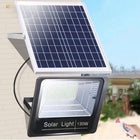
The current NoxLumin Commercial Dual-Panel Solar Flood Light is listed at 8,000 lumens and uses a 25,000mAh battery with two 35 × 35 cm solar panels. It supports wall or pole mounting and provides automatic dusk-to-dawn and controllable operating options.


The separate dual-panel arrangement matters on commercial properties because the best place to illuminate an area is not always the best place to collect sunlight. The lighting fixture can be positioned for the target zone while the solar panels are planned around available daytime exposure.
Where it makes the most sense
This type of fixture is better reserved for a genuinely large zone. It can be considered for broad exterior areas where lower-output wall or landscape lighting would require too many individual fixtures or would not provide the intended coverage.
That does not mean the light should simply be mounted as high as possible and operated at maximum output all night. High-output fixtures benefit from deliberate aiming and control. Keep the useful light within the intended property area and avoid directing the brightest part of the beam toward neighboring buildings, windows or driver sightlines.
Check before choosing it
Confirm that there is enough unobstructed daytime exposure for both panels, enough mounting structure for the lamp and panels, and enough physical space to orient the system correctly. Large solar lighting systems require more installation planning than small residential wall lights.
2. Large Areas With a Simpler Integrated Design: 6,000-Lumen Commercial Solar Light
Not every large commercial area needs a separate dual-panel system.
The 720LED Commercial Solar Lighting model provides a listed 6,000-lumen output, 6,800mAh battery, integrated solar panel, remote control and multiple operating modes.


Its integrated design reduces the number of separately positioned components. That can simplify installation when the same mounting location works well for both nighttime illumination and daytime solar exposure.
This makes it a useful alternative for business yards, larger access areas or other open outdoor sections where electrical wiring is inconvenient but a dedicated high-output zone is still needed.
Integrated versus separate solar panels
The decision should not be based only on appearance.
An integrated fixture is simpler when the mounting position faces useful sunlight during the day and also provides the correct nighttime beam direction. A separate-panel product provides more flexibility when the lighting target is shaded, under an overhang or facing a direction that is poor for charging.
For commercial properties, checking this relationship before installation is important because buildings, signage, mature landscaping and nearby structures can create significant shade.
3. Building Entrances and Facades: Hardwired Long LED Wall Light

Commercial lighting is not limited to solar flood lights. Where reliable mains power is already available, a hardwired fixture can be the more appropriate permanent solution.
The NoxLumin Long Outdoor LED Wall Light is designed for exterior wall installation and is available in lengths from 30 cm to 240 cm. Current configurations range from 540 lumens to 5,400 lumens based on the selected size.


It operates on AC 85–265 V and is available in fixed 3000K, 4000K or 6000K versions, as well as a remote-dimmable 3000–6000K option. The housing is rated IP65 for normal exterior exposure when installed correctly.
Good commercial placements
This type of linear fixture is particularly useful when the wall itself is part of the visual design. Examples include office entrances, restaurants, hotels, retail facades, exterior corridors and modern commercial buildings where an architectural fixture is preferable to a conventional flood light.
A long wall light can help define an entrance and add vertical illumination without turning the entire surrounding property into one bright zone.
Choose size for the wall, not just maximum output
A 240 cm fixture may be appropriate for a large architectural wall, while a much shorter model can be more proportional around a doorway or narrow facade section.
Select the fixture length according to wall scale, mounting height, required output and surrounding architecture rather than assuming the largest version is automatically better.
Because this is a mains-powered fixture, installation should be completed according to applicable local electrical requirements. Commercial or public projects may also have additional certification, accessibility, emergency-lighting or lighting-code requirements that must be checked separately.
4. Commercial Walkways and Courtyards: Hardwired LED Bollard Lights

Pedestrian routes create a different lighting problem from open yards.
A walkway usually does not need thousands of lumens from a high wall-mounted flood light simply to show where the route continues. Low-positioned lighting beside the path can provide a more controlled visual structure.
The NoxLumin Hardwired Outdoor LED Bollard Light uses the same listed 7W input across its current 40 cm, 60 cm and 80 cm height options. It operates on AC 85–265 V and uses a die-cast aluminum body with an IP65 rating.


The light is directed downward and is better suited to path guidance, landscape edges, courtyards, gates and entrance approaches than to broad high-output area lighting.
Where bollards work well commercially
Potential applications include hotel approaches, apartment-complex landscaping, restaurant walkways, office courtyards, campus-style paths and landscaped routes between buildings.
Install bollards beside the walking surface rather than directly in the circulation line. The base requires a stable surface and should not be placed where it creates an obstacle for pedestrians or vehicles.
The three fixture heights provide different visual proportions, but the taller model should not be interpreted as a higher-output model. All current variants use the same listed 7W input.
Important limitation
These bollards should be treated as decorative and pathway-guidance fixtures. Do not assume they are sufficient as the sole source of code-required stair, egress, task or emergency lighting. Those functions should be evaluated against the actual site requirements.
5. Restaurant Patios, Pergolas and Hospitality Areas: Solar COB Rope Lights

Restaurants, hotels, event spaces and hospitality properties often have another type of lighting problem: they need to define the shape of an outdoor space rather than flood it with overhead light.
The NoxLumin Solar COB Rope Light uses 320 COB LEDs per meter and is available in illuminated lengths from 16.4 ft to 164 ft. The system uses a separate solar panel and offers White or Warm White light with 5-hour, 8-hour and 10-hour timer settings.


This makes it useful for continuous visual elements such as pergolas, patio boundaries, railings, gentle landscape curves and architectural edges.
Why continuous lighting is different
A flood light creates an illuminated area. A bollard creates a series of low points of light. A rope light creates a line.
That line can help visually organize a restaurant patio or hospitality space without requiring every section to be illuminated from above.
Warm White is generally the more natural starting point when the goal is atmosphere around dining or hospitality spaces, while White provides a crisper edge appearance.
The rope lighting should still be treated as accent and boundary lighting rather than as a substitute for required stair, exit, task or emergency illumination.
Solar or Hardwired: Which Is Better for a Commercial Property?
Neither power source is automatically better.
| Consider solar lighting when | Consider hardwired lighting when |
|---|---|
| Running new cable or trenching is difficult | Mains power is already available nearby |
| The installation location receives usable sunlight | The location is heavily shaded |
| Independent or remote outdoor zones need lighting | Consistent permanent operation is the priority |
| Motion, timers or dusk-to-dawn controls fit the task | Lighting must integrate with building electrical controls |
| A separate solar panel can solve a shaded fixture location | The project requires a fixed electrical installation |
Many commercial properties will benefit from using both systems rather than forcing the entire site onto one power source.
A building entrance may make sense as a hardwired architectural-lighting zone, while a distant yard or landscape feature can use solar lighting to avoid running another electrical circuit across the property.
Do Not Design Commercial Lighting by Lumens Alone
Lumen output is useful, but it is only one part of outdoor lighting.
A commercial lighting plan should also consider mounting height, beam direction, glare, neighboring properties, operating schedule, color temperature, available sunlight and whether people are walking, driving, dining or working in the illuminated area.
Use the lowest practical output that solves the actual problem, keep the beam directed toward the intended zone, and use timers, dimming or motion-related controls where continuous full output is unnecessary.
This is especially important when moving into high-output 6,000- or 8,000-lumen fixtures. A well-controlled high-output light can solve a large-area problem. The same fixture aimed poorly can simply create glare and spill light.
A Practical Commercial Lighting Combination
A medium-size commercial property does not need to choose one winner from these products.
A more realistic plan might use a high-output solar flood light for a remote service yard, hardwired linear wall lights around the primary building entrance, bollards beside the landscaped approach and warm-white rope lighting around a restaurant or hospitality patio.
Each fixture then performs one clearly defined job.
That is usually a stronger lighting strategy than trying to make one extremely bright fixture illuminate the entire property.
To compare additional off-grid products, browse Commercial Solar Lights. For permanent mains-powered exterior fixtures, see Hardwired Outdoor Lighting.
Commercial Outdoor Lighting Checklist
- Define the purpose of each outdoor zone before selecting a fixture.
- Use high-output flood lights only where a genuinely large area requires them.
- Check solar exposure before choosing an integrated solar fixture.
- Use separate-panel designs when the ideal lighting position and solar position differ.
- Use wall lights where the building facade or entrance itself needs illumination.
- Keep bollards beside pedestrian routes rather than inside the walking or driving line.
- Use rope lighting primarily for continuous decorative edges and hospitality spaces.
- Control glare and keep light within the intended property area.
- Use timers, dimming or motion-related controls where full output is not required continuously.
- Verify applicable electrical, building, accessibility and outdoor-lighting requirements for commercial installations.
Bottom Line
The best commercial outdoor light depends on the zone.
Large open areas may justify a 6,000- or 8,000-lumen solar lighting system. Building entrances and facades can benefit from permanent hardwired architectural wall lights. Walkways and landscaped approaches call for lower, more controlled fixtures such as bollards. Restaurant patios and hospitality spaces can use continuous COB lighting to define architectural and landscape edges.
Instead of asking which light is the most powerful, ask what the people using that particular part of the property need to see after dark.
Once that question is clear, choosing the right fixture becomes much easier.
Frequently Asked Questions
What type of outdoor lighting is best for commercial properties?
Are solar lights suitable for commercial areas?
When should a business choose hardwired outdoor lighting instead of solar?
How many lumens does a commercial outdoor light need?
Can bollard lights be used along commercial walkways?
What type of lighting works well for restaurant patios and hotel outdoor areas?
Do outdoor lights used on commercial properties automatically meet commercial building codes?
Get more NoxLumin guides on Google
Add NoxLumin as a Preferred Source to help Google show you more of our outdoor lighting guides in Search and AI experiences.


Leave a comment