Residential solar lights illuminating a modern home exterior, garden path and trees at dusk Residential solar lights illuminating a modern home exterior, garden path and trees at dusk
Filter

    How to Plan Residential Solar Lighting

    Plan a home as several lighting zones instead of choosing one solar fixture for every location. Pathways need guidance, entrances need functional visibility, trees and planting beds need directional or accent light, and driveways may need brighter security-focused coverage.

    Best for Paths and Garden Edges

    For low-profile route marking, the 8-LED Solar Disk Pathway Lights can define walkway and driveway edges without adding tall fixtures. Use brighter or raised lights at steps, gates, and other higher-risk transitions.

    Best for Doors and Garage Approaches

    For automatic entrance lighting, the 112 LED Solar Wall Light with Motion Sensor is suited to doors, garage areas, and access points where brighter light is mainly needed during activity.

    Best for Trees and Landscape Features

    For directional landscape lighting, the High-Power Solar Tree Light can focus light on trunks, canopies, statues, paths, and garden features. Aim the beam to emphasize the target without sending glare toward windows or neighboring properties.

    Functional, Security, and Decorative Lighting Layers

    Functional lighting helps people navigate paths, steps, and entrances. Security lighting adds stronger or motion-triggered visibility at garages, side yards, and approaches. Decorative lighting adds lower-level ambience around gardens, fences, patios, and seating areas. A balanced property can use all three rather than forcing one brightness level everywhere.

    Integrated vs Separate Solar Panels

    Use integrated-panel fixtures where the lamp position also receives useful sun. Use separate-panel systems under covered porches, inside sheds, on shaded walls, or near dense trees where the charging position needs to move independently. Panel exposure should be considered before permanent mounting.

    Key Buying Factors for Home Solar Lights

    Compare application and beam pattern first, then brightness, mounting height, sensor or timer behavior, battery capacity, panel configuration, fixture dimensions, weather rating, and daytime shade. Runtime depends on the complete energy system and operating mode, not battery size alone.

    Shop Residential Solar Lights by Zone

    For walkways and planting beds, browse Solar Pathway & Garden Lights. For entrances and exterior walls, see Solar Wall Lights. For outdoor living areas, browse Solar Porch & Patio Lights. For boundaries and railings, see Solar Fence, Deck & Railing Lights. For outbuildings, browse Solar Lights for Shed & Garage.

    FAQ

    • Use a brighter motion wall light at the entrance, repeated low-output fixtures along paths, warm or color-changing accents around the patio, and a spotlight or flood light for selected backyard features. Plan each zone by task, then confirm that every panel location receives useful sun.
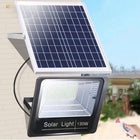
    • Separate-panel spotlights, pendants, or selected flood lights provide the most placement flexibility because the lamp can remain under cover while the panel moves into sun. Integrated wall and decorative fixtures need adequate exposure at the mounting point. Measure cable routes before choosing a split design.
    • Use the brightest fixtures only at entrances, driveway approaches, or larger task zones. Keep pathway and decorative lights lower, aim beams downward or at intended features, and avoid shining into bedrooms or neighboring properties. Warm light and motion activation can reduce visual impact in close residential settings.
    • Choose a pack when the goal is a repeated edge, path, fence, or garden pattern. Choose a higher-output wall, spotlight, or flood model for a defined visibility zone. Many homes benefit from both: repeated low lights for orientation and one brighter fixture where people enter or work.
    • Ground stakes, portable lanterns, and some no-wire solar fixtures can be easier to relocate than hardwired products, but wall-mounted models may still require holes or landlord approval. Choose removable placement where possible, protect panels from shade, and verify mounting requirements before altering exterior surfaces.
    • Use pathway lights for navigation, decorative lights for ambiance, wall lights for entrances, spotlights for trees, and motion or flood lights for security.
    • Aim for about 6–8 hours of direct sunlight. Separate panels are useful when the fixture location is shaded.
    • Plan by zones—entry, driveway, steps, path, patio, fence, and landscape—and overlap safety lighting where dark gaps are hazardous.
    • Runtime depends on battery size, brightness, mode, motion activity, season, and weather. Product-specific runtime is the best guide.
    • Warm white is welcoming, neutral white balances comfort and visibility, cool white improves contrast, and RGB or flame effects are decorative.
    • Many are outdoor-rated, but IP ratings and materials differ. Keep them above standing water and clear panels of snow and debris.
    • Clean panels and lenses, trim plants, inspect mounts and seals, test sensors, and reposition panels as seasonal sun angles change.