




Can You Wrap an Outdoor Tree Trunk with Solar Rope Lights?

Yes. A solar rope light works well as a temporary, loose spiral around a sturdy outdoor tree trunk. The spiral can continue onto a sturdy main branch you can reach, following its curve in broad turns. For little points of light scattered among fine branches, choose mini string lights instead. The easiest way to tell whether a rope will suit your tree is to stand where you’ll see it at night: can you see an uninterrupted stretch of trunk, and is there a sunny place nearby for the panel?
What do you want the tree to look like after dark?
Picture a bare maple beside a front porch. In daylight, its trunk and branches read as one shape. At night, a lit spiral draws your eye around the trunk; the bark between the turns stays dark. A string of tiny bulbs does something different: you see the individual points first, especially where the wire disappears against the bark. A spotlight does a third job. It lets you see the ridges and shadows in the bark itself.
| The view you want | What to choose | What to look for on your tree |
|---|---|---|
| A clean spiral visible from the front walk | A continuous COB rope light | A sturdy trunk or low main branch with room for gradual turns |
| Pinpoints tracing a fork or dotted through branches | Outdoor mini string lights | A branch pattern worth following, with the display within easy reach for removal |
| Natural bark or a canopy that stands out against the sky | A ground-mounted spotlight | A clear line of sight from the ground to the feature you want to see |
If a shrub hides the bottom half of the trunk from your porch, winding extra rope behind it won’t improve that view. Pick the stretch above the shrub that you can reach comfortably, or choose a different tree. If what caught your eye was the bark itself, this guide to lighting the trunk versus the canopy shows what changing the aim of a spotlight can do.
Try the spiral from the porch before you buy it
Use a length of pale cord as a daytime stand-in for the light. Have someone hold the ends while you lay a few loose turns around the trunk. Step back to the porch or front window. If the turns crowd together from there, open the spacing until there’s a distinct band of bark between them. A pattern that looks a little sparse at arm’s length can be just right from across the yard.

At the first fork, try carrying the cord onto a low main branch instead of stopping at the trunk. Follow the limb you can see from the porch and let the turn open up at the junction. For the two-branch look in the cover photo, plan one lighted run per main branch. Start both measuring cords at the Y-splitter and follow each route all the way to its last turn, including the distance to the trunk. A single strip cannot split at the fork. Leave fine twigs and fresh shoots bare, and keep both ends within reach for removal.
For a sense of scale, imagine a trunk about 3 ft (0.91 m) around and a visible section 4 ft (1.22 m) high. A turn rising 6 in (15 cm) gives roughly eight turns and a lighted route a little over 24 ft (7.3 m). Open the rise to 8 in (20 cm) and you get about six turns and a little over 18 ft (5.5 m). Those are two looks for the same tree, not recommended spacing for every trunk. Bark and taper change the real route. Mark the cord where the display should end, take it down, and measure it on the ground.
One trunk and a pair of trees are different purchases
One tree by the front walk. Suppose your cord measures about 24 ft (7.3 m). In the NoxLumin kit, a 16.4 ft (5 m) lighted run falls short; a 32.8 ft (10 m) single run gives you room. Before you order the longer size, plan where the extra lit length would go. You might prefer a slightly closer spiral or a different stopping point. If the shorter layout looks better, change the layout on purpose instead of bunching extra turns at the bottom.
Two trees in the same planting bed. Start both measuring cords at the proposed splitter. Follow each route across the bed, around its trunk and out to the last turn on a main branch. Suppose the routes measure 46 ft (14.0 m) and 48 ft (14.6 m). Each fits a 49.2 ft (15 m) run. That leaves about 3.2 ft (1.0 m) on the first run and 1.2 ft (0.4 m) on the second. Try extending each cord a little farther along sturdy wood, or bring the turns slightly closer together while keeping each loop loose. Over the same trunk height, wider spacing uses less rope. Spare length on one side cannot make the other side longer.
The NoxLumin warm white 98.4 ft (30 m) solar COB rope light kit has two equal 49.2 ft (15 m) lighted runs. A Y-splitter connects them to one panel, so both trees light on the same schedule. The selected kit has a separate 32.8 ft (10 m) unlit cable: this reaches from the panel to the split and does not count toward either wrap. For a single uninterrupted spiral, use the single-run and split-run sizing guide to choose the right length.


Give the panel its own spot in the yard
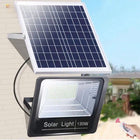
The most attractive tree and the best charging spot may be several yards apart. Walk the proposed cable route in daylight. On a front lawn, the open side of the planting bed may get sun while the trunk sits in the shadow of the house. Choose firm, level ground and unfold the rear bracket. Rest both the lower edge of the panel frame and the foot of the bracket on the ground; from the side they form a triangle. Check the spot again later in the day for shade from the fence.

The unlit cable runs from the power unit to the start of the lighting; it lets you move the panel without adding a glowing line across the bed. Choose a route that stays off the walkway and clear of standing water. From the window, check that you’ll see the lit trunk where you want it, rather than a bright line crossing the lawn on its way there. The kit comes on after dark; its five-hour timer is a useful choice if you mainly enjoy the tree over dinner and into the evening. Actual running time depends on the charge available.
Leave the tree as you found it
Treat the lights as seasonal decorations. Let the turns rest loosely, avoid nails and staples in the bark, and leave tender shoots and buds alone. The Morton Arboretum’s Plant Clinic explains that wires left around growing wood can cut into the tissue beneath the bark. If a turn needs support, tie it loosely with a strip of soft fabric. Avoid plastic zip ties and wire twist ties, which can rub the bark as the branch moves. Set a removal date when you put the display up. When it comes down, unwind the rope turn by turn instead of pulling the whole spiral over the first fork.
Frequently asked questions
What kind of solar light makes a solid spiral on a tree trunk?
Can I wrap two tree trunks with one solar rope light kit?
Does a 98.4 ft (30 m) NoxLumin kit come as one long rope?
Does the solar panel have to sit at the foot of the tree?
Can I wrap the main branches as well as the trunk?
Will the wrap look good from both the street and the house?
Can I leave rope lights wrapped around a living tree all year?
Get more NoxLumin guides on Google
Add NoxLumin as a Preferred Source to help Google show you more of our outdoor lighting guides in Search and AI experiences.


Leave a comment