


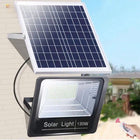


Where to Put a Pole-Mounted Solar Flood Light: Five Site Layouts

Put a pole-mounted solar flood light where someone stops or changes direction after dark: the first steps from a parking bay, the latch at a farm gate, an equipment return point, an RV key drop, or a driver check-in spot. A new pole makes sense when it can light that spot with the site in normal use. If the light only reaches the walk when the last parking space is empty, it’s in the wrong place.
The five layouts below pair one NoxLumin Dual Panel commercial solar flood light with a separately sold 20 ft (6 m nominal) galvanized steel pole. Each layout illustrates a placement choice. Start by standing where the visitor stands, then look back toward the proposed light. On a second visit in daylight, look at the same site from the panel’s point of view: the best angle for lighting somebody’s next step can still be a poor spot for charging.
1. The last parking bay, where the walk begins
Stand beside the passenger door of a car in the end space of a small office lot. The building entrance may be easy to see, yet the turn onto the sidewalk disappears behind the car. That turn is a better target for one light than the center of the asphalt. Put the pole on the outer verge, clear of vehicles and the walk, and aim inward across the pavement transition.

Now look from two places: beside the parked car and from the seat of an arriving driver. Can the passenger pick out the first stretch of sidewalk? Does the driver see the route, or mainly the bright face of the lamp? If a taller vehicle hides the turn, try the walk side of the space before choosing a higher output. The vehicle will still cast a shadow; the point is to leave that shadow somewhere people aren’t stepping.
If the brief is to light every bay and walking aisle, use a site lighting plan. The U.S. Department of Energy’s parking lot lighting guide explains why distribution and uniformity matter along with total light output.
2. A rural vehicle gate, on the latch side
At a freestanding farm gate, decide which side a person uses to open it. Someone getting out of a truck needs to find the latch and see where to put a foot on the gravel. Someone using a keypad needs light on its face; bright gravel below a keypad can leave every button in shadow. At dusk, park clear of the gate, switch off the headlights, then walk to the latch from each side.

Look for a position on the fixed verge, clear of the gate’s full swing and the turn a trailer makes through it. Aim back toward the stopping point, away from the approaching driver’s eyes. Leave the pasture beyond the gate dark. If a keypad on an existing post is the only thing anyone struggles to see, a small local light may do the job without a new pole or foundation.
3. The equipment return point between two sheds
A tractor and its implement are back before sunset. Once the tractor is parked and shut down, stand at the shed door and look for the marked equipment return spot. Can you see both the marker and the gravel leading to it? A lamp above the door may light an empty yard yet leave that spot in the tractor’s shadow.

Walk the route after the equipment is parked and shut down. Mark the patch where the two people meet and the side from which they approach the implement. A pole at the fixed edge of the yard can light that patch from the side, without sitting in the path of a tractor turning with an attachment. If the usual parking position still puts a wheel or a trailer between the lamp and the handoff, move the handoff point before committing to concrete. This layout is for finding and returning equipment; inspecting a hitch or repairing machinery calls for light directly on the work.
4. The after-hours key drop at an RV storage yard
The useful stretch of an RV return route is often only a few steps long: out of the cab, across the pedestrian strip, and up to the key slot. Stand at the box and hold an envelope the way a customer would. If your body casts a shadow over the slot, light coming from directly behind you is missing the job. A position to one side can light the box face and the place where you stand.

Check the layout with the tallest motorhome in its normal space. Keep the box and walk on the lamp side of the vehicle; a lamp on the other side may light the RV roof beautifully while leaving the customer in the dark. Also check whether that parked row shades the solar panels by day. Where the box sits against an office wall with a clear view of the walk, a wall mount is a simpler choice. A well-lit return point tells you nothing about visibility behind a reversing RV.
5. The driver check-in point outside a small warehouse
An arriving driver may know which warehouse they want and still be unsure where to go after leaving the cab. Follow those first few steps yourself. Is the check-in point recognizable before you reach the truck lane? Can you see where to wait without walking up to an active dock? A protected pedestrian area gives the light a specific job: show the check-in pedestal, the curb and the beginning of the route to reception.

Consider a freestanding pole when a docked trailer blocks the warehouse wall light or when pickup takes place at the outer edge of the yard. Site it on the waiting-area side of the barrier and point it inward. Judge the result with a trailer docked. If people still have to cross a loading maneuver to find the light, move the waiting point or change the route. Raising the lamp won’t separate foot traffic from freight. For a project that also includes the loading face, use the commercial lighting guide by zone to plan that work separately.
What to check before you order the light and pole
Check sunlight and obstacles separately. The Dual Panel flood light calls for at least eight hours of direct sun per day. Check the proposed panel position during the season with shorter days, with vehicles parked and nearby trees in mind. At night, check the path from the downward-facing lamp to the target. A sunny piece of ground behind a shed may pass the first check and fail the second.


Will solar lighting work at a remote gate or equipment yard? At a gate without utility power, start with a practical question: can the entrance go without this light while the battery recharges? The Dual Panel model’s 42 Ah rating doesn’t tell you how many cloudy nights it will cover. After prolonged cloudy weather, the product guide recommends switching the light off and recharging it in sunlight for two days. Choose a pole location a maintenance crew can reach to clean the panels. If people still need to see the latch during that recharge, plan a separate light source for those nights.
Check the attachment and the foundation. The 20 ft pole has a 2.99 in (76 mm) top outside diameter, within the light’s 1.97–3.94 in (50–100 mm) clamp range. The 4.49 in (114 mm) base is outside that range. For motion sensing, NoxLumin specifies a light-head height of 15–30 ft (4.6–9.1 m) above ground. The pole needs a concrete footing and anchor cage; have the installer verify the foundation and the combined fixture and panel load for local wind conditions. If there’s a pole already on site, start with the existing-pole checklist.


Choose the light level for the people nearby. Both versions use one daylight-white 6500 K head, with up to 4,050 lumens and a 100° beam. Dual Panel gives you 50 W of rated panel power and a 42 Ah battery; Single Panel has 35 W and 30 Ah. The larger version adds charging and storage capacity, not a brighter head. Use the lowest brightness that lets people see their next step. Dimming this 6500 K head won’t make its light warmer. If the site calls for warm light, especially near homes or sleeping areas, choose a fixture with a lower color temperature. The DarkSky and IES outdoor lighting principles are a useful guide to limiting spill and keeping light where it’s needed.
Frequently asked questions
Can I put two lights on the pole because the fixture has two solar panels?
Can the motion setting keep the area completely dark between visitors?
Does dusk-to-dawn operation mean full brightness until morning?
What happens when a three-, five- or eight-hour timer ends?
Can the first charge tell me whether a shaded location will work?
How many parking spaces will one 4,050-lumen head cover?
Do I need to order a pole if there is a suitable wall nearby?
Get more NoxLumin guides on Google
Add NoxLumin as a Preferred Source to help Google show you more of our outdoor lighting guides in Search and AI experiences.


Leave a comment