




How Tall Should a Solar Light Pole Be? Comparing 13, 16 and 20 ft

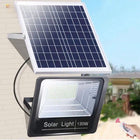
For the NoxLumin commercial solar flood light in radar mode, start by comparing the 16 ft (5 m) and 20 ft (6 m) poles. The light head needs to sit 15–30 ft (4.6–9.1 m) above finished ground. A 13 ft (4 m) pole with its base at ground level and its head at or below the top falls short. For a different solar fixture, start with its own mounting instructions. In either case, measure to the head, not to the top of the pole.
How tall should the light be at your entrance?
Picture a side entrance to a workshop. A delivery driver has to see where the pavement turns, and someone walking back from the parking area has to see the step at the door. Stand at each approach and pick out the spot that disappears after dark. If the step is under an awning, raising a pole across the drive may leave the step in shadow at every height you consider. If the problem is the turn itself, a pole beside the turn gives you a useful location to evaluate.
Give your installer a photo taken from the approach, along with the mounting instructions for the exact light. Even within the recommended height range, a parked van can block the sensor’s view of someone walking toward the door.
13, 16 or 20 ft: what changes between the pole kits?
The three sizes below are the product's nominal height labels. Each kit builds one fixed-height pole from interlocking steel sections. Read the table from the fixture requirement back to the pole size. If your fixture needs a lower mounting point, buying the tallest kit first can leave you trying to attach a bracket to the wrong part of the shaft.
| Nominal pole height | What comes in that size | What that means at the site |
|---|---|---|
| 13 ft (4 m) | Four sections; 11.81 in (300 mm) anchor cage. | Consider this height for a solar fixture designed for a lower mount. With the base at grade and a head at or below the pole top, it falls below the example flood light’s motion-mode range. |
| 16 ft (5 m) | Five sections; 15.75 in (400 mm) anchor cage. | Close to the lower end of the example range. Check the actual head elevation on a side-view drawing; a side-mounted arm can put it below the minimum. |
| 20 ft (6 m) | Six sections; 15.75 in (400 mm) anchor cage. | A candidate when the head needs to sit higher on a freestanding support. Confirm the bracket location and the view of the target before committing to the base position. |


For a new installation that calls for the tallest of these sizes, see the 20 ft (6 m) NoxLumin galvanized steel pole kit. Its six pieces include a flanged bottom section, four middle sections and one top section. The individual lengths are 3.28 ft (1 m), useful when the route from the delivery point includes a turn through a side gate. The sections overlap at their joints. Use the specified assembled size when planning the height, and the individual lengths when planning how to carry the kit to the site.

Will the fixture bracket fit where the head needs to sit?
Take the 16 ft (5 m) pole as an example. The four-bolt clamp on the NoxLumin flood light accepts a round shaft with an outside diameter of 1.97–3.94 in (50–100 mm). The pole’s upper section, at 2.99 in (76 mm), fits that range; the base, at 4.49 in (114 mm), is too wide. Those two measurements don’t tell you the diameter at a joint.
Now mark the clamp and the center of the light head separately on a side view. If a side-mounted arm puts the head at 14 ft (4.3 m), the clamp may fit perfectly, but the head is below the 15 ft (4.6 m) minimum for radar mode. Before choosing the pole, have the installer confirm both the diameter at the fixing point and the head’s height above the finished surface.


What will the extra height do for the light on the ground?
Return to the workshop entrance, this time with a delivery van parked where it normally stops. From the proposed pole location, can the light reach the curb beside the van? From the driver's approach, would the bright face of the fixture point into the windshield? Ask to see two possible layouts with the same light: one at the proposed height, and one with the pole closer to the turn. Compare what happens at the curb and at the door, not just how large the bright patch looks in the middle.
If the job is to light several parking bays, request a drawing that shows the predicted light levels on the pavement, including the darkest points between fixtures. The U.S. Department of Energy’s parking lot lighting guide shows why light distribution and uniformity belong in that comparison. A lumen rating describes the light leaving the fixture; it cannot tell you how many parking spaces one pole will serve. For solar, also check daylight at the proposed panel position. The example flood light calls for at least eight hours of direct sun per day. A higher head is little help if the panel still sits in the afternoon shadow of the building.
What comes with the steel pole, and what belongs on the project drawing?
The pole kit supplies the black, hot-dip galvanized Q235 steel sections, the anchor cage, joining and anchoring hardware, and a top cover with a stainless steel ball cap. The zinc coating helps protect the underlying steel against moisture. The fixture, mounting arm and solar panel are separate from the pole kit. If you are specifying the NoxLumin flood light as well, its arm and backplate come with the light. Keeping the two packing lists separate makes it easier to see what will actually arrive.
All three poles use a square flange measuring 8.66 × 8.66 in (220 × 220 mm), with four slots on 6.30 × 6.30 in (160 × 160 mm) centers. That second number is the distance between two adjacent slot centers, measured along one side of the square, not the width of the plate. The same flange pattern appears on all three kits, even though the shortest kit has a different anchor cage. A matching bolt pattern or the cage length alone cannot tell you whether an existing concrete base is suitable.

Ask the installer to review the proposed foundation with the actual head, arm and panel configuration. The Federal Highway Administration’s lighting hardware workbook explains how the weight and area exposed to wind enter pole selection. Those are different questions from whether the bracket closes around the shaft. If there's already an upright where the light needs to go, start with the guide to using an existing pole for solar parking lot lights before ordering a new support.
Frequently asked questions
Are the height labels exact conversions from meters?
Can I buy the 20 ft (6 m) kit and leave out a middle section?
Can I use a hardwired light on this pole?
Does the 2.99 in (76 mm) top measurement mean my slipfitter will fit?
Can I use a 13 ft (4 m) pole with the example flood light if the bracket fits?
Does choosing a Dual Panel flood light require a different diameter pole?
What should I send my installer before choosing the pole?
Get more NoxLumin guides on Google
Add NoxLumin as a Preferred Source to help Google show you more of our outdoor lighting guides in Search and AI experiences.


Leave a comment