




Solar Wall Lights Beside vs Above a Garage Door: Which Placement Works Better?

For most residential garages, mounting solar wall lights beside the door is the more reliable starting choice because the fixtures can illuminate side approaches, reduce driver glare, and let people cross the motion-sensor field. One light above the door can work when side wall space is limited and the integrated panel receives better sun there, but it must clear the moving door, trim, gutters, eaves, cameras, and the beam’s direct sightline. The best location passes four tests: sun, useful motion coverage, downward lighting, and clearance.
Side-by-Side Verdict
| Decision factor | Beside the garage door | Above the garage door |
|---|---|---|
| Best fit | Wide wall returns, paired layouts, side doors, and approaches from the driveway edges | Narrow façades, a centered architectural layout, or a sunny header with limited side space |
| Motion path | People often move across the sensor view, which can provide a clear change for a PIR sensor to detect | People and vehicles may approach more directly toward the sensor, so the real zone needs testing |
| Beam placement | Can cover the apron, handle area, and side approach without aiming straight at the driver | Can distribute light across the door and apron but may create glare if mounted in the main sightline |
| Solar exposure | May be shaded by a corner, tree, neighboring wall, or deep side return | May receive open sky, or may sit under an eave that shades the integrated panel |
| Symmetry | A pair can frame a two-car or single-car door | One centered fixture can suit a compact façade |
| Clearance risk | Door trim, downspouts, controls, cameras, and pedestrian traffic | Door travel, header trim, weather seals, gutters, eaves, and service access |
Garage construction, wall orientation, roof overhang, parking direction, and the fixture instructions can change the result. Never fasten a light to a moving door panel, track, spring assembly, or other door component.

When Side Mounting Usually Works Better
A side position is often the practical choice for a garage entrance used by both drivers and pedestrians. A light near the outer edge of the door can illuminate the apron without sitting directly above the vehicle’s windshield. Two fixtures can frame the opening, but they do not have to be perfectly symmetrical if one side is shaded or obstructed.
Side mounting also gives more flexibility for motion detection. Passive infrared sensors respond to changes in infrared energy within their zones. Panasonic’s PIR sensor guidance describes performance under defined target, temperature, speed, and zone-crossing conditions and recommends evaluation under representative conditions. In a garage layout, a person walking from the driveway edge toward a side-mounted fixture often crosses part of the field of view. That does not guarantee activation, but it is a useful reason to test a side position.
When an Above-Door Position Makes Sense
Above-door mounting can solve a narrow-wall problem. Some garages have only slim strips of siding beside the frame, masonry details that are difficult to use, or downspouts occupying the best side locations. A centered fixture may also suit a small single-car garage where one light can cover the immediate apron.
The tradeoff is that the sensor and LEDs may face the same direction as an approaching vehicle. A bright fixture in the driver’s forward view can feel harsher than the same output mounted off-axis. Light reflected by a white garage door, glossy paint, wet pavement, snow, or a pale driveway can increase the apparent brightness. Test from the driver’s seat and from normal walking height before drilling.
Physical clearance matters as much as appearance. Verify the maximum door position, header and trim depth, weather seals, gutters, eaves, camera view, and access needed for cleaning or service. The light must attach to a stable surface permitted by its instructions. It should not interfere with the garage door, its hardware, or required maintenance.
Let Sunlight Override Perfect Symmetry
An integrated solar wall sconce combines the panel and lamp in one housing, so moving the light also moves its charging surface. A visually balanced location under a deep eave may perform worse than a slightly offset location with longer daylight exposure. Likewise, one side of a garage may remain shaded by the house, a tree, or the neighboring property while the other receives useful sun.
The U.S. Department of Energy’s solar guidance identifies excessive shade and roof orientation as factors that affect solar suitability. A small integrated fixture is not a rooftop solar array, but the same basic placement lesson applies: shade reduces the solar energy available to charge the battery.
Observe candidate locations in the morning, around midday, and later in the afternoon. Repeat the assessment when seasonal foliage changes if trees are nearby. Do not infer adequate charging from bright ambient daylight alone; a north-facing wall, deep overhang, or narrow passage can remain poorly exposed even when the driveway looks bright.

Separate the Detection Zone from the Lighted Area
The motion-sensor zone and the LED beam are not the same shape. A light can detect someone beyond the useful pool of illumination, or it can brighten a wide area while its sensor watches a different region. For the current NoxLumin solar wall sconce, the product data lists a 180° PIR detection angle and a 5–10 m detection distance. Treat those values as a testable outer envelope, not a surveyed property boundary or a promise of equal sensitivity at every point.
Side mounting can favor motion crossing the view, while an above-door position may place a direct vehicle approach near the center of the sensor. Test pedestrians approaching from the driveway, front walk, side yard, and parked-car area. Check vehicles separately because motion, heat patterns, angle, and distance differ from a person walking.
Also verify where the light lands after activation. DarkSky International’s Five Principles for Responsible Outdoor Lighting recommend useful, targeted, low-level, controlled, and warm-colored light. Aim and position the fixture so the downward illumination stays on the garage apron and private approach rather than windows, the street, neighboring property, or the sky.
A Practical Position Test Before Drilling
Use a secure temporary mock-up that cannot fall or obstruct the door. With the fixture charged and its intended mode selected, compare both positions over more than one evening.
- Open and close the garage door fully while observing clearance from a safe position.
- Walk each private approach across and toward the proposed sensor direction.
- Drive toward the garage and check glare from the driver’s eye level.
- Stand at the side door, keypad, handle area, and any nearby step or turn.
- Review security-camera footage for flare, washed-out faces, or reflected light.
- Confirm that the panel is not shaded during the main daylight window.
- Check whether street traffic, neighbors, pets, branches, or HVAC exhaust enter the watched area.

If both locations fail one of the four core tests—sun, detection, beam, or clearance—move the fixture to another stable wall surface rather than accepting a decorative but unreliable position. The related solar wall-light mounting-height guide addresses vertical placement, while the motion-sensor range and angle guide explains field testing in more detail.
Where the NoxLumin Solar Wall Sconce Fits
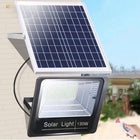
The current NoxLumin Solar Wall Sconce is an outdoor wall-mounted fixture with an integrated 5V 6W solar panel, 80 LEDs, 1400-lumen output, a 3.2V 6000mAh battery, and 6–8-hour charging time. Its current 4000K and 6000K variants are both available for sale.


Its four modes include dim-to-high motion operation, motion-activated high output, constant low output, and medium output with a four-hour timer. Product data also lists IP65, a 180° PIR angle, and a 5–10 m detection distance. Actual performance depends on solar exposure, season, weather, temperature, mode, activation frequency, panel cleanliness, and battery condition.


This sconce fits a sun-exposed wall where its downward light can cover a garage apron, porch approach, patio, or gate without glare or spill. It is unsuitable where deep shade or moving door hardware conflicts with the only mounting point. Related options appear in Solar Wall Lights, Wall Decorative Solar Lights, and Wall-Mounted Outdoor Lights.
Frequently Asked Questions
Is it better to install solar wall lights beside or above a garage door?
How far from a garage door should a solar wall light be mounted?
Can an integrated solar wall light charge under a garage eave?
Should solar wall sconces be installed in pairs?
Will a motion sensor work when the light is mounted above a garage door?
Can a solar wall sconce interfere with a security camera?
Is 4000K or 6000K better for a garage entrance?
Get more NoxLumin guides on Google
Add NoxLumin as a Preferred Source to help Google show you more of our outdoor lighting guides in Search and AI experiences.


Leave a comment