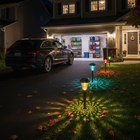
Low-output solar pathway and garden lights illuminating a curved residential walkway and flower beds at dusk Low-output solar pathway and garden lights illuminating a curved residential walkway and flower beds at dusk
Filter

    Where Lower-Output Solar Lights Fit

    Lower-output solar lights are often a better fit for edge lighting, decorative planting beds, fence accents and close-range pathways because they can add visual guidance without flooding the entire area with bright light.

    Use Spacing and Beam Pattern with Lumens

    Several low-output fixtures placed along a path can create more useful guidance than one brighter light at a single point. Runtime still depends on daily solar charging, selected mode, battery condition and seasonal sun exposure.

    Related Low-Level Lighting

    Solar Pathway & Garden Lights for walkways, lawns and planting beds.

    Decorative Outdoor Solar Lights for accent and decorative effects.

    Solar Lights for 1000-2000 Lumens for stronger functional illumination.

    FAQ

    • Pathway and disk lights can mark route edges, while fence, flower, mushroom, color-changing, and flame lantern models are primarily decorative. The 800-lumen pendant and higher variants of selected spot or wall products are more task-oriented. Check the exact variant because one product may span more than one output band.
    • A split pendant can light a defined shed or covered zone when its separate panel is outdoors in direct sun. Separate-panel spotlights can also place the lamp in shade while charging elsewhere. Small integrated decorative fixtures need sunlight at their own panel and are not intended as a room’s primary light.
    • Use 30–60 lumen models for repeated path markers, borders, and ambiance. An 800-lumen pendant serves a concentrated task zone such as a small shed or covered work area. These categories solve different problems; compare mounting, beam, control method, and pack configuration rather than treating them as interchangeable.
    • Yes. Lower-output lights create less glare, preserve dark-sky comfort, suit close-range landscaping, and can use battery energy more gently. They are often better beside seating, garden beds, or narrow paths. Choose brighter models only where visibility, distance, or task lighting requires it.
    • Read the selected variant’s lumen value, battery, light color, and control mode before checkout. Some wall or spotlight listings include multiple sizes whose outputs fall on different sides of the collection threshold. The collection is a browsing aid; the selected variant specification is the final reference.
    • They suit decorative gardens, pathways, patios, fences, flowerbeds, lantern effects, and close-range accent lighting.
    • Most prioritize ambiance or guidance. Upper-range motion models may suit small entrances, but broad security usually needs higher output.
    • Start around 3–6 feet, then adjust for beam, fixture height, path width, and the nighttime effect.
    • Generally yes, although battery, panel, controls, season, and weather also influence runtime.
    • Warm white creates ambiance, neutral white aids navigation, RGB adds color, and flame effects are decorative.
    • Aim for about 6–8 hours of direct sunlight and keep the panel clean and free from plant shade.
    • Many are IP65 or IPX5, but exact ratings vary. Keep them above standing water and follow the selected product’s rating.