












Can You Store a Rechargeable Camping Lantern in Your Car? Heat, Battery, and Emergency-Use Guide

Quick Answer
Do not permanently store a rechargeable lithium-battery camping lantern in a hot or freezing car unless the manufacturer provides a storage-temperature range that covers those conditions. A lantern can still be part of a vehicle emergency kit, but the safer approach is to keep it in a cool, dry place, move it out of the vehicle during temperature extremes, inspect it regularly, and recharge it under suitable indoor conditions. Never charge a lantern inside a parked hot car, and stop using it if the battery or housing becomes swollen, cracked, leaking, unusually hot, or otherwise damaged.
Why Vehicle Storage Is Different from Campsite Storage
A rechargeable lantern may spend only a few hours outdoors during a camping trip, but an emergency lantern left in a vehicle can experience heat, cold, vibration, long periods without inspection, and repeated changes in battery charge. Those conditions make storage strategy as important as brightness or runtime.
A closed vehicle can become much hotter than the outdoor air. The National Highway Traffic Safety Administration warns that a vehicle’s interior temperature can rise approximately 20°F in as little as 10 minutes and that parking in shade or partially opening windows does little to prevent dangerous heating. Although that guidance focuses on human safety, the rapid temperature rise also explains why a parked car is not equivalent to normal room-temperature battery storage.
The practical question is therefore not simply whether the lantern fits in a trunk. It is whether the battery, charging method, storage location, inspection routine, and local climate support safe and reliable emergency use.
Key Takeaways
- A rechargeable lantern can be carried in a vehicle, but permanent year-round storage is not appropriate in extreme heat or cold without a confirmed manufacturer storage rating.
- Do not charge a lithium-battery lantern inside a parked hot car.
- Bring the lantern indoors during heat waves, freezing conditions, or long periods when the vehicle is not being used.
- Inspect the housing, battery area, charging port, cable, and controls before relying on the lantern for an emergency.
- Secure the lantern inside a closed cargo organizer instead of leaving it loose in the passenger compartment.
- Recharge and function-test the lantern on a regular rotation rather than assuming a stored battery remains ready indefinitely.
Key Decision Factors
1. How hot does the vehicle become?

Summer vehicle temperatures can exceed ordinary battery-storage conditions even on a day that does not feel extreme outdoors. Direct sunlight, dark interior materials, limited ventilation, and time parked on pavement can all increase cabin and trunk temperatures.
The U.S. Fire Administration’s lithium-ion battery guidance recommends storing batteries at room temperature when possible and specifically advises against keeping lithium-ion batteries in hot cars or direct sunlight. It also advises against charging below 32°F (0°C) or above 105°F (40°C). These are general public-safety guidelines rather than a product-specific storage rating, so the lantern manufacturer’s instructions remain controlling when they provide a narrower range.
2. Is the lantern being carried temporarily or stored permanently?
Carrying a lantern to a campsite, fishing location, or evening event is different from leaving it in the trunk for an entire season. Temporary transport gives you more opportunities to notice temperature, damage, and battery condition. Permanent storage can allow heat exposure, deep discharge, corrosion, or physical damage to go unnoticed.
For regular vehicle use, consider a rotation system: carry the lantern when needed, bring it indoors during temperature extremes, and perform a scheduled function test. A separate non-rechargeable flashlight rated for the intended storage environment can provide backup if the rechargeable lantern is unavailable.
3. Can the lantern be secured?

A folded lantern, charging cable, fixing pins, and other accessories should be contained in a closed emergency-kit organizer. Do not leave the lantern loose on a seat, parcel shelf, dashboard, or open cargo floor where it can move during braking or a collision.
A magnetic base is useful when intentionally attaching a lantern to a compatible steel surface during stationary use. It should not be treated as a crash-restraint system or relied on to hold the lantern in place while the vehicle is moving.
4. Is the battery still in good condition?
Before storing or using the lantern, inspect it for swelling, cracking, leaking, unusual odor, excessive heat, discoloration, damaged charging connections, or unexpected noises. The U.S. Fire Administration recommends stopping use when a lithium-ion battery shows warning signs such as excessive heat, shape change, leakage, odor, or unusual sounds.
If the lantern smokes, catches fire, or enters an obvious thermal event, move away, warn others, and call emergency services. Do not continue handling or charging a visibly failing battery.
5. How will the lantern be recharged?
Use the supplied cable or a compatible, reputable charging source that meets the product instructions. Recharge the lantern on a stable surface in a cool, dry, observable location. Do not place it under clothing, inside a closed bag, or on a vehicle seat while charging.
A power-bank function can be useful for short emergency phone charging, but it also consumes the energy reserved for lighting. If illumination is the primary need, avoid draining the lantern battery unnecessarily before nightfall.
6. What level of readiness is required?
An emergency lantern should be tested before a trip and periodically during storage. Confirm that the main light, lower settings, flashlight function, SOS mode, telescopic mechanism, magnetic base, and charging port work as expected. Battery indicators are useful, but a brief real-world function test provides better evidence that the controls and LEDs operate correctly.
The Ready.gov emergency-kit guidance includes a flashlight among basic emergency supplies. For a vehicle kit, lighting is most dependable when it is supported by a backup light, spare compatible charging method, and a repeatable inspection schedule.
Vehicle Storage Options Compared
| Storage approach | Readiness | Temperature exposure | Best use |
|---|---|---|---|
| Carry only for planned trips | High when tested before departure | Limited | Camping, fishing, RV trips, and planned night travel |
| Keep in vehicle with regular rotation | Good with scheduled inspection | Moderate and climate-dependent | General emergency preparedness in mild conditions |
| Leave permanently in the trunk | Uncertain without testing | Potentially severe | Not recommended when heat, freezing, or long neglect is likely |
| Store indoors and add before travel | High if included consistently | Low | Very hot or cold climates |
| Store in a temperature-managed RV compartment | Potentially good | Depends on whether climate control operates while parked | RV travel after confirming actual compartment conditions |
Suitable and Unsuitable Use Cases

| Situation | Suitable when | Unsuitable when |
|---|---|---|
| Roadside tire inspection | The vehicle is safely stopped and the lantern is positioned away from traffic and moving parts | The lantern creates glare for drivers or is placed near a hot engine component |
| Camping-trip transport | The lantern is secured, inspected, and removed after the trip | It remains loose in the passenger area or is forgotten in extreme heat |
| Seasonal emergency kit | The lantern is rotated indoors for charging and inspection | No one checks the battery through an entire hot or freezing season |
| RV emergency lighting | The storage compartment stays within the manufacturer’s acceptable conditions | The RV is parked without climate control and develops the same heat as a closed car |
| Long-term unattended vehicle | A storage rating and inspection plan support the conditions | The product has no confirmed rating for the expected temperature extremes |
Common Mistakes
- Leaving the lantern in the car all summer: A closed vehicle can expose the battery to much higher temperatures than the surrounding air.
- Charging in a parked vehicle: Charging adds heat and should not occur inside an already hot car.
- Assuming a full indicator means perfect battery health: Inspect the housing and test actual operation.
- Relying on the magnetic base during travel: Secure the folded lantern in a closed organizer while the vehicle is moving.
- Draining the battery as a phone power bank: Preserve enough energy for lighting when an emergency may continue after dark.
- Treating IPX5 as waterproof storage protection: Splash resistance does not make the charging port or battery suitable for flooding, immersion, or persistent moisture.
- Depending on one light: Keep a separate backup flashlight available.
Practical Vehicle-Lantern Checklist
- Read the product’s battery, charging, and temperature instructions.
- Inspect the lantern for swelling, cracks, leakage, odor, heat, or damaged connectors.
- Fully test the main light, lower settings, flashlight, and SOS modes.
- Recharge in a cool, dry, observable place—not in a parked hot car.
- Fold and secure the lantern in a closed cargo organizer.
- Keep fixing pins and charging cables contained so they cannot move around the vehicle.
- Remove the lantern during heat waves, freezing weather, or prolonged vehicle storage.
- Set a recurring inspection and recharge interval appropriate for the product instructions and local climate.
- Keep a backup flashlight in the emergency kit.
- Retest the lantern before long trips or severe-weather seasons.
Product Recommendation
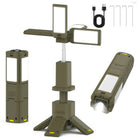
The NoxLumin 14000mAh Rechargeable Camping Lantern is relevant to vehicle and campsite preparedness because it combines a folding 11-inch storage form with a telescopic structure that extends to approximately 43 inches. Its Khaki and Army Green variants are currently available for sale.


The lantern is listed with four adjustable 1500-lumen light sections, a combined nominal output of 6000 lumens, a 14000mAh rechargeable battery, Type-C charging, multiple white-light and SOS modes, a magnetic and self-standing base, four ground-fixing pins, and IPX5 splash resistance. The listed maximum runtime is up to 72 hours, but actual runtime depends on brightness, selected mode, temperature, battery condition, and use of the power-bank function.


The product page does not specify a dedicated long-term vehicle-storage temperature range. It should therefore not be presented as suitable for permanent storage in a hot trunk. Use it as a transportable and regularly inspected emergency light, follow its charging instructions, and remove it from the vehicle when conditions may exceed safe battery-storage limits. Additional rechargeable outdoor lighting options are available in the Camping Lights collection. For related planning, see the Rechargeable Camping Lantern Placement Guide and the Camping Lantern Runtime Guide for Power Outages.
Frequently Asked Questions
Can I leave a rechargeable camping lantern in my car all year?
Can heat damage a rechargeable lantern battery?
Can I charge a camping lantern inside my car?
How often should I check a lantern stored for vehicle emergencies?
Where should a camping lantern be stored in a vehicle?
Is a magnetic camping lantern safe for roadside repairs?
What battery warning signs mean I should stop using the lantern?


Dejar un comentario